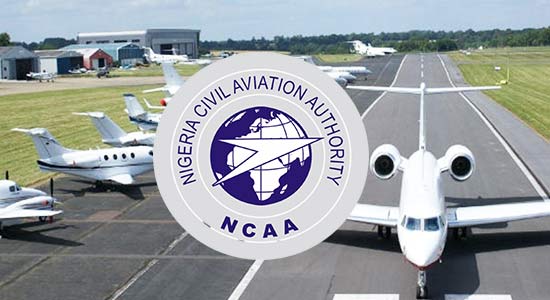
Aviation professionals have stepped into the dispute between the Nigeria Civil Aviation Authority and domestic airlines over the controversial five per cent Ticket Sales Charge.
The Aviation Safety Round Table Initiative intervened in the dispute, saying the ongoing standoff between the regulator and members of the Airline Operators of Nigeria points to deeper structural challenges in how the charge is administered.
In an advisory report signed by its President, Air Commodore Ademola Onitiju (Retd), the group argued that the current percentage-based model effectively turns airlines into unpaid tax collectors, compelling them to absorb merchant transaction costs on funds that do not belong to them.
According to the report, the system creates financial pressures because regulatory funds are mixed with airlines’ operational revenues immediately tickets are purchased by passengers.
“Industry participants argue that the current ad valorem percentage model transforms airlines into unpaid tax collectors, forcing them to absorb commercial merchant processing fees on funds that do not belong to them,” the report stated.
The group noted that in an industry already battling low profit margins, expensive aviation fuel and stringent maintenance obligations, airlines often find themselves tempted to deploy the TSC funds for daily operational survival.
“In an environment characterized by low single-digit margins and strict cash-before-service demands for Jet A1 aviation fuel and immediate maintenance deadlines, commingled cash is frequently absorbed into daily survival costs,” the report explained.
ASRTI said the consequence is a cycle of mounting debts, prolonged reconciliation disputes and regulatory sanctions, including the recurring “no-pay, no-service” confrontations that have unsettled the industry in recent years.
The advisory also questioned the fairness of the existing TSC structure, citing international best practices. It argued that the current percentage charge conflicts with the International Civil Aviation Organisation’s principle of cost-related charges.
ASRTI further alleged that the present arrangement has encouraged airlines to redesign ticket pricing structures in ways that minimise the regulator’s earnings. It said airlines often keep base fares low while increasing fuel surcharges, currency adjustment charges and ancillary fees, which are excluded from TSC calculations.
Onitiju further stated, “Operators frequently cite ICAO Doc. 9082 to challenge the fee’s legitimacy. A business-class passenger and an economy passenger on the same flight consume the exact same safety infrastructure and air navigation services, yet they are assessed vastly different fees based on their fare tier.”
“The regulator is left collecting five percent of a deflated nominal base fare instead of five per cent of the true economic cost paid by the passenger,” the report stated.
To address the problem, the group proposed replacing the five per cent ad valorem charge with a fixed fee for every passenger travelling on domestic routes and a dollar-denominated equivalent for international flights.
The report recommended, “First, the statutory basis of the fee must shift from a variable five percent to a fixed naira amount per domestic segment and a dollar-equivalent for international flights. This flat-rate basis establishes safety regulation as a quantifiable, constant utility fee.
“Under this framework, the moment a passenger completes a digital purchase, the payment gateway executes a real-time financial split. The split-payment engine automatically sweeps the fixed regulatory fee directly into the Treasury Single Account, while routing the pure base fare to the carrier’s operational account.”
According to the aviation professionals, such a system would eliminate revenue leakages, remove the burden of debt collection from the regulator and free airlines from the risk of sanctions arising from unpaid TSC obligations.
“For the regulator, this model completely eradicates collection leakage, dynamic fare undervaluing and the massive administrative cost of chasing historical carrier debts,” the report further stated.
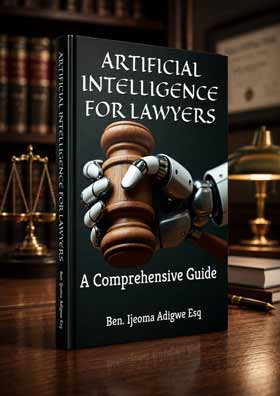 The book also examines Nigeria's legal ecosystem, focusing on the LPELR and NBA AI Guidelines. As a bonus, every purchase comes with a FREE eBook titled: How to Use the AI Features in LegalPedia and LawPavilion.
Ohio Books Ltd praises the publication, stating:
"....this is the only Nigerian book I know of on the topic."
How to Order:
📞 Call, Text, or WhatsApp: 08034917063 | 07055285878
📧 Email: benadigwe1@gmail.com
🌎 Website: www.benadigwe.com
Ebook Version: Access it directly online at https://selar.com/prv626
Authored by Ben Ijeoma Adigwe Esq., ACIarb (UK), LL.M, Dip. in Artificial Intelligence, Director at the Delta State Ministry of Justice, Asaba, Nigeria.
_______________________________________________________________________
“Enhance Legal Practice With Authoritative Reports” — Alexander Payne Offers Comprehensive Law Reports, Spanning Over A Century Of Nigerian Jurisprudence
The book also examines Nigeria's legal ecosystem, focusing on the LPELR and NBA AI Guidelines. As a bonus, every purchase comes with a FREE eBook titled: How to Use the AI Features in LegalPedia and LawPavilion.
Ohio Books Ltd praises the publication, stating:
"....this is the only Nigerian book I know of on the topic."
How to Order:
📞 Call, Text, or WhatsApp: 08034917063 | 07055285878
📧 Email: benadigwe1@gmail.com
🌎 Website: www.benadigwe.com
Ebook Version: Access it directly online at https://selar.com/prv626
Authored by Ben Ijeoma Adigwe Esq., ACIarb (UK), LL.M, Dip. in Artificial Intelligence, Director at the Delta State Ministry of Justice, Asaba, Nigeria.
_______________________________________________________________________
“Enhance Legal Practice With Authoritative Reports” — Alexander Payne Offers Comprehensive Law Reports, Spanning Over A Century Of Nigerian Jurisprudence
 Interested buyers are encouraged to place their orders and enquiries via:
0704 444 4777, 0704 444 4999, 0818 199 9888
Website: www.alexandernigeria.com
Interested buyers are encouraged to place their orders and enquiries via:
0704 444 4777, 0704 444 4999, 0818 199 9888
Website: www.alexandernigeria.com