
The Court’s decision arose out of the 2nd Cross-Appellant’s Cross appeal against the decision of the Court of Appeal, Sokoto Division which summarily dismissed the 2nd Cross-Appellant’s preliminary objection challenging the competence of the Appellants’ Notice of Appeal for failure to bear the stamp/seal of the legal practitioner who signed it as stipulated by Rule 10(1) of the Rules of Professional Conduct for Legal Practitioners, 2007. In the lead judgment of the Court delivered by Nwali Ngwuta JSC, the court held that such a process even though signed and filed is not null and void or incompetent like the case of a court process so signed in the name of corporation or association (even of lawyers). The court held that such a document even though signed and filed is not proper in law for the reason that the condition precedent for its proper signing and filing has not been met. The court also held that such a document is ‘akin to a legal document or process filed at the expiration of the time allowed by the rules or extended by the court’. Particularly the court, held that ‘in such cases the filing of the process can be regularised by extension of time and deeming order. In the case at hand, the process filed in breach of Rule 10(1) can be saved and it’s signing and filing regularised by affixing the approved seal and stamp on it. It is a legal document improperly filed and the fixing of the stamp and seal would make the filing proper in law. Since this was not done the court cannot take cognizance of a document not properly filed and the filing not regularised’. In a concurring judgment, Clara Bata Ogunbiyi, JSC held thus; ‘The refusal of the document by the registry is a sanction in itself and pending proper signature and affixing of stamp/seal as required by Rule 10(1). The breach of the rule in my opinion should not be viewed as a substantive infraction but a mere irregularity which can be remedied. ‘Contrary to our earlier release, failure to affix the stamp and seal does not render the process incompetent but irregular or voidable as the court rejected the argument that the effect of not affixing the stamp and seal is to render the legal document incompetent. ‘Such a voidable process will be valid when counsel affixes the stamp and seal on the legal process. In order words ‘such documents are redeemed and made valid by a simple directive by the judge or the relevant authority at the time of filing the voidable document for erring counsel to affix stamp and seal as provided for in Rule 10..’, per Olabode Rhodes-Vivour JSC. ‘We need to point out that there is no inconsistency between the decision in this matter and the decision in Appeal No. SC.665/2015 (Mega Progressives Peoples Party v. INEC, decided by the apex court on October 12, 2015.’]]>

[A MUST HAVE] Evidence Act Demystified With Recent And Contemporary Cases And Materials
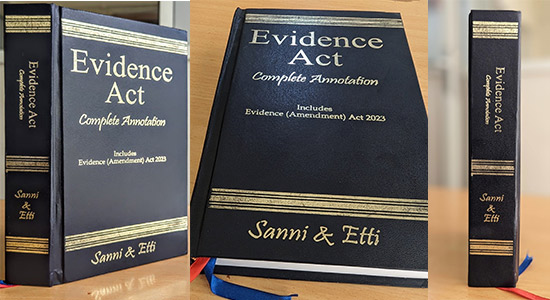
Available now for NGN 40,000 at ASC Publications, 10, Boyle Street, Onikan, Lagos. Beside High Court, TBS. Email publications@ayindesanni.com or WhatsApp +2347056667384. Purchase Link: https://paystack.com/buy/evidence-act-complete-annotation
 Interested buyers are encouraged to place their orders and enquiries via:
0704 444 4777, 0704 444 4999, 0818 199 9888
Website: www.alexandernigeria.com
“A Comprehensive Guide To Evidence Law” — Releases Second Edition In Three Volumes, Covering 4,051 Cases
For enquiries and orders, contact: 08035526491 Email: jerryamadisilk@gmail.com
 Prof. Jerry Amadi’s Evidence Law, Second Edition (2026), contains 3,314 pages in three volumes, covering the Evidence Act 2011, its 2023 amendment, and 4,051 Nigerian and English cases.