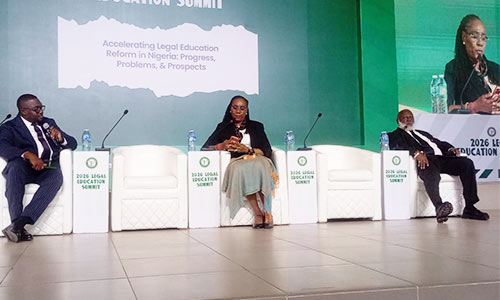
Senior lawyers clashed openly on Monday at the 2026 Legal Education Summit organised by the Nigerian Bar Association (NBA) after the Vice Chancellor of Imo State University, Prof. Uchefula Chukwumaeze, SAN, recommended the outright abolition of the Nigerian Law School as an institution, arguing that it has outlived its usefulness and that the responsibility for training lawyers should be transferred entirely to university law faculties.


The recommendation drew immediate and forceful pushback from the Director-General of the Nigerian Law School, Dr Olugbemisola Odusote, who dismissed the call as “out of place,” and the Chairman of the Council of Legal Education, Chief Emeka Ngige, SAN, who insisted that the coordination of legal education “should not be an all-comers affair” and criticised the Vice Chancellor for comparing the Council with examination bodies like WAEC and JAMB.
The exchange became the defining moment of the summit, exposing a deep philosophical divide within Nigeria’s legal establishment over the future of legal education — with one camp arguing that the current centralised Law School model is outdated, expensive, and unable to cope with the growing number of law graduates, and the other insisting that dismantling the institution would do the profession “more disservice” and undermine quality control.
Chukwumaeze: “The Law School Has Served Its Useful Purpose”
Prof. Chukwumaeze, who holds the rank of Senior Advocate of Nigeria and leads one of the country’s state universities, mounted a comprehensive argument for abolishing the Law School by drawing comparisons with legal education systems in other jurisdictions and with how other professions in Nigeria are regulated.
“If we are to talk about legal education, we must examine its foundation. Take the United States of America, for instance — the difference between them and us is that there is no Law School. There is also no Law School in the UK. Universities teach while the relevant law bodies accredit and examine,” Chukwumaeze stated.
He pointed out that in no other professional field in Nigeria does the regulatory council operate its own teaching institution. “In which of the professional courses does the council set up an institution? The Council of Medical Associations in Nigeria conducts external examinations. Likewise the Council of Nursing and Midwifery, COREN for engineering, and the rest,” the Vice Chancellor argued.
He then delivered his central recommendation: “The Council of Legal Education should abandon the idea of teaching. The Law School has served its useful purpose. Let us return to reality — and that reality is that the Council should abandon the idea of teaching and concentrate on setting the standards and requirements for Call to Bar.”
The Seven-Year Model
Chukwumaeze proposed a comprehensive restructuring of legal education into a seven-year programme conducted entirely within university law faculties. Under his model, the first five years would cover Bar Part 1, the sixth year would be dedicated to Bar Part 2, and the seventh year would be strictly for internship. The Bar Part 2 examinations would be supervised and conducted by the Council of Legal Education — which would retain its standard-setting and examination functions but would no longer operate as a teaching institution.
He drew a parallel with examination bodies to reinforce his point: “It should be noted that WAEC conducts exams — it does not teach. NECO conducts exams — it does not teach. The Medical and Dental Council, COREN, ICAN, and others conduct exams; they do not teach.”
Chukwumaeze also proposed reforms to the entry requirements for studying law, recommending that the mandatory requirement of Literature in English for admission into law faculties be abolished, that subject combinations in JAMB be removed, and that the minimum requirement to study law should be credits in English and any other three subjects.
He recommended that the Council of Legal Education, in conjunction with the National Universities Commission (NUC), should perform the role of stipulating the minimum requirements for legal education in Nigeria — effectively creating a dual regulatory framework where the NUC handles academic accreditation and the CLE sets professional standards and conducts examinations.
Law School DG: “The Call Is Out of Place”
The Director-General of the Nigerian Law School, Dr Olugbemisola Odusote, responded sharply, dismissing Chukwumaeze’s recommendation as misplaced and potentially damaging to the profession.
“It would have been good if everybody attending this summit were able to say that the call was made objectively and in the interest of the nation and the profession,” Odusote stated, implying that the Vice Chancellor’s recommendation may have been motivated by factors other than a genuine concern for the quality of legal education.
Odusote highlighted a practical problem with the proposal: the gap between NUC accreditation and CLE approval. She pointed out that some universities that have been accredited by the NUC to offer law programmes have not been given the go-ahead to commence by the Council of Legal Education — suggesting that NUC accreditation alone does not guarantee that a university’s law programme meets the professional standards required to train competent lawyers.
“You will find out that some universities accredited by the NUC are not given the go-ahead to start by the Council of Legal Education. If such universities start law and train students for seven years, or whatever is being proposed, and then call them to the Bar, it does the profession more disservice, and that is not in the national interest,” the Law School DG warned.
“I believe that the call, with due respect, is out of place. The Council is regulating and doing what it should do,” Odusote added.
CLE Chairman: “Not an All-Comers Affair”
The Chairman of the Council of Legal Education, Chief Emeka Ngige, SAN, joined the pushback against Chukwumaeze’s proposal, taking particular issue with the comparison between the Council and examination bodies like WAEC and JAMB.
“WAEC qualifies you to take further examinations to become what you want to be. What we are doing here is to reform our legal education and not to destroy it,” Ngige stated, framing the abolition recommendation as destructive rather than reformist.
He insisted that the coordination of legal education required specialised institutional capacity that could not simply be distributed among dozens of university law faculties of varying quality. “This should not be an all-comers affair,” Ngige declared.
The CLE Chairman also urged the NBA to provide greater support to the various Law School campuses across the country, lamenting that recommendations from previous legal education summits had ended up gathering dust on shelves rather than being implemented.
NBA President: Reduce the Law Degree to Three Years
NBA President Afam Osigwe, SAN, while not directly endorsing or rejecting the abolition call, staked out his own position by advocating for a reduction in the number of years required for the study of law.
“It is generally said that a lawyer can only be as good as the system of legal education that produced him. The imperativeness of a system of legal education that can produce lawyers with the necessary skills and capacity to meet the evolving needs of society has always been emphasised,” Osigwe stated.
He then made a proposal that diverged from Chukwumaeze’s seven-year model: “The practical and focused content of university education will achieve better results even if it lasts for three years.”
Osigwe also acknowledged the systemic pressure that is driving the reform debate, noting that the increasing number of law graduates, coupled with the inability of the Law School to admit them all, may ultimately force a review of the current system — whether or not a formal decision to abolish the Law School is taken.
INEC Chairman and NALT President Weigh In
The Chairman of the Independent National Electoral Commission (INEC), Prof. Joash Amupitan, SAN, whose speech was read by Mr Alhassan Umar, SAN, described the summit as both timely and significant, saying it demonstrated the commitment of the NBA and stakeholders to develop practical, forward-looking reforms capable of strengthening the quality, relevance, and global competitiveness of legal training.
The President of the Nigerian Association of Law Teachers (NALT), Mr John Akintayo, urged the NBA to recognise its members in academia as critical stakeholders, stating that law teachers must be treated as active participants in the quest to build a legal profession capable of rising to the challenges of contemporary society — rather than being sidelined in debates about the institutions where they teach.
The clash at the summit exposed a tension that has simmered within Nigeria’s legal education system for years. On one side are those who view the centralised Law School model as a bottleneck an institution that cannot admit the growing number of law graduates, charges fees that many cannot afford, and produces lawyers through a curriculum that critics say is outdated and insufficiently practical. On the other side are those who view the Law School as the last quality-control checkpoint before lawyers are admitted to the Bar a gatekeeper that, however imperfect, prevents the profession from being flooded by graduates of uneven quality from dozens of law faculties across the country.
Chukwumaeze’s proposal would effectively decentralise legal training by distributing it across university law faculties, with the CLE retaining only its examination and standard-setting functions. Odusote and Ngige’s opposition is rooted in the concern that many university law faculties lack the capacity, infrastructure, and faculty quality to deliver the kind of practical vocational training that the Law School, for all its limitations, currently provides.
The summit did not produce a resolution on the abolition question, but the public nature of the disagreement involving a university vice chancellor, the Law School director-general, and the chairman of the Council of Legal Education ensures that the debate will continue well beyond the conference venue and into the policy deliberations that will shape the future of legal education in Nigeria.

 Interested buyers are encouraged to place their orders and enquiries via:
0704 444 4777, 0704 444 4999, 0818 199 9888
Website: www.alexandernigeria.com
Interested buyers are encouraged to place their orders and enquiries via:
0704 444 4777, 0704 444 4999, 0818 199 9888
Website: www.alexandernigeria.com