The Nigerian Bar Association (NBA) Branch Elections Appeals Committee (North) has ruled that virtual or online attendance at branch meetings does not satisfy the constitutional attendance threshold required under the Uniform Bye-Laws for candidates seeking to contest branch elections a decision that has disqualified at least four aspirants across multiple branches and sent shockwaves through the legal community, where lawyers have condemned the ruling as anachronistic and inconsistent with the growing acceptance of virtual participation across Nigeria’s court system.

The Appeals Committee, chaired by Abdul Atadoga Ibrahim, SAN, sat on Saturday, May 16, 2026, and heard appeals from aspirants relating to forthcoming branch elections in NBA Garki, Gwagwalada, Yola, and Kano branches. The committee’s decisions focused on electoral qualification, meeting attendance requirements, procedural competence of petitions, and the limits of the powers of branch Electoral Committees (ELCOMs).
The dominant and most consequential finding was the committee’s consistent holding that only the physical attendance register maintained by the Branch Secretary constitutes the valid and recognised record of attendance for electoral qualification purposes effectively ruling that lawyers who attended branch meetings virtually cannot use that attendance to meet the mandatory minimum of five meetings required to contest elections.
The Four Disqualified Aspirants
The committee’s ruling directly resulted in the dismissal of appeals by four aspirants whose attendance arguments relied substantially on online participation.
Rosemary Ogechi Ogazi of NBA Garki Branch had her appeal dismissed. The committee found that the financial misappropriation allegations raised against her fell outside ELCOM’s jurisdiction and nullified her disqualification on that ground, but sustained her disqualification on the basis that her nominator failed to meet the required meeting attendance threshold. The relevant provisions cited were Articles 14(3), 14(4), and 15 of the Uniform Bye-Laws.
Chekwube Osita Ebubealor of NBA Garki Branch had her appeal dismissed and her disqualification upheld. The committee held that only the physical attendance register in the Branch Secretary’s custody is valid and that online attendance records could not be recognised under the Bye-Laws. The committee specifically held that “adopted branch minutes cannot override mandatory Bye-Law requirements.”
Babatunde Moses Tijani of NBA Garki Branch had his appeal dismissed and disqualification upheld on the same grounds. The committee reiterated that virtual attendance could not supplement physical attendance under the mandatory requirements of the Bye-Laws.
Oluwaseyi Adedeji Arowosebe of NBA Garki Branch had both her petition against early nomination form payments dismissed (the committee found that early payment did not amount to a breach and was not a ground for disqualification) and her appeal against disqualification based on her nominator not meeting attendance requirements dismissed. The committee held that “only physical meetings count towards electoral eligibility.”
Online Attendance Lists Rejected
The committee delivered what may be its most consequential procedural ruling when it addressed the evidentiary status of online attendance records. Online attendance lists tendered before the committee were rejected as “unsigned, unauthenticated, and lacking verifiable membership details.”
This finding effectively closes the door on any aspirant who seeks to prove meeting attendance through screenshots, WhatsApp participation records, Zoom logs, or other digital evidence of virtual participation. The committee’s position is that only the physical attendance register a handwritten or printed document signed by attendees and maintained in the custody of the Branch Secretary carries evidentiary weight for electoral qualification purposes.
Qualification Requirements “Incapable of Waiver”
The committee further reaffirmed that qualification requirements under Sections 14 and 15 of the Uniform Bye-Laws are mandatory and “incapable of waiver by ELCOM, the Branch, or any committee established by the Branch.” This means that even if a branch had adopted a practice of counting virtual attendance towards meeting requirements, such practice would be invalid because the Bye-Laws do not permit any body within the branch structure to waive or modify the mandatory qualifications.
ELCOM’s Powers Have Limits
In a ruling that went in favour of an aspirant, the committee allowed the appeal of Kalu Chibuikem Imo of NBA Garki Branch, who had been disqualified by ELCOM on grounds of alleged impersonation and financial impropriety.
The committee distinguished between electoral qualification issues which ELCOM is empowered to adjudicate and allegations of financial impropriety or impersonation, which the committee held fall outside ELCOM’s jurisdiction under the Bye-Laws. The committee ruled that “the Bye-Laws did not empower ELCOM to disqualify candidates on grounds outside the express provisions governing electoral eligibility.” Kalu’s disqualification was accordingly set aside and his candidacy restored.
Kano Campaign Restrictions Partially Overturned
The committee also addressed a significant challenge from Sani Ammani against campaign restrictions imposed by the NBA Kano Branch ELCOM. Ammani had argued that the restrictions unlawfully prohibited ordinary political communication, including phone calls, messages, courtesy visits, WhatsApp participation, and distribution of campaign materials all under threat of disqualification.
Ammani contended that the restrictions violated principles of constitutional fairness, proportionality, and natural justice. The matter raised questions about the scope of ELCOM’s regulatory authority and whether campaign restrictions not expressly grounded in the Bye-Laws could lawfully attract sanctions.
The committee ruled that Ammani’s appeal succeeded in part, holding that campaigning is allowed but must be conducted within the confines of the provisions of the Constitution. The ruling effectively reined in ELCOM’s attempt to impose campaign restrictions that went beyond what the Bye-Laws expressly authorise.
Other Decisions
The committee addressed several other appeals across the Gwagwalada and Yola branches.
In the Gwagwalada Branch, the appeal of Maria Okon Edet succeeded after the committee found that her 2024 Bar Practising Fee receipt reflected Calabar Branch due to a system glitch, rather than any fault on her part. The appeal of Nuraddin Daud Abdulsalam also succeeded on similar grounds his portal printout indicated Gwagwalada Branch despite his BPF payment showing under Abuja Branch.
However, the appeal of Blessing Chinyere Isaac was dismissed because the aspirant failed to attach the nominator’s BPF and Branch Due receipt as required under Article 14(2)(a).
The petition of Sekpe Mark Joseph and others against Nuraddin Abdulsalam was struck out for failure to first approach ELCOM before filing with the Appeals Committee, as required under Article 16(8) of the Bye-Laws.
In the Yola Branch, the appeal of Yuguda against ELCOM’s disqualification failed after the committee found that the candidate who emerged victorious at screening had not attained seven years post-call.
Several cross-petitions and responses were also struck out for procedural incompetence, including failure to comply with statutory timelines or reliance on procedures unknown to the Bye-Laws.
The Committee’s Composition
The Appeals Committee comprised Abdul Atadoga Ibrahim, SAN (Chairman); Murtala A. Kankia, Life Bencher (Alternate Chairman); Gloria Okuduwa (Secretary); Yakubu Moses Ede, PhD (Alternate Secretary); Dr Adamu Lawal Danbatta (Member); Haruna Yelma (Member); Garba L. Hudu, SAN (Member); Sunusi Musa, SAN (Member); and Adiguve, Esq. (Member).
Lawyers React with Outrage
The committee’s ruling on virtual attendance has provoked fierce criticism from lawyers across the country, many of whom view the decision as fundamentally inconsistent with the direction of Nigeria’s legal system itself.
One lawyer captured the dominant sentiment: “Even courts sit and accept appearance through virtual appearance. Yet my dear NBA in 2026 is saying virtual attendance at a meeting does not count? What a pity! When I stay in my office and conduct my court proceeding at Enugu State High Court, when I stay in the comfort of my home and take my judgment from Court of Appeal, Sokoto, when the Federal High Court is embarking on e-filing, when hearing notices are permissible through electronic means, NBA prefers the ancient method.”
The argument highlights a glaring contradiction: the same courts in which NBA members practise have embraced virtual proceedings, remote appearances, e-filing, and electronic service of hearing notices yet the association that represents those lawyers refuses to recognise virtual attendance at its own meetings for the purpose of internal elections.
Another lawyer stated: “We’re in a world where the virtual has gained ascendancy! An organisation that ties itself to physical attendance is not ready for the world of 2026 and beyond. We all attend this WhatsApp Group virtually and yes the Group exists very vibrantly.”
Others pointed to the NBA’s own Continuing Legal Education (CLE) programme, noting that much of the NBA’s mandatory CLE is conducted online making it contradictory for the association to accept virtual participation for professional development purposes while rejecting it for electoral qualification.
The Counter-Argument
Not all lawyers disagreed with the committee’s decision. Some argued that the physical attendance requirement serves a legitimate purpose in ensuring that aspirants for branch leadership demonstrate commitment and presence within their local legal community.
“A person who wants to be an officer of a branch should show commitment, readiness, and seriousness to lead the bar. The minimum requirement for attendance is just five. Is this too much to attend five physical meetings? Will the person be leading the branch virtually?” one lawyer argued.
The counter-argument emphasises that branch leadership is fundamentally a local, hands-on role that requires physical engagement with members, courts, and institutions within the branch’s jurisdiction and that a minimum of five physical appearances over twelve months is a modest threshold that any serious aspirant should be able to meet.
What the Bye-Laws Actually Say
An examination of the relevant provisions reveals that the NBA Constitution and Uniform Bye-Laws do not explicitly distinguish between physical and virtual meeting attendance. Article 14(2)(b) of the Uniform Bye-Laws states that to be eligible to stand for election, a member shall “have attended a minimum of five (5) monthly meetings of the Branch within the twelve (12) months prior to the close of nominations for the election.”
The provision further states: “For the purpose of determining attendance at meetings, the Attendance Register of the Branch shall be used in reckoning the number of attendance by members of the Branch.”
The critical phrase is “Attendance Register of the Branch.” The Appeals Committee interpreted this to mean exclusively the physical attendance register maintained by the Branch Secretary a document that by its nature records only those who are physically present and sign in. The committee’s position is that online attendance lists, Zoom logs, WhatsApp records, and other digital evidence of virtual participation do not constitute the “Attendance Register” contemplated by the Bye-Laws.
Critics argue, however, that the Bye-Laws’ silence on whether attendance must be physical or can be virtual should be interpreted in light of contemporary practice and the growing acceptance of virtual meetings across all sectors of Nigerian professional life including the courts.
NBA President: “Our Hands Are Tied”
In a development that suggests the decision may have a stamp of finality, NBA President Afam Osigwe, SAN, reportedly told members at the recently concluded National Executive Council (NEC) meeting in Awka that the hands of the NBA leadership are tied in such matters, as the NBA Constitution does not give the leadership any oversight role over appeal committees.
This means that the Appeals Committee’s decisions on virtual attendance cannot be reviewed, overturned, or modified by the NBA President, the NEC, or any other body within the association’s governance structure short of a constitutional amendment to the Bye-Laws that would either explicitly recognise virtual attendance or grant a higher body the power to review appeals committee decisions.
The ruling has immediate and far-reaching implications for branch elections across the country. A significant number of lawyers who have been attending branch meetings virtually particularly since the COVID-19 pandemic normalised remote participation may now discover that they do not meet the mandatory attendance threshold for electoral eligibility.
The decisions are particularly consequential for lawyers in branches that have long reckoned with virtual meetings in validating members to vote and be voted for. Branches that adopted hybrid meeting formats combining physical and virtual attendance may find that members who relied on the virtual component are now ineligible.
The ruling also creates a practical disincentive for virtual participation in branch meetings. If virtual attendance does not count towards electoral eligibility, lawyers who wish to contest branch elections in the future will need to ensure they attend at least five meetings physically over a twelve-month period regardless of the availability of virtual alternatives.
The controversy is likely to intensify calls for an amendment to the NBA Uniform Bye-Laws to explicitly address the status of virtual attendance. Such an amendment could either validate virtual attendance as equivalent to physical attendance for all purposes including electoral qualification, or establish a hybrid framework that recognises virtual attendance but imposes minimum physical attendance requirements.
Until such an amendment is made, the Appeals Committee’s ruling stands as the authoritative interpretation of the Bye-Laws one that prioritises physical presence, the traditional attendance register, and what the committee described as “strict compliance with the Uniform Bye-Laws” over the growing reality of virtual professional engagement.
The decision was made on Saturday, May 16, 2026, and signed by Abdul Atadoga Ibrahim, SAN (Chairman) and Gloria Okuduwa (Secretary) of the NBA Branch Elections Appeals Committee (North).
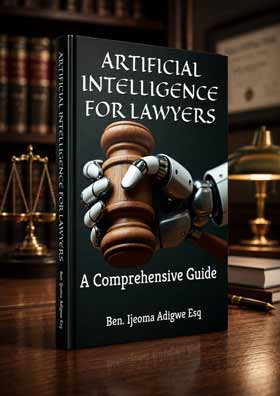 The book also examines Nigeria's legal ecosystem, focusing on the LPELR and NBA AI Guidelines. As a bonus, every purchase comes with a FREE eBook titled: How to Use the AI Features in LegalPedia and LawPavilion.
Ohio Books Ltd praises the publication, stating:
"....this is the only Nigerian book I know of on the topic."
How to Order:
📞 Call, Text, or WhatsApp: 08034917063 | 07055285878
📧 Email: benadigwe1@gmail.com
🌎 Website: www.benadigwe.com
Ebook Version: Access it directly online at https://selar.com/prv626
Authored by Ben Ijeoma Adigwe Esq., ACIarb (UK), LL.M, Dip. in Artificial Intelligence, Director at the Delta State Ministry of Justice, Asaba, Nigeria.
_______________________________________________________________________
“Enhance Legal Practice With Authoritative Reports” — Alexander Payne Offers Comprehensive Law Reports, Spanning Over A Century Of Nigerian Jurisprudence
The book also examines Nigeria's legal ecosystem, focusing on the LPELR and NBA AI Guidelines. As a bonus, every purchase comes with a FREE eBook titled: How to Use the AI Features in LegalPedia and LawPavilion.
Ohio Books Ltd praises the publication, stating:
"....this is the only Nigerian book I know of on the topic."
How to Order:
📞 Call, Text, or WhatsApp: 08034917063 | 07055285878
📧 Email: benadigwe1@gmail.com
🌎 Website: www.benadigwe.com
Ebook Version: Access it directly online at https://selar.com/prv626
Authored by Ben Ijeoma Adigwe Esq., ACIarb (UK), LL.M, Dip. in Artificial Intelligence, Director at the Delta State Ministry of Justice, Asaba, Nigeria.
_______________________________________________________________________
“Enhance Legal Practice With Authoritative Reports” — Alexander Payne Offers Comprehensive Law Reports, Spanning Over A Century Of Nigerian Jurisprudence
 Interested buyers are encouraged to place their orders and enquiries via:
0704 444 4777, 0704 444 4999, 0818 199 9888
Website: www.alexandernigeria.com
Interested buyers are encouraged to place their orders and enquiries via:
0704 444 4777, 0704 444 4999, 0818 199 9888
Website: www.alexandernigeria.com