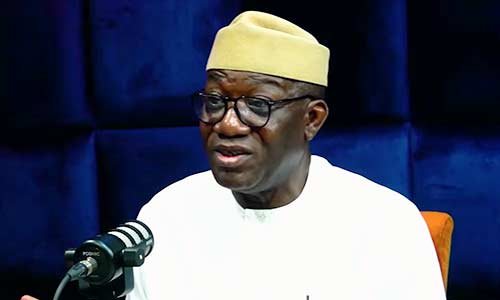
Former Ekiti State Governor, Dr Kayode Fayemi, has delivered one of the most candid and wide-ranging assessments of the state of the All Progressives Congress (APC) by any serving member of the party, admitting that the party he helped build has drifted from its founding ideals, revealing that he personally advised President Bola Tinubu to reach out to Labour Party’s Peter Obi after the 2023 election and was rebuffed, and describing the APC’s 2023 victory as a “minority” win that should have produced a national unity government rather than the winner-takes-all approach that has deepened Nigeria’s divisions.
Fayemi made the disclosures during an extensive interview on State Affairs, a podcast hosted by Edmund Obilo, where he reflected on his political journey, his role in Tinubu’s emergence as president, the rise of Peter Obi as a political phenomenon, and his vision for restructuring Nigeria — while also confirming that he was the one who brokered the deal that brought the G5 governors, including Nyesom Wike, into Tinubu’s fold during the 2023 campaign.
Fayemi recounted how he stepped down for Tinubu during the APC presidential primary, explaining that he did so because of their shared history in the political trenches.
“Tinubu and I had been in the trenches together. Of all the people who were in the race with me, at least he was someone that I was very familiar with his trajectory in politics, with his courage, with his consistency, with his can-do spirit and that I was a much younger person and that there’s still time for me,” Fayemi recalled.
He then revealed that he went beyond merely stepping down, actively working to secure Tinubu’s victory including brokering the critical alliance with the G5 PDP governors who had fallen out with their party’s presidential candidate, Atiku Abubakar.
“I then went ahead to do what I had to do in order to ensure that he won, including bringing the G5 into his fold, by the way,” Fayemi disclosed.
When pressed on how he achieved this, Fayemi explained that as Chairman of the Nigeria Governors’ Forum, he had cross-party relationships that positioned him to bridge the gap. “I knew what challenges they were going through on the other side and I felt I was reasonably well positioned to bridge the gap once they fell into difficulty with their own party and their candidate Atiku,” he said, declining to reveal the specific details of the negotiations and referring the interviewer to his forthcoming memoirs.
In one of the interview’s most striking passages, Fayemi described the rise of Peter Obi in the 2023 election as a political phenomenon that caught the APC off-guard.
“It was a wave. It was a phenomenon,” Fayemi stated, admitting he did not see it coming. “Honestly, no. I was not oblivious of the fact that there was deep-seated resentment in the country, but I believed that we would scale through as a party, and we did scale through partly because the opposition divided itself.”
Asked directly whether the APC is afraid of Peter Obi, Fayemi responded: “Why should we be afraid of him? He’s a formidable contestant. Yes, he is formidable. Anybody who could come up with the number of votes that he did in the 2023 election could not be treated with levity. It shouldn’t be.”
He extended the same respect to other opposition candidates: “Even Rabiu Kwankwaso had 1 million plus votes. It’s not easy to come by such number of votes. These are serious-minded Nigerians and they have a legitimate claim to say they want to run for president.”
Fayemi made a remarkably frank admission about the nature of the APC’s 2023 victory, describing it in political science terms as a “minority victory.”
“We won 36% of the vote, and that’s 36% of 20% of the electorate. The electorate according to INEC was almost 90 million, but that particular vote the turnout was about 21 million collectively. So that 36% of that 21 million, by any definition, was a minority,” Fayemi stated.
He quickly added that the victory was constitutionally valid: “The constitution of Nigeria does not ask you to win 50% plus one before you are declared. So we have no apology to make about that.”
However, he argued that the APC should have responded to the narrow mandate by building a government of inclusion. “My approach would have been to bring in those who got those other votes. That’s why I’ve argued that even 10% of the vote deserves 10% of a seat at the table,” Fayemi said.
Fayemi revealed that after the 2023 election, he personally advised President Tinubu to reach out to Peter Obi and build a national unity government advice that was not taken.
“I even advised the president that we have to reach out to Mr Peter Obi. I told him all this,” Fayemi disclosed.
When asked what happened, Fayemi responded: “Well, the APC has hijacked everything.”
He cited examples of other countries where similar approaches worked: Kenya, where President Ruto accommodated opposition leader Odinga; Germany’s coalition model; and South Africa, where Ramaphosa built a government of national unity. “Zero-sum game always leads inexorably to interminable division. That’s what we’re seeing,” Fayemi warned.
Fayemi was unflinching in his criticism of the APC’s current state, admitting that the party has lost both its ideological compass and the vision of its founders.
“We have lost our bearing and we’ve lost the vision of the founding fathers of this party,” Fayemi stated, noting that he had made these views public at a Southwest Conference of the party in Lagos.
Asked about intellectualism within the APC, Fayemi was blunt: “You don’t see intellectualism because there’s no debate in our party. There’s no debate.”
He criticised the party’s turn towards consensus and imposition over competitive primaries. “There is nothing in principle wrong with consensus if it is genuine consensus. However, I am a product of a democratic process and I would always be on the side of primaries, all the time,” Fayemi stated.
He warned that the APC’s approach of absorbing opposition politicians and governors was unsustainable. “If you kill them in that manner, then you are breeding internal opposition within our own fold,” he cautioned.
In his most politically charged observation, Fayemi suggested that Nigeria may be drifting towards what political scientists call “competitive authoritarianism” a system where autocratic governance is disguised in the trappings of democracy.
“A lot of autocrats are covering their system and government in the garb of democracy. Whether you’re talking of Erdogan, or you’re talking of Putin, or you’re talking of Trump, or you’re talking of the man who just got kicked out of Hungary, you will see that incrementally our democracy is being subverted by autocracy. And I hope that’s not the bad lesson we are learning in Africa,” Fayemi stated.
He warned that the danger was particularly acute given Nigeria’s youth demographics. “If you talk to young people who never experienced or lived under military rule, they’re the campaign managers for the juntas of this world. Go on social media and see the way they sing their praises because they’ve never lived under military rule.”
Fayemi revealed a previously undisclosed encounter between Obi and Tinubu at the Vatican during the inauguration of the new Pope, which he personally facilitated.
Fayemi recounted that he and Obi both Catholics had breakfast with a Cardinal on the morning of the papal inauguration and were seated four rows behind President Tinubu at the ceremony. When Bianca Odumegwu-Ojukwu, the current Minister of Foreign Affairs and a member of the presidential delegation, came to greet them, Fayemi suggested to Obi that they go and greet the President.
“Peter had his concern that ‘look, this might be misused in the media.’ I said, Peter, it really didn’t matter. You are Catholic. You are a Nigerian. You are here. Our president has honoured us. He’s even a Muslim. He’s not a Catholic like you and I,” Fayemi recounted.
Obi agreed, and they walked up to the President. “I said, ‘Mr President, welcome to the Vatican. Thank you for honouring us with your presence.’ And the president is quick-witted he immediately retorted, ‘Kayode, what are you saying? I should be the one welcoming you because I’m the leader of the Nigerian delegation.’ And Peter kindly said to him, ‘Yes sir, you are our leader. Thank you for coming to Rome to honour us even though we’re not part of your delegation, but you are our leader,'” Fayemi narrated.
Fayemi devoted significant portions of the interview to his vision for restructuring Nigeria, drawing from his recent book, “If This Giant Must Rise: Interventions on Leadership and Governance in Africa.”
He argued that Nigeria’s majoritarian winner-takes-all democracy is not delivering development, and that the country needs “alternative politics” driven by inclusion rather than the current four-year electoral cycle that produces governments worse than their predecessors.
“This majoritarian winner-takes-all approach is not taking us anywhere developmentally, and we probably need another alternative political framework that allows us to deal with the structural question and then deal with the governance question,” Fayemi stated.
He advocated for devolution of powers from the federal government to the states, arguing that the military’s centralisation of power had arrested Nigeria’s development. “If we had continued at the pace of development from the 1952 self-government period to independence to 1966, Nigeria would probably be where South Korea and similar other entities are now,” Fayemi observed.
He called on President Tinubu, who has an overwhelming majority in the National Assembly and about 30 governors aligned with him, to use his political capital to drive constitutional reform rather than governing through the existing centralised structure.
When asked directly whether he still wanted to be president, Fayemi was characteristically diplomatic but did not close the door.
“My political journey is not ended. I still want to serve Nigeria to my capacity. I want to serve Nigeria,” Fayemi stated, while deflecting follow-up questions about specific ambitions.
He described his governorship as a “vocation, not a profession,” noting that he is primarily a scholar who has returned to the university to teach, and urged the interviewer not to define him solely by his gubernatorial tenure.
The interview revealed a political figure who is simultaneously proud of his role in building the APC and bringing Tinubu to power, yet deeply critical of what the party has become and openly calling for the kind of inclusive, restructured governance that his own party has shown no inclination to pursue.
Neither President Tinubu, Peter Obi, nor the APC national leadership has publicly responded to Fayemi’s remarks as at the time of this report.
[A MUST HAVE] Evidence Act Demystified With Recent And Contemporary Cases And Materials

Available now for NGN 40,000 at ASC Publications, 10, Boyle Street, Onikan, Lagos. Beside High Court, TBS. Email publications@ayindesanni.com or WhatsApp +2347056667384. Purchase Link: https://paystack.com/buy/evidence-act-complete-annotation
______________________________________________________________________ “Enhance Legal Practice With Authoritative Reports” — Alexander Payne Offers Comprehensive Law Reports, Spanning Over A Century Of Nigerian Jurisprudence Interested buyers are encouraged to place their orders and enquiries via:
0704 444 4777, 0704 444 4999, 0818 199 9888
Website: www.alexandernigeria.com
Interested buyers are encouraged to place their orders and enquiries via:
0704 444 4777, 0704 444 4999, 0818 199 9888
Website: www.alexandernigeria.com
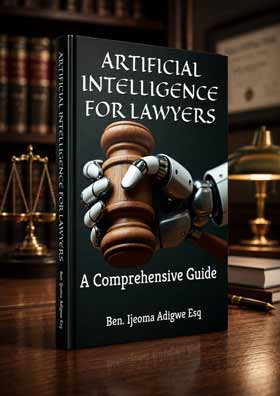 The book also examines Nigeria's legal ecosystem, focusing on the LPELR and NBA AI Guidelines. As a bonus, every purchase comes with a FREE eBook titled: How to Use the AI Features in LegalPedia and LawPavilion.
Ohio Books Ltd praises the publication, stating:
"....this is the only Nigerian book I know of on the topic."
How to Order:
📞 Call, Text, or WhatsApp: 08034917063 | 07055285878
📧 Email: benadigwe1@gmail.com
🌎 Website: www.benadigwe.com
Ebook Version: Access it directly online at https://selar.com/prv626
Authored by Ben Ijeoma Adigwe Esq., ACIarb (UK), LL.M, Dip. in Artificial Intelligence, Director at the Delta State Ministry of Justice, Asaba, Nigeria.
______________________________________________________________________
The book also examines Nigeria's legal ecosystem, focusing on the LPELR and NBA AI Guidelines. As a bonus, every purchase comes with a FREE eBook titled: How to Use the AI Features in LegalPedia and LawPavilion.
Ohio Books Ltd praises the publication, stating:
"....this is the only Nigerian book I know of on the topic."
How to Order:
📞 Call, Text, or WhatsApp: 08034917063 | 07055285878
📧 Email: benadigwe1@gmail.com
🌎 Website: www.benadigwe.com
Ebook Version: Access it directly online at https://selar.com/prv626
Authored by Ben Ijeoma Adigwe Esq., ACIarb (UK), LL.M, Dip. in Artificial Intelligence, Director at the Delta State Ministry of Justice, Asaba, Nigeria.
______________________________________________________________________