By Oliver Azi


Here is a legal argument that has been used in Nigerian courts for years. A party participates deeply in a business transaction; it receives and makes profit from that transaction. And then, when an arbitral tribunal rules against it and orders it to repay, it walks into court, opens a contract law textbook, and announces with great calm: “I never signed the arbitration agreement. The tribunal had no jurisdiction over me. The award is a nullity.”
It is a clever argument, dressed in the language of jurisdiction, privity, and consent but there are three things Nigerian courts take very seriously. And it almost always forces the other side into a lengthy battle just to enforce what the arbitrator already decided. On 6 March 2026, the Supreme Court of Nigeria heard that argument from 9Mobile and said a plain and final: No.
The decision in EMTS Ltd v. Afdin Ventures Ltd & Ors (SC/CV/1096/2024) is not just about a telecommunications company and two investment firms. It is about a question that sits at the heart of commercial arbitration in Nigeria: can a party that never signed an arbitration agreement still be bound by it? And the Supreme Court’s answer will reshape how lawyers advise clients; how arbitral tribunals exercise jurisdiction and how Nigerian courts deal with award enforcement going forward.
The Facts of the Case
The dispute traces to Suit No. FHC/ABJ/CS/288/2018, filed before the Federal High Court, Abuja Division. Two investment companies; Afdin Ventures Limited and Dirbia Nigeria Limited had placed funds into a structured investment arrangement connected to the 9Mobile telecommunications business. The governing documents were an Offer of Terms and a Custodial Agreement. Both contained an arbitration clause. Emerging Markets Telecommunications Services Limited (EMTS), the company operating the 9Mobile brand, was not listed as a signatory to either document.
The investment sums were not small. Afdin put in USD 13,300,910 and Dirbia put in USD 30,030,040. The Sole Arbitrator later found, on concrete and cogent evidence, that those funds were received by EMTS.When the investment arrangement broke down, Afdin and Dirbia sued in court.
Here is the crucial detail: it was the defendants, including EMTS that applied to have the matter referred to arbitration, invoking the arbitration clause in the very agreements EMTS would later claim had nothing to do with it. The Federal High Court, per Nyako J., referred the matter on 11 December 2019 with the concurrence of all parties and a sole arbitrator was appointed and proceedings ran for nearly three years.
On 2 September 2021, the Tribunal delivered a Partial Award on jurisdiction and on the 26th of September 2022, it delivered its Final Award. Typographical corrections followed on 18 October 2022 and 31 October 2022. The result was EMTS, together with the 5th and 6th Respondents Karington Telecommunications Limited and Premium Telecommunications Holdings N.V. was ordered, jointly and severally, to refund both sums to the investors.
What EMTS did next defines the entire shape of this litigation. On 31 October 2022, the very month the award was corrected and finalised, EMTS filed a separate action at the Lagos Division of the Federal High Court to set the award aside. Meanwhile, on 18 January 2023, Afdin and Dirbia moved before Nyako J. in Abuja to have the Final Award recognised and enforced under the Arbitration and Conciliation Act and the Federal High Court (Civil Procedure) Rules, 2019. The enforcement hearing came up on 26th of April 2023. EMTS’s counsel sought an adjournment on grounds of the lead counsel’s unavailability but the trial judge refused and counsel was invited to adopt the processes already filed on EMTS’s behalf.
The Counsel declined and the trial court struck out EMTS’s counter-affidavit and written address and granted the application for recognition and enforcement. EMTS appealed. The Court of Appeal dismissed the appeal in its entirety on 22 November 2024, affirming the trial court in Appeal No. CA/ABJ/660/2023. EMTS filed its Notice of Appeal to the Supreme Court that same day which was the 22nd of November 2024.
The Preliminary Objection: A Winning Argument That Still Lost
Before the Supreme Court heard a word about jurisdiction or privity, Afdin and Dirbia raised a preliminary objection. It had two independent grounds, and both were powerful.
The First Ground: The deposit order. On 2nd June 2023, the trial court granted a stay of the enforcement proceedings on condition that EMTS deposit the full judgment sum with the Chief Registrar within one month. EMTS never complied. It appealed the deposit order and the Court of Appeal dismissed that appeal on 10th October 2024. No further appeal was filed. The order stood, binding, and completely ignored.
The respondents relied on Oleksandr & Ors v. Lonestar Drilling Co. Ltd & Anor (2015) LPELR-24614(SC), Uwazurike & Anor v. Nwachukwu & Anor (2012) LPELR-19659(SC), NALSA & Team Associates v. NNPC (1991) LPELR-1935(SC), and Drexel Energy & Natural Resources Ltd & Ors v. Trans-International Bank Ltd & Ors (2008) LPELR-962(SC), arguing that a party in contempt of court cannot seek discretionary relief. They also relied on Military Governor, Lagos State & Ors v. Ojukwu (1986) ALL NLR 233.
The Second Ground: Order 6 Rule 3(5) of the Supreme Court Rules, 2024. This rule requires that within twenty-one days of filing a Notice of Appeal, an appellant must file proof that all cost orders have been paid into an escrow account in the Chief Registrar’s name. Failure to comply renders the appeal liable to dismissal. EMTS did not comply. The Court of Appeal Registrar filed a certificate of non-compliance on 24th February 2025. EMTS filed no reply brief to the preliminary objection at all.
The Supreme Court found the objection meritorious on both grounds. Citing Management Enterprises Ltd v. Otusanya [1987] 2 NWLR (Pt. 55) 179, Balogun v. Adejobi [1995] 2 NWLR (Pt. 376) 131, Odiase v. Agho & Ors (1972) 1 All NLR (Pt. 1) 170 at 176, Melifonwu v. Egbuji (1982) 9 SC 145 at 165, and Johnson v. Williams 2 WACA 248 at 254, the court confirmed that a subsisting court order must be obeyed whether it was correctly made or not. On the mandatory nature of Order 6 Rule 3(5), it relied on Chukwuogor & 3 Ors v. Chukwuogor & Anor [2021] 15 NWLR (Pt. 1799) 357 at 373, where the court held that “shall” is mandatory and admits of no discretion and Chairman, CEO, NDLEA Headquarters, Lagos & Ors v. Umah & Anor (2018) 7 NWLR (Pt. 1617) 350, which held that a certificate of non-compliance is ordinarily fatal. EMTS’s non-compliance was described by the court as “glaring,” “deliberate,” and “deprecated in the strongest terms” Despite all of that, the court proceeded to hear the appeal.
The reasoning is important and must not be misread. The court drew a clear distinction between defects that strip it of constitutional jurisdiction and defects that are serious but remain manageable through its inherent and statutory authority. It invoked Section 233 of the Constitution of the Federal Republic of Nigeria, 1999 (as amended) which confers its appellate jurisdiction and Section 22 of the Supreme Court Act which empowers it to
“Make any order necessary for determining the real question in controversy.” The court held that EMTS’s procedural defaults, as grave as they were, did not extinguish its constitutional jurisdiction.
The court was equally open about the bigger reason it pressed on. This was not a routine civil appeal. It arose from the recognition and enforcement of a commercial arbitral award under the Arbitration and Mediation Act, 2023 a matter with implications for Nigeria’s standing in the international commercial community. Relying on its earlier decision in Metroline Nigeria Ltd v. Dikko [2021] 16 NWLR (Pt. 1761) 422(SC) at page 45, paras. A–F, where Rhodes-Vivour JSC had warned that litigants bringing “unsubstantiated and spurious challenges against otherwise good arbitration awards” ought to be discouraged, the court framed its decision to proceed as a deliberate policy choice to settle arbitration jurisprudence, restore investor confidence and demonstrate that arbitration in Nigeria need not be the beginning of an endless journey of “impediments, hick-ups, hurdles and uncertainties.“ The lesson for practitioners is unambiguous: this was a one-off exercise of inherent jurisdiction in circumstances of systemic commercial importance. It is not an invitation to treat Supreme Court Rules as optional in any case where the stakes are high.
The Main Question: Can a Non-Signatory Be Bound by an Arbitration Clause?
This is the question the case will be remembered for and it must be approached with the same precision the court used. EMTS, through her counsel, Paul Usoro SAN, raised two issues for determination:
- Whether the lower court was right to affirm recognition of the award when the entire arbitral proceedings were a nullity for want of jurisdiction, distilled from Grounds 1, 2, 5, and 6 of the Amended Notice of Appeal
- Whether the lower court was right to strike out Issue One before it, distilled from Grounds 3 and 4.
The heart of the case was Issue One.
EMTS’s argument was doctrinally structured. An arbitral tribunal, like a court, gets its jurisdiction from the arbitration agreement. The arbitration agreement is a contract and a contract binds only its signatories. EMTS did not sign the Offer of Terms or the Custodial Agreement. The Tribunal itself acknowledged that EMTS was not a signatory, yet proceeded on the basis that EMTS was “inextricably intertwined” with the transaction. EMTS argued that reasoning was legally untenable.
EMTS relied on Madukolu & Ors v. Nkemdilim (1962) 2 SCNLR 341; (1962) 1 ALL NLR 587 for the principle that proceedings without jurisdiction are nullities; Dairo v. Union Bank of Nigeria Plc & Anor [2007] 16 NWLR (Pt. 1059) 99 at 139–140 and Awuse v. Odili & Ors [2003] 18 NWLR (Pt. 851) 116 at 158 for the principle that jurisdiction cannot be conferred by consent; Kano State Urban Development Board v. Fanz Construction Co. Ltd [1990] 4 NWLR (Pt. 142) 1 and NNPC v. Lutin Investments Ltd & Anor [2006] 2 NWLR (Pt. 965) 506 for the proposition that an arbitrator who exceeds jurisdiction renders the award liable to be set aside; and Dunlop Pneumatic Tyre Co. Ltd v. Selfridge & Co. Ltd [1915] AC 847 (HL), African Insurance Development Corporation v. Nigeria LNG Ltd [2000] 4 NWLR (Pt. 653) 494, and Ikpeazu v. African Continental Bank Ltd (1965) NMLR 374 for the doctrine of privity.
EMTS also argued a second limb: that the Tribunal had entertained allegations of fraud and criminal misrepresentation, matters that are non-arbitrable relying on UBA Plc v. Trident Consulting Ltd [2023] 14 NWLR (Pt. 1903) 95 and B.J. Export & Chemical Co. Ltd v. Kaduna Petrochemical Co. Ltd [2003] 7 NWLR (Pt. 819) 489. The respondents; Afdin and Dirbia through Igwe SAN and Magaji SAN, and the 3rd and 4th Respondents (First Bank of Nigeria Plc and First Nominees Nigeria Limited) through Ige, pushed back comprehensively.
On the failure to use the statutory set-aside procedure: The provision of Section 29(1) and (2) of the Arbitration and Conciliation Act, Cap A18 (applicable when the award was delivered on 26 September 2022), now re-enacted as Section 55(1)–(3) of the Arbitration and Mediation Act, 2023, gives an aggrieved party three months from receipt of an award to apply to court to have it set aside. EMTS did not comply with that mandatory timeline. Reliance was placed on Gusau v. Lawal & Ors (2023) LPELR-60152(SC), Okoronkwo v. INEC (2025) LPELR-80425(SC), Folarin v. Augusto (2023) LPELR-59945(SC), Mekwunye v. Imoukhuede (2019) LPELR-48996(SC), Amadi & Anor v. INEC (2012) LPELR-7831(SC), and Commerce Assurance Ltd v. Alli [1992] 9 NWLR (Pt. 232) 710. By declining to adopt its processes at the enforcement hearing, EMTS was deemed to have admitted the depositions in the respondents’ affidavit relying on Ugwuanyi v. NICON Insurance Plc (2013) LPELR-20092(SC) and Mabamije v. Otto (2016) LPELR-26058(SC).
On the non-signatory question, the respondents invoked Section 57 of the Arbitration and Conciliation Act (now Section 91 of the Arbitration and Mediation Act, 2023), which defines “party” to include “any person claiming through or under” a party to the arbitration agreement. They argued that recognised exceptions to privity, assignment, agency, alter ego, estoppel, and the group of companies’ doctrine all applied to the facts. They relied on Metroline Nigeria Ltd & Ors v. Dikko (2018) LPELR-46853(CA) and its Supreme Court sequel Metroline Nigeria Ltd v. Dikko [2021] 16 NWLR (Pt. 1761) 422(SC), as well as comparative authorities.
On fraud, the respondents relied on the doctrine of separability, Section 12(2) of the Arbitration and Conciliation Act, mirrored in Section 14(2) of the Arbitration and Mediation Act, 2023 affirmed in UBA Plc v. Trident Consulting Ltd [2023] 14 NWLR (Pt. 1903) 95 at 130, paras. B–F, and the House of Lords in Fiona Trust & Holding Corporation v. Privalov [2007] UKHL 40.
The Court’s Resolution
The Supreme Court resolved Issue One against EMTS and built its reasoning on three pillars.
First, the Statutory Text: The provision of Section 57 of the Arbitration and Conciliation Act, Cap A18 (now Section 91 of the Arbitration and Mediation Act, 2023) defines “party” to include “any person claiming through or under a party.” The court held this language is deliberate and expansive. The legislature had already moved beyond the narrow formalism of the signed page.
Second, the Recognised Doctrines: The court surveyed each established route for binding non-signatories. Where a contract is assigned, the arbitration clause travels with it. The assignee cannot accept the contract’s benefits while disclaiming its dispute mechanism.
- In agency, a principal whose agent signs the contract is bound by the arbitration clause, notwithstanding whose name appears on the document, citing CMA CGM SA v. Hyundai M.I.P.O. Dockyard Co. Ltd [2008] EWHC 2791 (Comm); [2008] 2 CLC 687 at 32–33.
- Equitable estoppel prevents a non-signatory from embracing a contract’s benefits while repudiating its arbitration clause, citing Tepper Realty Co. v. Mosaic Tile Co., 259 F. Supp. 688, 692 (S.D.N.Y. 1966).
- Alter ego and veil-piercing disregards corporate separateness where the corporate form is being used as a shield against legitimate liability citing Aloe Vera of America, Inc v. Asianic Food (S) Pte Ltd & Anor (2006) 3 SLR(R) 174. The group of companies doctrine originating in Dow Chemical France v. Isover-Saint-Gobain, ICC Award No. 4131, YCA 1984, confirmed by the Paris Court of Appeal holds that affiliated companies that actively participate in the negotiation and performance of a contract can be bound by its arbitration clause even without signing it.
On the domestic front, the court affirmed the reasoning in Metroline (Nig.) Ltd & Ors v. Dikko (2018) LPELR-46853(CA), per Adah JCA (now JSC), where a non-signatory entity was held bound as “a child of that agreement and a beneficiary … akin to that of a privy to the contract.” It also cited Oboh v. N.F.L. Ltd [2022] 5 NWLR (Pt. 1823) 283 on the veil-piercing doctrine in Nigerian corporate law.
Third, Three Governing Jurisprudential Principles: The court synthesised everything into three anchors.
- On intention: The court, citing Lord Hope of Craighead in Fiona Trust & Holding Corporation v. Privalov [2007] UKHL 40, paragraph 26, held that where a non-signatory’s conduct demonstrates assumption of obligations or active participation in the transaction, an intention to be bound by the arbitration clause can be inferred. Consent may be manifested by conduct as much as by ink.
- On Benefit and Burden: The court invoked the Latin maxim Qui sentit commodum sentire debet et onus (he who enjoys the benefit must also bear the burden). The Sole Arbitrator found, on concrete and cogent evidence, that EMTS received the funds paid by Afdin and Dirbia from the very transaction governed by the arbitration clause. That finding, affirmed by both the Federal High Court and the Court of Appeal, established what the Supreme Court called “a powerful estoppel.” A party that knowingly receives money from a transaction cannot, in good conscience, deny the mechanism agreed upon for resolving disputes arising from that same transaction.
- On Fairness: the court held that arbitration would be rendered vulnerable to manipulation if parties could embed themselves in the commercial benefits of a transaction while insulating themselves from its arbitral obligations through interconnected corporate structures. That is the exact mischief that alter ego and veil-piercing are designed to prevent citing Oboh v. N.F.L. Ltd [2022] 5 NWLR (Pt. 1823) 283.
On the Fraud Argument: the court disposed of it on three grounds. First, jurisdiction is determined by the claimant’s pleadings citing Ndakene v. Adamu [2023] 9 NWLR (Pt. 1889) 389 and P.T.F. v. Fidelity Bank Plc [2022] 9 NWLR (Pt. 1836) 475. The Points of Claim which superseded the Notice of Arbitration were never placed before the Supreme Court by EMTS. Any assertion that the Tribunal entertained criminal matters was therefore speculation, and courts do not act on speculation: Martins v. State (2019) LPELR-48889(SC); Ikenta Best (Nig.) Ltd v. AG Rivers State (2008) LPELR-1476(SC). Second, the reliefs the Tribunal actually granted restitution and breach of fiduciary duty were entirely civil in nature. No criminal sanction was imposed. Third, the doctrine of separability, Section 12(2) of the Arbitration and Conciliation Act, affirmed in UBA Plc v. Trident Consulting Ltd [2023] 14 NWLR (Pt. 1903) 95 at 130, paras. B–F, means that even if fraud tainted the main contract, the arbitration clause survives as a distinct and independent agreement unless the fraud is directed at the arbitration clause itself.
On the Limits of Curial Review: The court was equally firm. Citing Taylor Woodrow (Nig.) Ltd v. Suddeutsche Etna-Werk GmbH (1993) LPELR-3139(SC) and quoting at length from NNPC v. Fung Tai Engineering Co. Ltd [2023] 15 NWLR (Pt. 1906) 117 at 209, paras. A–H, per Garba JSC “there is no law which specifically vests or confers appellate jurisdiction on any court in Nigeria over an award made by an Arbitral Tribunal” the court confirmed that courts do not sit in appeal over arbitral findings of fact or law. The inquiry is not whether the arbitrator was right or wrong. The court places itself in the position of the arbitrator not above them and asks only whether the arbitrator faithfully applied their own stated understanding of the law to the issues submitted.
Issue Two; Whether the Court of Appeal was right to strike out Issue One before it, was not determined at all. Once Issue One was resolved against EMTS, Issue Two could not change the outcome of the appeal regardless of how it was decided. Following Yegede v. Othman [2025] 18 NWLR (Pt. 2017) 369 and A.P.C. v. Elebeke [2022] 10 NWLR (Pt. 1837) 1, the court declined to spend judicial time on a question that had become academic. The appeal was dismissed. The Court of Appeal judgment in Appeal No. CA/ABJ/660/2023, delivered on 22 November 2024, was affirmed. Costs of Ten Million Naira (₦10,000,000) were awarded against EMTS in favour of the 1st and 2nd Respondents, and a further Ten Million Naira in favour of the 3rd and 4th Respondents.
Principles from the Judgment
- On Non-Signatory Binding: The test is no longer merely formal. A court will not stop at the signature page. It will look at what the party actually did, what money it received, what role it played, how it conducted itself throughout the transaction and ask whether, on that full picture, it would be unjust to allow the party to escape the arbitration clause. The doctrines the court has endorsed require evidence of real connection, real participation and real benefit. They are not tools for pulling uninvolved third parties into arbitrations. The pivot in this case was the arbitrator’s finding that EMTS actually received the investors’ money. That evidence was everything.
- On Arbitral Finality: No Nigerian court has appellate jurisdiction over an arbitral award. Packaging a factual challenge as a jurisdictional argument will not convert it into a competent legal ground. The three-month window under Section 29 of the Arbitration and Conciliation Act (now Section 55 of the Arbitration and Mediation Act, 2023) for setting aside an award is mandatory. Missing it extinguishes the right permanently.
- On Separability: An allegation of fraud directed at the main contract does not kill the arbitration clause. The clause is an independent agreement. It survives unless the fraud specifically targets the agreement to arbitrate itself.
Conclusion
The principle the Supreme Court anchored this judgment on is stated in Latin but lives in plain English: he who enjoys the benefit must bear the burden. EMTS invoked the arbitration clause in 2019 to move this dispute out of court and into arbitration. It participated in the arbitral proceedings for three years. When the award went against it in 2022, it reversed course and argued that the clause never applied to it in the first place. The Supreme Court found that position to be, in its own words “a belated attempt to evade the binding consequences of a process to which it was innately connected and from which it derived substantial benefit.”
The broader signal from EMTS Ltd v. Afdin Ventures Ltd & Ors is one Nigerian commercial arbitration has needed for a long time. Arbitration is not a tool you pick up when it suits you and put down when it does not. Awards are final. Non-compliance carries consequences. And a party that sits at the centre of a transaction, collecting money, performing obligations, and operating as though it were a party in every commercial sense cannot escape the dispute resolution mechanism of that transaction simply by pointing to a page it did not sign. The law has said so now, at the highest level, with full citations, in language that admits of no ambiguity.
Oliver Azi recently passed the 2025 Bar Finals Examinations and will be called to the Nigerian Bar in 2026. He lives in Abuja and can be reached at: oliverazi20@gmail.com or Varexlaw@gmail.com
 Interested buyers are encouraged to place their orders and enquiries via:
0704 444 4777, 0704 444 4999, 0818 199 9888
Website: www.alexandernigeria.com
Interested buyers are encouraged to place their orders and enquiries via:
0704 444 4777, 0704 444 4999, 0818 199 9888
Website: www.alexandernigeria.com

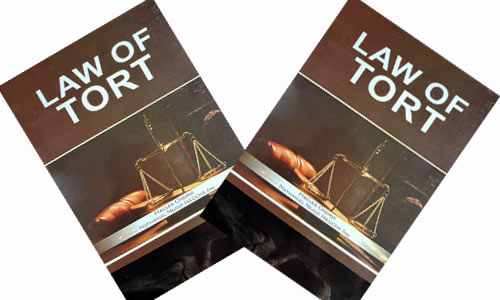 The book, titled The Law of Torts in Nigeria: A Functional Approach, authored by Professor Hagler Sunny Okorie Ph.D and Ikeocha, Nathaniel Ngozi Esq, offers law students, practitioners, and academics a comprehensive guide to understanding and applying tort law in Nigerian courts. Interested buyers can place orders via the following contact numbers: 08028636615, 08037667945, 08032253813, or +234 902 196 2209.
_______________________________________________________________________
Groundbreaking Guide For Lawyers: Adigwe Publishes ‘Artificial Intelligence For Lawyers’ With Free Research eBook
The book, titled The Law of Torts in Nigeria: A Functional Approach, authored by Professor Hagler Sunny Okorie Ph.D and Ikeocha, Nathaniel Ngozi Esq, offers law students, practitioners, and academics a comprehensive guide to understanding and applying tort law in Nigerian courts. Interested buyers can place orders via the following contact numbers: 08028636615, 08037667945, 08032253813, or +234 902 196 2209.
_______________________________________________________________________
Groundbreaking Guide For Lawyers: Adigwe Publishes ‘Artificial Intelligence For Lawyers’ With Free Research eBook
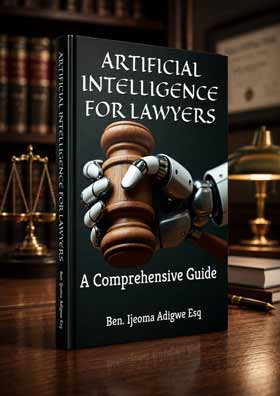 As an added bonus, every purchase comes with a FREE ebook titled: “How to use the AI in Legalpedia and Law Pavilion.”
Ohio Books Ltd praises the publication, stating:
"....this is the only Nigerian book I know of on the topic."
How to Order:
📞 Call, Text, or WhatsApp: 08034917063 | 07055285878
📧 Email: benadigwe1@gmail.com
🌎 Website: www.benadigwe.com
Ebook Version: Access it directly online at https://selar.com/prv626
Authored by Ben Ijeoma Adigwe Esq., ACiarb (UK), LL.M, Dip. in Artificial Intelligence, Director at the Delta State Ministry of Justice, Asaba, Nigeria.
As an added bonus, every purchase comes with a FREE ebook titled: “How to use the AI in Legalpedia and Law Pavilion.”
Ohio Books Ltd praises the publication, stating:
"....this is the only Nigerian book I know of on the topic."
How to Order:
📞 Call, Text, or WhatsApp: 08034917063 | 07055285878
📧 Email: benadigwe1@gmail.com
🌎 Website: www.benadigwe.com
Ebook Version: Access it directly online at https://selar.com/prv626
Authored by Ben Ijeoma Adigwe Esq., ACiarb (UK), LL.M, Dip. in Artificial Intelligence, Director at the Delta State Ministry of Justice, Asaba, Nigeria.