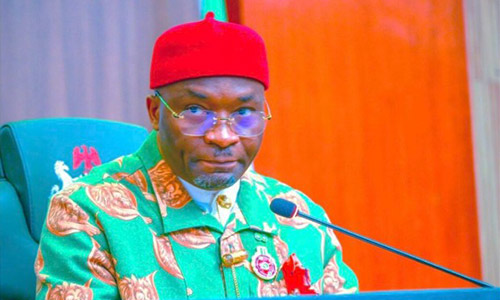
The Council of Legal Education has formally invited the Deputy Speaker of the House of Representatives, Rt. Hon. Benjamin Okezie Kalu, to respond to a petition calling for the withdrawal and cancellation of his Qualifying Certificate No. 051144, constituting a three-member ad hoc committee to investigate the petition and giving the Deputy Speaker seven days to submit a written response, in a development that legal commentator Dr. Ifranyi Dike has described as “A Tale of Two Kalus” and a sequel to Abia State’s earlier certificate storm involving Senator Orji Uzor Kalu.

The invitation, contained in a letter dated April 21, 2026, and signed by the Secretary to the Council and Director of Administration, Ms. Aderonke O. Osho BL, LL.M, states that the Council received a petition dated March 16, 2026, and that at its sitting on Friday, April 17, 2026, it constituted the investigative committee to examine the allegations.
“The Committee has requested that you submit a written response to the petition within seven (7) days from the date hereof, to enable the Committee to expeditiously carry out its assignment,” the letter states. “The Committee may also require your personal appearance at any stage of its work, if deemed necessary.”
The Council’s letter, addressed to “Hon. Benjamin Okezie Kalu, Deputy Speaker, House of Representatives, National Assembly Complex, 3 Arms Zone, Abuja,” is procedurally precise.
It confirms receipt of the petition dated March 16, 2026, requesting the withdrawal and cancellation of Qualifying Certificate No. 051144, and states that a copy of the petition has been attached for the Deputy Speaker’s attention.
It records that the Council, at its sitting on Friday, April 17, 2026, constituted a three-member ad hoc committee to investigate the petition, indicating that the allegations were considered sufficiently serious to warrant a formal inquiry rather than being summarily dismissed.
It requests a written response within seven days from April 21, establishing a deadline of April 28, 2026.
And it warns that the committee “may also require your personal appearance at any stage of its work, if deemed necessary,” signalling that the investigation could extend beyond documentary review to include an oral hearing at which the Deputy Speaker may be required to appear in person.
The letter does not disclose the specific grounds on which the withdrawal and cancellation of the qualifying certificate is being sought, nor does it identify the petitioner. These details are presumably contained in the attached copy of the petition provided for the Deputy Speaker’s review and response.
Legal commentator Dr. Ifranyi Dike, in an analysis that has gained wide circulation, described the development as “what may soon become Abia’s most dramatic sequel since the first certificate storm.”
Dr. Dike noted the political irony at the heart of the situation: “Another Kalu, Senator Orji Uzor Kalu, once had his Abia State University degree result and certificate cancelled and withdrawn by the Senate of the University, a decision later considered in Abia State University, Uturu & Anor v. Chief Dr. Orji Uzor Kalu (2021) LPELR 56190 CA, where the Court of Appeal noted that the University Senate had approved the cancellation and withdrawal of his degree result and certificate following allegations relating to admission and graduation requirements.”
The Court of Appeal case, decided by the Owerri Judicial Division on November 30, 2021, in suit No. CA/OW/245/2018, arose from the decision of the Senate of Abia State University at its 169th Extra-Ordinary Meeting on March 1, 2013, to approve the cancellation and withdrawal of Orji Kalu’s degree result and certificate, approximately eleven years after the degree was conferred.
The cancellation followed an investigation by an Ad-hoc Senate Investigation Panel, which was set up after a petition raised allegations of fraud and breach of regulations relating to Orji Kalu’s admission and graduation. The Panel’s investigation uncovered irregularities in admission documentation and found that the candidate had been out of university for over fifteen years before seeking admission by transfer, a period that conflicted with the university’s academic regulations.
Orji Kalu challenged the cancellation at the Abia State High Court, which found in his favour and set aside the University Senate’s decision. However, the Court of Appeal reversed the trial court, holding that Orji Kalu had failed to exhaust the domestic remedies provided under Section 9(5) of the Abia State University Law 1995 before approaching the court, and that the lower court was wrong to have assumed jurisdiction. The appeal was allowed and the trial court’s decision was set aside, effectively reinstating the cancellation.
Dr. Dike noted the remarkable convergence of circumstances surrounding the two Kalus.
“Now, with Rt. Hon. Benjamin Kalu facing a petition before the Council of Legal Education, the surname ‘Kalu’ appears to have acquired a strange recurring role in Nigeria’s certificate theatre,” Dr. Dike observed.
“One Kalu had his university certificate controversy; another Kalu is now being asked to defend his Law School qualifying certificate. Coincidentally, both men share more than a surname: they are also central figures in the increasingly crowded contest for control and influence within the APC structure in Abia State,” Dr. Dike noted.
The observation introduces an important political dimension. Both Orji Uzor Kalu, a former governor and current senator, and Benjamin Okezie Kalu, the Deputy Speaker of the House of Representatives, are powerful APC figures in Abia State whose political fortunes and rivalries have shaped the party’s dynamics in the South-East zone.
Whether the petition against Benjamin Kalu’s qualifying certificate is driven by genuine concerns about the integrity of the credential or by the factional politics of Abia State’s APC structure is a question that Dr. Dike raises by implication but wisely declines to answer, noting that “the Council must investigate, he must be heard, and due process must run its full course.”
Dr. Dike was careful to distinguish between the investigation and any potential outcome.
“In plain English, the Council has not withdrawn anything yet; it has merely opened the door, switched on the light, and asked the Deputy Speaker to explain what may be hiding in the room,” Dr. Dike stated.
“Fairness demands that no one should conclude that Benjamin Kalu’s certificate will be withdrawn merely because a petition has been filed,” he added.
The distinction is legally and ethically important. The filing of a petition creates an obligation on the Council to investigate, not an automatic presumption of wrongdoing. The Deputy Speaker is entitled to the full protections of due process, including the right to know the specific allegations against him, the right to respond in writing, the right to appear before the committee if called, and the right to have the matter decided on the basis of evidence rather than assumption.
The Council’s decision to constitute a committee indicates the petition was not dismissed as frivolous, but it says nothing about the ultimate merits of the allegations.
A qualifying certificate issued by the Council of Legal Education is the formal credential that confirms a person has successfully completed the Nigerian Law School’s Bar Part II programme and passed the Bar Final Examination, qualifying them for call to the Nigerian Bar by the Body of Benchers.
The certificate is the gateway to legal practice in Nigeria. Without it, a person cannot be called to the Bar, cannot be enrolled as a legal practitioner, and cannot appear before Nigerian courts as a lawyer.
The withdrawal or cancellation of a qualifying certificate would effectively revoke the holder’s qualification to practise law, with potential consequences for any professional activities undertaken on the basis of that qualification.
For a sitting Deputy Speaker of the House of Representatives, who is also a legal practitioner, the implications of a certificate withdrawal would extend beyond professional status to questions of public office, qualification for legislative service, and political standing.
The investigation comes at a politically charged moment. With the 2027 elections approaching and APC primaries imminent, the political stakes in Abia State are high.
Benjamin Kalu, as Deputy Speaker, is one of the most prominent APC officeholders from the South-East zone. Any challenge to his professional credentials, whether legitimate or politically motivated, carries implications for his political positioning and his influence within the party.
The precedent of Orji Kalu’s certificate cancellation, which occurred in the context of Abia State’s notoriously competitive politics, provides a backdrop against which the current petition will inevitably be interpreted.
Dr. Dike captured the political atmosphere with characteristic wit: “In the meantime, Abia politics has once again supplied the public with a familiar lesson: when two Kalus are in the same political kitchen, even certificates may begin to sweat.”
The seven-day deadline for the Deputy Speaker’s written response from April 21 would have fallen on April 28, 2026. Whether the response has been submitted, or an extension requested, is not publicly known at this time.
Once the response is received, the three-member ad hoc committee will review it alongside the petition, examine any supporting evidence, and may call for the Deputy Speaker’s personal appearance if deemed necessary.
The committee will then report its findings to the full Council of Legal Education, which will make the final determination on whether the qualifying certificate should be withdrawn, cancelled, or confirmed as validly issued.
For Benjamin Kalu, the next few weeks will determine whether the petition amounts to a political nuisance that is investigated and dismissed, or whether it uncovers substantive issues that threaten his professional standing and political career.
For the Council of Legal Education, the investigation is a test of institutional independence, a demonstration of whether the body that controls entry to the legal profession is willing to investigate allegations against the most politically powerful certificate holders with the same rigour it applies to ordinary candidates.
And for Abia State politics, the certificate theatre continues, with the same dramatic tension, the same familiar themes, and, remarkably, the same surname in the starring role.
[A MUST HAVE] Evidence Act Demystified With Recent And Contemporary Cases And Materials

Available now for NGN 40,000 at ASC Publications, 10, Boyle Street, Onikan, Lagos. Beside High Court, TBS. Email publications@ayindesanni.com or WhatsApp +2347056667384. Purchase Link: https://paystack.com/buy/evidence-act-complete-annotation
______________________________________________________________________ “Enhance Legal Practice With Authoritative Reports” — Alexander Payne Offers Comprehensive Law Reports, Spanning Over A Century Of Nigerian Jurisprudence Interested buyers are encouraged to place their orders and enquiries via:
0704 444 4777, 0704 444 4999, 0818 199 9888
Website: www.alexandernigeria.com
Interested buyers are encouraged to place their orders and enquiries via:
0704 444 4777, 0704 444 4999, 0818 199 9888
Website: www.alexandernigeria.com