*As Federal High Court Voids Mark-Led Congresses And Three Factions Claim Victory From The Same Ruling

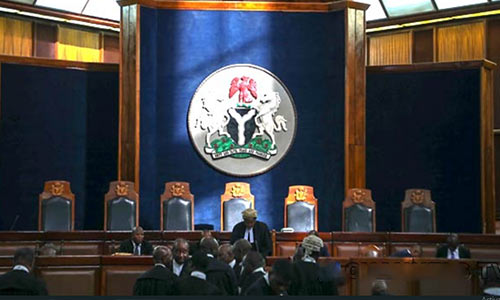
The Supreme Court of Nigeria will today deliver judgments in two high-stakes political appeals involving the leadership crises rocking the African Democratic Congress and the Peoples Democratic Party, in rulings scheduled for 2 p.m. that will either clear the path for the opposition’s participation in the 2027 general elections or effectively shut both parties out of the electoral process at the very moment the primaries window is open and closing.
The judgments, listed under “Political Appeals” on the apex court’s official cause list for Thursday, April 30, come nine days after the five-member panel led by Justice Mohammed Garba heard arguments from all parties on April 22 and reserved judgment, and just two days after the ADC’s legal team wrote to the Chief Justice of Nigeria warning that any further delay could expose the party to “grave and irreversible risk” of exclusion from the 2027 polls.
The Supreme Court’s rulings arrive against the backdrop of a Federal High Court judgment delivered on Wednesday by Justice Joyce Abdulmalik that voided the ADC’s congress committee, restrained INEC from recognising any congress organised by the Mark-led caretaker leadership, upheld the tenure of state executive committees, and barred Mark and other defendants from interfering with state structures, a ruling that has produced the remarkable spectacle of three competing ADC factions each claiming the judgment as a victory for their position.
The apex court will deliver judgment in three appeals, two involving the PDP and one involving the ADC.
The ADC Appeal (SC/CV/180/2026)
The ADC appeal, fixed for 2 p.m., centres on whether courts have jurisdiction to entertain disputes over the internal affairs of political parties.
Mark’s legal team, led by Jibril Okutepa SAN, argued at the April 22 hearing that the Supreme Court itself had settled the issue in a March 21, 2025 judgment holding that “no court has jurisdiction to entertain cases bordering on internal affairs of political parties.” He urged the apex court to allow the appeal and hold that the Federal High Court lacked jurisdiction to entertain Gombe’s suit.
Robert Emukpero SAN, representing Gombe, urged the court to dismiss the appeal and affirm the Court of Appeal’s judgment, which held that Mark’s earlier appeal was premature and brought without leave of the trial court. INEC did not file any process to either support or counter the appeal.
If the Supreme Court allows the appeal, it would clear the path for the Mark-led leadership to participate and field candidates in all elective offices in the 2027 elections. If the appeal fails, the ADC could be shut out on the grounds that it lacks a recognised leadership to conduct and supervise candidate selection.
The PDP Appeals
The PDP matters involve two related appeals arising from the controversial Ibadan convention of November 15 to 16, 2025, which produced the Kabiru Tanimu Turaki-led national executive.
In the first appeal, Paul Erokoro SAN, representing the Turaki-led executive, urged the Supreme Court to set aside the Court of Appeal’s judgment that nullified the Ibadan convention on grounds it was held in disobedience to Federal High Court orders. Sule Lamido, through his lawyer Ewere Aliemeke, and Chief Joseph Daudu SAN for the third to fifth respondents, urged the court to dismiss the appeal.
In the second appeal, Chief Chris Uche SAN, arguing for PDP, submitted that the two lower courts granted orders against the party’s convention without jurisdiction, urging the apex court to set aside both judgments and hold that the lower courts erred in assuming jurisdiction in the internal matters of PDP.
The PDP battle lines pit the faction said to be loyal to FCT Minister Nyesom Wike, an ally of President Tinubu, against the camp of Oyo State Governor Seyi Makinde. The legal dispute stemmed from Justice Peter Lifu’s order restraining the then Damagum-led executive from proceeding with the Ibadan convention until Lamido, an aspirant for national chairman, was given the opportunity to purchase nomination forms. The party defied the court order and held the convention, leading to its nullification by the Court of Appeal.
The Abdulmalik Judgment
The Federal High Court judgment delivered on Wednesday by Justice Joyce Abdulmalik in suit FHC/ABJ/CS/581/2026 has added a dramatic new dimension to the ADC crisis on the eve of the Supreme Court’s verdict.
The suit was filed by Don Norman Obinna, Johnny Tovie Derek, Obah C. Ehigiator, Hon. Olona Yinka, Dr. Charles Idowu Omideji, Samuel Pam Gyang, and Obianyo Patrick, suing for themselves and on behalf of all ADC state chairmen and state executive committees.
The defendants included the ADC, David Mark, Patricia Akwashiki, Malam Bolaji Abdullahi, Ogbeni Rauf Aregbesola, Oserheimen Osunbor, and INEC.
Justice Abdulmalik held that neither the 1999 Constitution nor the ADC constitution empowered the caretaker or interim National Working Committee led by Mark to appoint committees for the purpose of conducting state congresses.
“The procedure adopted, including the appointment of a congress committee, is not recognised by the party’s constitution,” the judge ruled.
She relied on Section 223 of the 1999 Constitution, which mandates political parties to conduct periodic elections on democratic principles, and Article 23 of the ADC constitution, which provides that national and state officers shall hold office for a maximum of two terms spanning eight years.
On the jurisdictional objection that the matter was purely internal, the judge held: “The law is settled that courts will not interfere. However, where there is an allegation of breach of constitutional or statutory provisions, the court has a duty to intervene. Where a party alleges that its constitution has been violated, the court is bound to adjudicate. Any argument that this court lacks jurisdiction on that basis fails.”
The court set aside the appointment of the congress committee, restrained INEC from recognising any congress organised by it, restrained the Mark-led leadership from organising congresses or conventions outside the party’s constitution, and upheld the tenure of state executive committees as valid and subsisting.
Three Factions, One Judgment, Three Victory Claims
The Abdulmalik judgment produced the extraordinary result of three competing ADC factions each claiming it validated their position.
The Mark Faction dismissed concerns, with Mark himself assuring members: “You do not have anything to be afraid of regarding all the litigations before the party. I want to assure you that we shall triumph in all the cases, and we shall be on the ballot for every election. In this legal battle, though I am not a lawyer, I will lead from the front, and we shall surely triumph.”
ADC National Publicity Secretary Bolaji Abdullahi acknowledged the judgment but noted: “We issued a statement shortly after the congresses stating that the congresses have not truncated the tenure of the current State Executive. Nevertheless, the leadership of ADC has instructed its legal team to review the said judgment and advise the party appropriately.”
The Kachikwu Faction, led by the party’s 2023 presidential candidate Dumebi Kachikwu, celebrated the ruling as vindication. “I had long warned that the African Democratic Congress is not for sale and that these political buccaneers would be shown the way out through the same back door they came in from,” Kachikwu stated. He described the voided exercises as “kangaroo congresses” and an attempted “hostile takeover” that had “failed woefully.”
The State Chairmen, who filed the suit, claimed the most direct victory. Don Norman Obinna said the judgment “has clarified the authority structure within the party” and affirmed that “it is the responsibility of state executives to conduct congresses.” He declared that “the recognised NEC will now take over the administration of the party and organise fresh congresses and conventions in line with due process.”
Kingsley Ogga, Chairman of ADC State Chairmen, described the ruling as “a victory for grassroots leadership and internal democracy,” stating: “The ADC belongs to the people, not to any individual or group.”
The Osun State ADC chapter sought to reassure members, clarifying that the judgment “did not nullify ADC congresses nationwide” but “only restrained INEC from recognising the recently conducted congresses.” The chapter noted that arrangements were in place for the swearing-in of newly elected executives upon the expiration of the current tenure on May 12, 2026.
“A Car Without An Engine”
Legal practitioner and public affairs analyst Liborous Oshoma, speaking on Channels Television’s Politics Today, painted the starkest picture of the ADC’s predicament.
“This judgment makes ADC a car without an engine and without the force to move forward,” Oshoma stated.
He explained that the ruling creates a practical impossibility for the party to meet electoral deadlines. “What it means is that between now and the deadline, it is not up to 21 days. So it becomes a practical impossibility for even these people now to conduct state congresses,” Oshoma stated, referring to the statutory requirement to give a 21-day notice to INEC.
He noted that even those now recognised by the court face tenure constraints. “Their tenure would have expired by the time they issue the notice. That means they also do not have the power to conduct congresses,” Oshoma added.
Oshoma warned that prolonged litigation could consume the party’s remaining time before the elections. “They might just keep ADC busy in court until a few days to the election, and it might be too late for them to hit the ground running,” he cautioned.
His advice to stakeholders was blunt: “The best resort would be to look for a Plan B out of this.”
The Letter To The CJN
The Supreme Court’s decision to list the judgment for today followed the ADC’s urgent letter to the Chief Justice of Nigeria dated April 28, 2026.
In the letter signed by lead counsel Shuaibu E. Aruwa SAN, the party warned that failure to deliver judgment within three days could jeopardise its participation in the 2027 elections.
“Without the delivery of judgment within the next three days from the date of this letter, the ADC stands the grave and irreversible risk of being excluded from participating in the 2027 General Elections. This would disenfranchise millions of Nigerians who have subscribed to the ideals of the ADC and deny them their constitutional right to freely associate and contest elections through a political party of their choice,” the letter stated.
“The entire political future of our client and the legitimate expectations of its members nationwide now hang in the balance,” the lawyers added.
The Supreme Court’s listing of the judgment for today, two days after the letter, suggests the court was responsive to the urgency while taking the time it needed to reach its decision.
Nwosu: “Without ADC, No Credible Election”
Founding National Chairman Ralph Nwosu declared that the 2027 elections “would not hold if the party was not on the ballot,” describing the coalition-building efforts as “phenomenal.”
Speaking at the ADC Youths Champion and Prospective Legislative Summit in Abuja, Nwosu stated: “What we have achieved by the coalition is phenomenal. No matter how anybody tries to knock it down, they cannot. To knock this down will be almost like knocking down democracy itself, and that will not happen.”
He revealed that “as of Tuesday evening, some serving senators in the APC and other parties were still talking to ADC leadership to join the party,” indicating continued political migration toward the opposition platform even amid the legal chaos.
Nwosu described the current challenges as a product of “the existing culture of impunity in Nigerian politics” and declared: “The time is over for Tinubu politically, and he must go. The time is over for Akpabio, and they must go.”
Sam Amadi: “Get A Plan B”
Former NERC Chairman Sam Amadi advised Peter Obi to seek an alternative platform if he intends to be on the 2027 ballot, alleging a plot by the ruling government to proscribe the ADC.
“While you guys are fighting who has a right to win primaries and who has the duty to be VP, the ruling government through INEC and court may proscribe ADC,” Amadi stated on X.
He disclosed that “a few days before INEC came with its sledgehammer, a lady who knows the workings of INEC told me that the government would try and use the court to proscribe ADC.”
“If there is a Plan B, put it in motion now if you want to be on the ballot. Tinubu is mortally afraid of Peter Obi on the ballot. He cannot campaign rigorously. And the country is in a terrible state,” Amadi warned.
The Collision Of Courts
Today’s Supreme Court judgment will be delivered against a backdrop of competing lower court orders that have created a patchwork of contradictory judicial positions.
The Court of Appeal ordered status quo ante bellum on March 12. INEC derecognised the Mark leadership on April 1. Justice Nwite adjourned the Gombe suit indefinitely on April 14, calling it “judicial rascality” to proceed while the Supreme Court was involved. The Mark faction held a convention on April 14 without INEC monitoring. Justice Abdulmalik voided the congress committee and restrained INEC on April 30.
Throughout, the Supreme Court’s reserved judgment has hung over everything, the definitive answer that every party, court, and institution has been waiting for.
That answer comes today at 2 p.m.
For the ADC, the PDP, their candidates, their members, and the millions of Nigerians who had hoped the opposition would provide a credible alternative in 2027, the next few hours will determine whether that hope survives or dies.
As the ADC’s lawyers wrote to the Chief Justice: “Justice delayed, in this particular circumstance, would amount to justice denied.”
The Supreme Court has answered the call. The judgment will be delivered. And the future of Nigeria’s opposition will be written this afternoon.
Meanwhile, some legal practitioners have continued to raise questions over the possible legal effect of the Federal High Court judgment if the Supreme Court eventually rules in favour of the ADC or the PDP. One lawyer queried whether a Supreme Court victory would cure the defect created by Wednesday’s Federal High Court judgment declaring the ADC convention unconstitutional, especially as the party may no longer have sufficient time to issue the required notice to INEC for another convention. The lawyer further asked what would become of both parties if the apex court rules in their favour but declines to make consequential orders ratifying their disputed conventions, or if it holds that the subject matter is not purely an internal party dispute. Responding, another lawyer described the Federal High Court decision as “a preemptive judgment,” suggesting that it was designed to ensure that even if the Supreme Court “comes to the rescue at the top, there will be nothing at the bottom to stand on,” adding, “It is not a coincidence.”
[A MUST HAVE] Evidence Act Demystified With Recent And Contemporary Cases And Materials

Available now for NGN 40,000 at ASC Publications, 10, Boyle Street, Onikan, Lagos. Beside High Court, TBS. Email publications@ayindesanni.com or WhatsApp +2347056667384. Purchase Link: https://paystack.com/buy/evidence-act-complete-annotation
______________________________________________________________________ “Enhance Legal Practice With Authoritative Reports” — Alexander Payne Offers Comprehensive Law Reports, Spanning Over A Century Of Nigerian Jurisprudence Interested buyers are encouraged to place their orders and enquiries via:
0704 444 4777, 0704 444 4999, 0818 199 9888
Website: www.alexandernigeria.com
Interested buyers are encouraged to place their orders and enquiries via:
0704 444 4777, 0704 444 4999, 0818 199 9888
Website: www.alexandernigeria.com