
Three dramatic developments in the African Democratic Congress leadership crisis converged on Tuesday the Federal High Court adjourning Nafiu Bala Gombe’s suit indefinitely after the presiding judge declared it would be “judicial rascality” to proceed while the Supreme Court is seized of the matter, the Supreme Court itself ordering an accelerated hearing with a 24-hour filing deadline for legal processes and a hearing date of April 22, and the David Mark-led faction holding its national convention at which it expelled Gombe for what it described as “anti-party activities.”

The confluence of events marks potentially the most consequential day in the ADC’s crisis since it began in September 2025, with the Supreme Court’s accelerated timeline raising the possibility that the leadership dispute could be definitively resolved within days — even as the Mark faction’s decision to hold a convention and expel its rival deepens the factional divide.
At the Federal High Court, Justice Emeka Nwite the judge before whom Gombe originally filed his suit in September 2025 adjourned the matter sine die (indefinitely) after learning that an interlocutory appeal arising from the case is now pending before the Supreme Court.
Gombe’s counsel, Lukman Fagbemi, informed the court that the appeal was pending at the apex court and asked for an adjournment until the Supreme Court determines the matter.
In a notable exchange, counsel for the ADC, Shuaibu Aruwa SAN, and counsel for Mark, Sulaiman Usman SAN, argued that the trial court could proceed with the substantive suit while the Supreme Court considered the appeal, delivering judgment only after the apex court ruled.
Usman proposed what he called “the best time management strategy” clearing all pending applications, hearing the substantive matter, and then awaiting the Supreme Court’s decision before delivering judgment.
However, Justice Nwite rejected this approach, ruling that the proper course was to await the Supreme Court’s determination.
“I am of the view, and I so hold, that it would not serve any purpose if the jurisdiction of this honourable court is being challenged at the apex court,” the judge stated.
“Therefore, the reasonable thing to do is to await the decision of the supreme court. It is my view, and I so hold, that the interest of justice will be met by awaiting the outcome of the decision of the supreme court,” Justice Nwite stated.
He then delivered the line that captured the day’s proceedings: “Indeed, it will be judicial rascality for this court to struggle with the issue of jurisdiction with the supreme court.”
The indefinite adjournment effectively suspends Gombe’s suit the original case that triggered the entire leadership crisis until the Supreme Court determines the appeal.
At the Supreme Court, a five-member panel led by Justice Mohammed Garba took decisive action to accelerate the resolution of the ADC crisis, imposing one of the tightest timelines seen in recent political litigation.
The court ordered the Mark-led faction the appellants to file and serve all legal processes on all respondents within 24 hours.
Upon receipt of the processes, the respondents must file their responses within three days.
The appellants then have one day to reply to the respondents’ responses.
All filing and exchange of briefs must be completed before April 20.
The hearing was fixed for April 22.
This compressed timeline means the Supreme Court could potentially deliver a ruling on the ADC leadership crisis by late April a speed that reflects the court’s recognition of the time-sensitive nature of the dispute, with party primaries scheduled to begin on April 23.
In a significant procedural development, Jubril Okutepa SAN counsel to the Mark-led executives withdrew a motion earlier filed seeking to stay the execution of the Court of Appeal’s March 12 judgment that ordered the party to maintain the status quo ante bellum.
Okutepa explained that the motion was no longer needed since the apex court had expedited the hearing of the substantive appeal. With the accelerated timeline, seeking a stay of the lower court’s judgment became unnecessary — the Supreme Court would hear the substantive appeal before any stay order could take practical effect.
The Supreme Court struck out the withdrawn motion and confirmed April 22 as the hearing date for the substantive appeal.
While the courts were deliberating, the Mark-led ADC faction pressed ahead with its national convention in Abuja on Tuesday the same event that Peter Obi had confirmed would hold despite INEC’s derecognition and the denial of venues.
In the most dramatic action of the convention, the faction expelled Nafiu Bala Gombe for what it described as “anti-party activities” effectively severing the rival claimant from the party and attempting to settle the leadership dispute through internal party mechanisms rather than waiting for the courts.
The expulsion carries significant implications. If the Supreme Court ultimately rules in favour of Mark’s leadership, Gombe’s expulsion would be ratified and he would have no further standing to challenge the party’s leadership. If the Supreme Court rules against Mark, the expulsion — like all other actions taken by the Mark leadership — could be nullified.
The decision to expel Gombe on the same day the Federal High Court adjourned his suit indefinitely sends a clear signal: the Mark faction views the judicial process as moving in its favour and is taking steps to consolidate its position while the legal machinery works.
Tuesday’s developments have significantly clarified the trajectory of the ADC crisis.
The Federal High Court has effectively stepped aside, deferring entirely to the Supreme Court. This means that the Gombe suit — the case that started everything — will not proceed until the apex court rules.
The Supreme Court has imposed an accelerated timeline that could produce a definitive ruling by late April. The 24-hour filing requirement, three-day response period, and one-day reply window are exceptionally compressed for Supreme Court proceedings, reflecting the urgency of the matter.
The Mark faction has used the space created by the courts to hold its convention and expel its rival — actions that demonstrate confidence in the legal outcome but that also risk being nullified if the Supreme Court rules unfavourably.
INEC remains on the sidelines, having derecognised both factions and refused to monitor the convention. Whether the commission will recognise the convention’s outcomes — including the expulsion of Gombe and any other decisions taken — will depend on the Supreme Court’s ruling.
The Supreme Court hearing on April 22 is now the single most important date in the ADC’s future.
The appeal (SC/CV/180/2026) challenges the Court of Appeal’s March 12 judgment, which dismissed Mark’s appeal as incompetent and directed parties to return to the trial court while maintaining the status quo ante bellum.
If the Supreme Court upholds the Court of Appeal’s ruling, it would confirm that the trial court has jurisdiction over the matter and potentially clear the path for Gombe’s suit to be heard on its merits though Gombe’s expulsion from the party would then raise questions about his standing to continue the suit.
If the Supreme Court overturns the Court of Appeal and finds that the trial court lacks jurisdiction over internal party affairs as Mark has consistently argued it could effectively end the litigation and confirm Mark’s leadership.
Either way, the ruling is expected to provide the definitive clarity that has been absent since the crisis began, potentially allowing the ADC to move forward or confirming that the party’s internal contradictions are beyond judicial resolution.
The Supreme Court hearing on April 22 falls one day before the party primaries window opens on April 23. This timing is either providential or deliberate giving the court the opportunity to resolve the leadership question at the last possible moment before primaries must begin.
If the April 22 ruling goes in Mark’s favour, the ADC could potentially begin its primaries as early as April 23, conducting them under the leadership validated by the Supreme Court. If the ruling goes against Mark, the party would need to regroup under whatever leadership structure the court determines is legitimate a process that could take weeks and potentially miss the primaries window entirely.
For the ADC, Tuesday was a day of courts, conventions, and expulsions but April 22 will be the day that determines whether the party lives or dies as a credible opposition force for 2027.
[A MUST HAVE] Evidence Act Demystified With Recent And Contemporary Cases And Materials

Available now for NGN 40,000 at ASC Publications, 10, Boyle Street, Onikan, Lagos. Beside High Court, TBS. Email publications@ayindesanni.com or WhatsApp +2347056667384. Purchase Link: https://paystack.com/buy/evidence-act-complete-annotation
______________________________________________________________________ “Enhance Legal Practice With Authoritative Reports” — Alexander Payne Offers Comprehensive Law Reports, Spanning Over A Century Of Nigerian Jurisprudence Interested buyers are encouraged to place their orders and enquiries via:
0704 444 4777, 0704 444 4999, 0818 199 9888
Website: www.alexandernigeria.com
Interested buyers are encouraged to place their orders and enquiries via:
0704 444 4777, 0704 444 4999, 0818 199 9888
Website: www.alexandernigeria.com
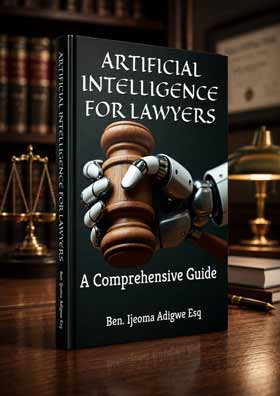 The book also examines Nigeria's legal ecosystem, focusing on the LPELR and NBA AI Guidelines. As a bonus, every purchase comes with a FREE eBook titled: How to Use the AI Features in LegalPedia and LawPavilion.
Ohio Books Ltd praises the publication, stating:
"....this is the only Nigerian book I know of on the topic."
How to Order:
📞 Call, Text, or WhatsApp: 08034917063 | 07055285878
📧 Email: benadigwe1@gmail.com
🌎 Website: www.benadigwe.com
Ebook Version: Access it directly online at https://selar.com/prv626
Authored by Ben Ijeoma Adigwe Esq., ACIarb (UK), LL.M, Dip. in Artificial Intelligence, Director at the Delta State Ministry of Justice, Asaba, Nigeria.
______________________________________________________________________
The book also examines Nigeria's legal ecosystem, focusing on the LPELR and NBA AI Guidelines. As a bonus, every purchase comes with a FREE eBook titled: How to Use the AI Features in LegalPedia and LawPavilion.
Ohio Books Ltd praises the publication, stating:
"....this is the only Nigerian book I know of on the topic."
How to Order:
📞 Call, Text, or WhatsApp: 08034917063 | 07055285878
📧 Email: benadigwe1@gmail.com
🌎 Website: www.benadigwe.com
Ebook Version: Access it directly online at https://selar.com/prv626
Authored by Ben Ijeoma Adigwe Esq., ACIarb (UK), LL.M, Dip. in Artificial Intelligence, Director at the Delta State Ministry of Justice, Asaba, Nigeria.
______________________________________________________________________