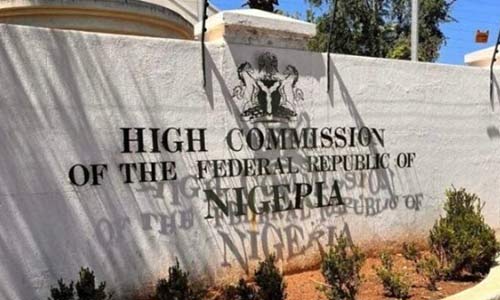
The Nigerian High Commission in South Africa has issued a 10-point advisory to Nigerians residing in the country over rising tension trailing the alleged coronation of an Igbo traditional ruler in the Eastern Cape Province.
On Monday, several vehicles were burnt in the province when protests erupted against the alleged coronation of Solomon Eziko as the traditional leader of the Igbo community in the city.
According to multiple reports, the protest was organised by members of ActionSA, one of South Africa’s political parties, who described Eziko’s coronation as a violation of the province’s sovereignty and constitutional order.
Reports indicate that the protest turned violent in KuGompo City, where demonstrators torched vehicles and buildings allegedly owned by foreign nationals.
In a circular issued on Monday, titled “Advisory to All Nigerians Living in the Republic of South Africa,” the High Commission urged Nigerians to prioritise safety and exercise caution amid what it described as “palpable tension” in the country.
The advisory includes the following directives:
- Be security-conscious at all times
- Moderate movement
- Limit interaction with unfamiliar persons
- Maintain a low profile
- Remain law-abiding
- Respect local laws and customs
- Suspend all socio-cultural activities
- Avoid making inflammatory statements capable of escalating tensions, particularly on social and mainstream media
- Steer clear of demonstrations or counter-protests
- Refrain from unnecessary display of wealth or flamboyance
The advisory also encouraged Nigerians to promptly report any threat to life or property to local security agencies.
“All nationals should consult the Nigerian High Commission in Pretoria or the Consulate General in Johannesburg for clarification on safety measures where necessary,” the statement added.
According to Newzroom Africa, the protest turned violent in KuGompo City, where demonstrators torched vehicles and buildings allegedly owned by foreign nationals.
Athol Trollip, ActionSA’s Eastern Cape chairman, said the party stands firmly with recognised traditional authorities, insisting that due process must be followed in matters of cultural and traditional governance.
The demonstrators marched through parts of the province, demanding immediate government intervention and warning that failure to act could trigger further unrest.
One protester said residents were prepared to take up arms if the matter remained unresolved, while others called for the deportation of Nigerians linked to the coronation.
The protest also snowballed into severe looting as the protesters besieged a local butchery, carting away meat products, according to EWN Reporters.
In a video posted by Amilcar Baleni, a South African resident, some protesters were seen smashing the windscreens of parked vehicles with planks as they marched through the area.
“Hard-earned money of South Africans, who owe banks and still support their families in a very bad economy, is being vandalised and destroyed like this — in the name of what?” Baleni wrote.
“There was no coronation of an Igbo king in the Eastern Cape. King Buyelekhaya, CONTRALESA, and CoGTA have all rubbished the propaganda.”
“All well and good if you don’t want Nigerians in the country, regardless of their legal status. But why must ordinary South Africans have their properties destroyed over lies and propaganda?”
In a statement on Monday signed by Sinawo Thambo, its national spokesperson, the Economic Freedom Fighters, a pressure group in South Africa, said the Department of Cooperative Governance and Traditional Affairs (COGTA) holds the exclusive right to determine and legitimise kings, queens, traditional leaders and royal authorities in the country.
“In order for an individual to be recognised as a royal or traditional authority in South Africa, the Minister for COGTA must make recommendations to the President of the Republic of South Africa, who subsequently utilises the Traditional and Khoi-San Leadership Act of 2019 to formally recognise a king or a queen,” the group stated.
The EFF said this recognition is then formalised through a notice in the government gazette.
The group said it is not only offensive but also illegal for any individual to declare themselves a monarch outside these legislative processes.
“It is even more insulting for a foreign national to declare kingship in another country,” the EFF added.
According to the group, kingship is not only ceremonial but is tied to the legislative framework of South Africa, bestowing authority over people and land on an individual under the sovereignty of the state.
“It is not to be taken lightly, nor should it be declared by individuals without any legal authority,” the group said.
The EFF condemned the alleged coronation, saying “this irresponsible act has led to a rightful and justified outcry by the people of KuGompo, the Eastern Cape, and South Africa at large.”
The group said it had instructed its structures in the area to monitor the situation closely and provide assistance to citizens whose infrastructure had been damaged as a result of the unrest.
“We additionally call for all those who instigated this violence to be arrested and held liable for damages,” it added.
Meanwhile, the Nigerian High Commission in South Africa has said no Igbo traditional ruler was coronated in Eastern Cape Province, contrary to widespread reports.
In a statement dated March 26, the High Commission said the Igbo East London festival was merely a cultural event and not a coronation.
“The High Commission wishes to state, unequivocally, that, contrary to the narrative in the public domain, no coronation took place and none intended,” the statement reads.
The mission said it had taken note of concerns raised by South African authorities, traditional leadership structures, and members of the public, acknowledging that the development generated “understandable concerns” within the framework of the country’s laws and cultural practices.
It added that Nigeria holds the sovereignty, laws, customs, and traditions of South Africa in high regard, noting that both countries share longstanding bilateral relations anchored on mutual respect and cooperation.
Explaining the context of the event, the High Commission said cultural expressions among the Igbo people are often misunderstood outside Nigeria, stressing that such gatherings are largely symbolic and not political.
It cited cultural practices such as the New Yam Festival (Iri Ji), masquerade displays (Mmanwu), traditional marriage rites (Igba Nkwu), and chieftaincy title ceremonies as key aspects of Igbo heritage.
According to the High Commission, “the event in East London has no territorial ambition, political authority or agenda within the host communities, but is rather a symbolic affirmation of identity and pride in cultural heritage.”
The mission expressed regret over any offence or misunderstanding the development may have caused, stressing that it was not intended to undermine South African traditional institutions or violate local laws.
It also called for calm and restraint among stakeholders, urging the public to show understanding.
The alleged coronation controversy has once again exposed the fragile relationship between Nigerian nationals and host communities in South Africa, a country with a history of xenophobic violence against African migrants.
Despite the Nigerian High Commission’s clarification that no coronation took place and that the event was merely a cultural festival, the damage has already been done — with vehicles burnt, buildings torched, and businesses looted.
The involvement of ActionSA, a political party, in organising the protests adds a political dimension to what might have been contained as a cultural misunderstanding.
The EFF’s characterisation of the protests as “rightful and justified” while simultaneously calling for the arrest of those who instigated violence reflects the complex dynamics at play.
For Nigerians in South Africa, the 10-point advisory from the High Commission is a stark reminder of the precarious nature of their existence in the country — where cultural expressions can be misinterpreted and trigger violent backlash.
The situation calls for urgent diplomatic engagement between Nigeria and South Africa to address not just the immediate crisis but the underlying tensions that continue to put Nigerian nationals at risk in the rainbow nation.
 Interested buyers are encouraged to place their orders and enquiries via:
0704 444 4777, 0704 444 4999, 0818 199 9888
Website: www.alexandernigeria.com
Interested buyers are encouraged to place their orders and enquiries via:
0704 444 4777, 0704 444 4999, 0818 199 9888
Website: www.alexandernigeria.com