By O. G. Ogbom, Esq.

Introduction
The law of contempt of court has its origins in English common law, where it developed as an inherent power of courts to protect the administration of justice and maintain their authority. Historically, contempt was rooted in the idea that the authority of the King’s courts must not be undermined. Any act that obstructed justice, disobeyed court orders, or scandalized the court was punishable summarily. This power was considered essential because courts lacked enforcement mechanisms and had to rely on their inherent authority.
One of the earliest articulations of the scope of contempt appears in R v. Gray [1900] 2 QB 36, where the court held that publications calculated to bring a judge into contempt are punishable. However, the strict approach of early common law gradually gave way to a more balanced view. By the 20th century, courts began to recognize the tension between contempt powers and freedom of expression, especially in democratic societies with the intention that the administration of justice thrives on the freedom of legal practitioners to present arguments fearlessly, even when such arguments are critical of the court or opposing positions.
A written address one of the means through which lawyers present legal arguments and is a fundamental tool of advocacy, allowing counsel to marshal facts, law, and reasoning in support of a client’s case. However, a recurring concern in legal practice is whether a lawyer can be held liable for contempt of court for opinions expressed in such written submissions.
This article argues that, except in cases of clear abuse, a lawyer should not be punished for contempt merely for expressing legal opinions in a written address. This position is supported by both Nigerian and foreign judicial authorities, as well as principles of fair hearing and the rule of law.
A written address is not evidence but argument. It is the counsel’s opportunity to interpret the law, critique judicial authorities, and persuade the court to adopt a particular position. The right to fair hearing under Section 36 of the Constitution of the Federal Republic of Nigeria 1999 guarantees that parties must be afforded the opportunity to present their case fully. This necessarily includes robust and even critical legal argumentation.
Contempt of court, particularly in facie curiae (in the face of the court), is designed to protect the dignity and authority of the court. However, it is not meant to stifle legitimate advocacy. The power of contempt must be exercised sparingly and with restraint, as it carries the risk of judicial overreach.
Nigerian courts have consistently cautioned against using contempt proceedings to punish counsel for discharging their professional duties. In Adeniyi v. Governor of Oyo State,(1982) 9 SC 1 the court emphasized that counsel must be allowed reasonable latitude in presenting arguments, even where such arguments may appear critical. In Nwankwo v. State,(1985) 6 NCLR 228 it was held that the right to defend a client includes the right to make submissions that may not align with the court’s preliminary views.
In Atake v. Afejuku (1994) 9 NWLR (Pt. 368) 379 (SC), a legal practitioner was summarily convicted for contempt by a trial judge over statements made in the course of proceedings, which were perceived as disrespectful to the court. The Supreme Court set aside the conviction, holding that the alleged conduct did not justify contempt. The Court stressed that counsel must be allowed latitude in presenting their client’s case, and contempt powers must be exercised cautiously.
The court warned that the power to punish for contempt must not be used to intimidate counsel or suppress legitimate advocacy. The court underscored that counsel should not be punished for statements made in the course of bona fide legal argument, provided they are relevant to the case. In Okoduwa v. State, (1988) 2 NWLR (Pt. 76) 333 (SC), during a criminal trial, issues arose regarding the propriety of counsel’s submissions, which were alleged to be improper. The Supreme Court held that counsel cannot be punished for making submissions in good faith, even if forceful, provided they are relevant. However, the Court noted that insulting or scandalous language would not be protected.
It is noteworthy that foreign jurisprudence strongly reinforces the principle that lawyers must be free to express opinions in court processes without fear of contempt sanctions except where it is a scurrilous abuse.
In R v. Gray,[1900] 2 QB 36, the court distinguished between scurrilous abuse and legitimate criticism, holding that only the former constitutes contempt. A judgement may be criticised, even strongly, Such criticism must be fair, temperate, and made in good faith. It should be directed at the reasoning, conclusions, or legal principles, not the personality of the judge. It must not impute improper motives or attempt to undermine public confidence in the administration of justice. The court went further to state that:
“fair and temperate criticism made in good faith does not amount to contempt; the mischief lies in scurrilous abuse, not legitimate critique made in the course of advocacy.”
Also, in Bridges v. California, 314 U.S. 252 (1941), Public comments and publications were made about pending court proceedings, raising the issue of whether such expressions constituted contempt. The Supreme Court of the United States overturned the contempt findings, holding that only speech posing a clear and present danger to the administration of justice can be punished.
In Ambard v. Attorney-General of Trinidad and Tobago, [1936] AC 322 (PC), Lord Atkin famously stated that:
“Justice is not a cloistered virtue; she must be allowed to suffer the scrutiny and respectful, even outspoken, comments of ordinary men.”
The court emphasized that legal submissions, even if strongly worded, do not amount to contempt unless they obstruct justice.
In Bridges v. California,314 U.S. 252 (1941), the Supreme Court of the United States held that freedom of expression must be protected, and contempt powers should not be used to silence criticism unless there is a clear and present danger to justice.
Chilling effect cannot be overemphasized; that if lawyers fear contempt sanctions, they may resort to self-censorship, thereby weakening the adversarial system.
Notwithstanding the above, a lawyer may be liable for contempt if the language used is abusive, scandalous, or intended to ridicule the court. In R v Gray (Supra) a barrister published a written article referring to a judge in highly abusive terms, including describing him in a derogatory and insulting manner following a decision. The court held him guilty of contempt, ruling that the publication was scurrilous abuse calculated to bring the court into contempt, not legitimate criticism. In Re Johnson, (1887) 20 QBD 68, a legal practitioner used offensive and abusive language in documents filed before the court, attacking the court rather than addressing legal issues. The court found the conduct contemptuous, holding that court processes must not be used as vehicles for abuse or insult. It was further held that the submission was irrelevant and aimed at undermining the authority of the court. There was a clear intention to obstruct or interfere with the administration of justice.
It is imperative to mention that the protection is not absolute but conditional on professionalism and relevance. A lawyer should not be held liable for contempt merely for expressing opinions in a written address except as stated in the cases cited herein above. Both Nigerian and foreign authorities affirm that the right to present robust legal arguments is essential to the administration of justice. The power of contempt must therefore be exercised cautiously, ensuring that it does not become a tool for suppressing legitimate advocacy. Ultimately, the balance lies in preserving the dignity of the court while safeguarding the lawyer’s duty to argue fearlessly within the bounds of decorum and relevance.
O.Ogbom, PhD, Notary Public, is a legal practitioner based in Port Harcourt, Rivers State. He can be reached via Ogbom@lawfreightattorneys.com or ogbomgoodluck@gmail.com.
 Interested buyers are encouraged to place their orders and enquiries via:
0704 444 4777, 0704 444 4999, 0818 199 9888
Website: www.alexandernigeria.com
Interested buyers are encouraged to place their orders and enquiries via:
0704 444 4777, 0704 444 4999, 0818 199 9888
Website: www.alexandernigeria.com

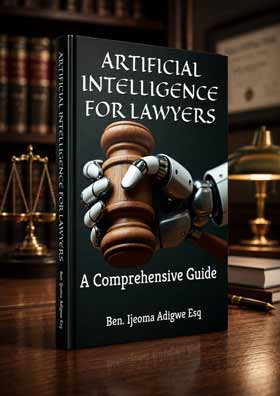 The book also examines Nigeria's legal ecosystem, focusing on the LPELR and NBA AI Guidelines. As a bonus, every purchase comes with a FREE eBook titled: How to Use the AI Features in LegalPedia and LawPavilion.
Ohio Books Ltd praises the publication, stating:
"....this is the only Nigerian book I know of on the topic."
How to Order:
📞 Call, Text, or WhatsApp: 08034917063 | 07055285878
📧 Email: benadigwe1@gmail.com
🌎 Website: www.benadigwe.com
Ebook Version: Access it directly online at https://selar.com/prv626
Authored by Ben Ijeoma Adigwe Esq., ACIarb (UK), LL.M, Dip. in Artificial Intelligence, Director at the Delta State Ministry of Justice, Asaba, Nigeria.
_______________________________________________________________________
The book also examines Nigeria's legal ecosystem, focusing on the LPELR and NBA AI Guidelines. As a bonus, every purchase comes with a FREE eBook titled: How to Use the AI Features in LegalPedia and LawPavilion.
Ohio Books Ltd praises the publication, stating:
"....this is the only Nigerian book I know of on the topic."
How to Order:
📞 Call, Text, or WhatsApp: 08034917063 | 07055285878
📧 Email: benadigwe1@gmail.com
🌎 Website: www.benadigwe.com
Ebook Version: Access it directly online at https://selar.com/prv626
Authored by Ben Ijeoma Adigwe Esq., ACIarb (UK), LL.M, Dip. in Artificial Intelligence, Director at the Delta State Ministry of Justice, Asaba, Nigeria.
_______________________________________________________________________