BY FEMI FALANA SAN

The decision of the Federal Government and State Governments to shrink the civic space has contributed to increasing wave of political violence in the country. Whereas, INEC is exclusively empowered to issue guidelines for the conduct and management of general elections, State Governments and the Federal Capital Territory have fixed campaign billboard permit fees between N100 million and N200 million. In addition, opposition political parties and candidates have been prohibited from hiring state owned stadia, hotels and publicly owned events centres for their campaigns. In frustration, some disenchanted youths have destroyed the billboards and other campaign materials mounted by the ruling party in some states.
Reacting to the development, the INEC National Commissioner and Chairman, Voter Education and Publicity, Mr. Mohammed Haruna, was reported to have said that, “there’s not much INEC can do about parties putting up what seems to be prohibitive fees on erecting billboards in states where they rule. This is partly because signage for such billboards are the prerogatives of states and local governments and there are no limits to what they can charge and therefore there are no penalties for over charging.”
In justifying the expensive fees, the Minister of the Federal Capital Territory, Mr. Nyessom Wike has said that political campaigns were expensive globally and argued that parties could also resort to social media platforms to reach their supporters. The minister maintained that the increase in billboard charges was part of the FCT administration’s efforts to generate revenue rather than a deliberate attempt to disadvantage opposition parties.
With respect, the positions of INEC and Mr. Wike are not in consonance with the provisions of the Constitution and the Electoral Act, 2026. By virtue of Section 15, Part 1of the Third Schedule to the 1999 Constitution, it is the exclusive duty of INEC to organise, undertake and supervise all elections to the offices of the President and Vice-President, the Governor and Deputy Governor of a State, and to the membership of the Senate, the House of Representatives and the House of Assembly of each State of the Federation. INEC is also charged with the sole duty to “monitor political campaigns and provide rules and regulations which shall govern the political parties.”
For the avoidance of doubt, under section 99 of the Electoral Act, 2026, it is a serious criminal offence to prevent a candidate and his or her party from campaigning for elections in accordance with such rules and regulations *as may be determined by the Commission.* It is also a criminal offence to deny a political party or candidate the use of state apparatus including the media and thereby put them in a disadvantaged position in the political campaigns.
It ought to be pointed out that state governments cannot add to, subtract from, or alter these constitutional conditions by imposing fees that are inconsistent with the Constitution and the guidelines issued by the INEC. In PDP V. SYLVA (2012) 13 NWLR (PT 1316) 85 and NDP V INEC (2013) 20 WRN 1 at 45 the Supreme Court (per Ariwoola J.S.C.) held that INEC has the sole responsibility to administer, organize and supervise the general elections to the exclusion of any other authority in the country.
Since state governments have no role to play in the conduct of political campaigns that are set out in the Electoral Act, the expensive billboards fees fixed by them are illegal and unconstitutional. Indeed, the administrative fees usually imposed on candidates contesting local government elections by state governments have been annulled by several courts because they were found to have contravened the provisions of the Electoral Act. Consequently, INEC should direct state governments to cancel the expensive campaign fees or face the full wrath of the law.
ON DUTY OF INEC TO PROSECUTE ELECTORAL OFFENDERS
The Mohammed Uwais Electoral Reform Panel had recommended the establishment of an Electoral Offences Commission to investigate allegations of electoral offences and prosecute the perpetrators. The recommendation was accepted by the Federal Government but the National Assembly deliberately refused to include the Electoral Offences Commission in the 2010, 2022 and 2026 Electoral Acts. Even though it is common knowledge that INEC is overburdened, the National Assembly has empowered it to prosecute electoral offenders. Thus, section 148 of the Electoral Act 2026 provides as follows:
1. An offence committed under this Act shall be triable in a Magistrate Court or a High Court of a State in which the offence is committed, or the Federal Capital Territory, Abuja.
2. A prosecution under this Act shall be undertaken by legal officers of the Commission or any legal practitioner appointed by it.
Having been conferred with the power to prosecute electoral offenders, INEC should set up an Investigation Unit and a Prosecution Unit. Like other prosecutorial agencies in the country, INEC should request the Inspector- General of Police to deploy some trained police investigators to conduct the investigation of electoral offences. Instead of monitoring the 2027 elections, the Nigerian Bar Association should liaise with INEC to bring indicted electoral offenders to book. In 2011, we convinced the leadership of the NBA and INEC to collaborate in the prosecution of electoral offenders. Since then, the collaboration between both bodies has led to the successful prosecution of many electoral offenders.
A few days ago, INEC disclosed that it had uncovered deliberate manipulation of voter registration procedures involving about 54 of its personnel, allegedly complicit in irregularities across 10 states of the federation. The 54 indicted officers and the armed thugs arrested by the police for attacking candidates and disrupting rallies of political parties should be charged in the appropriate courts by INEC with the assistance of the NBA. Otherwise, the 2027 general election will be marred by electoral violence of monumental proportion.
[A MUST HAVE] Evidence Act Demystified With Recent And Contemporary Cases And Materials

Available now for NGN 40,000 at ASC Publications, 10, Boyle Street, Onikan, Lagos. Beside High Court, TBS. Email publications@ayindesanni.com or WhatsApp +2347056667384. Purchase Link: https://paystack.com/buy/evidence-act-complete-annotation
______________________________________________________________________ “Enhance Legal Practice With Authoritative Reports” — Alexander Payne Offers Comprehensive Law Reports, Spanning Over A Century Of Nigerian Jurisprudence Interested buyers are encouraged to place their orders and enquiries via:
0704 444 4777, 0704 444 4999, 0818 199 9888
Website: www.alexandernigeria.com
“A Comprehensive Guide To Evidence Law” — Releases Second Edition In Three Volumes, Covering 4,051 Cases
For enquiries and orders, contact: 08035526491 Email: jerryamadisilk@gmail.com
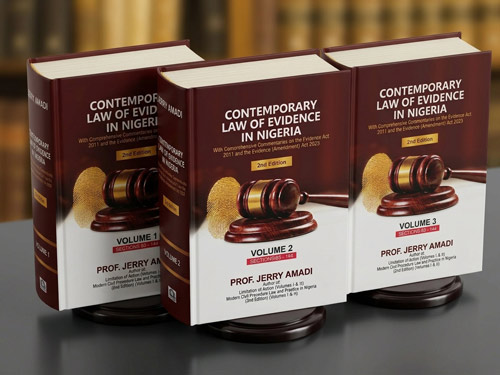 Prof. Jerry Amadi’s Evidence Law, Second Edition (2026), contains 3,314 pages in three volumes, covering the Evidence Act 2011, its 2023 amendment, and 4,051 Nigerian and English cases.