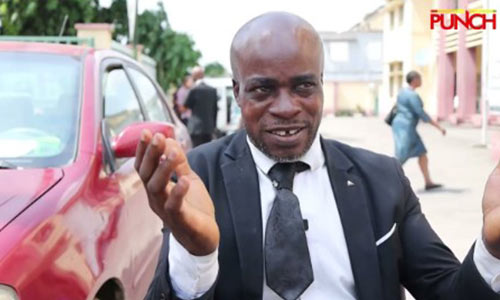
In one of the most remarkable stories of resilience and determination to emerge from the Nigerian legal profession, a physically challenged Lagos-based lawyer Abdulsalam Idowu has recounted his extraordinary journey from begging for alms on the streets as a child to being called to the Nigerian Bar, revealing a life marked by hardship, discrimination, and an unbreakable will to succeed.

The lawyer, who became disabled at the age of four after a bout of malaria that was initially treated with local herbs before being taken to hospital too late, shared his story in a deeply personal account that has moved many across the legal community and beyond.
The lawyer revealed that he began begging on the streets the very first day he started primary school in 1987, as he had to feed himself and fund his own education.
“The day I started primary school, I started begging in the streets because I have to feed for myself and I have to fund my education. So I did that throughout my secondary school, begging,” he said.
When he finished primary school and gained admission to secondary school, he needed about five hundred and twenty naira for school fees. Someone told him he could make money in Lagos, so he boarded a train with no particular destination in mind and alighted at the last stop — Idumota.
He slept at the terminal for two days, battling bed bugs, before relocating to sleep under a bridge. After about twelve days of begging, he raised one thousand nine hundred naira — more than enough for his school fees — and returned to continue his education.
“So whenever I need money, I come back to Lagos and I beg money,” he recalled.
The lawyer disclosed that he slept under bridges for a total of nine years during the course of funding his education, yet never succumbed to any vice despite the harsh conditions.
“I slept for good six years under the bridge, or nine years under the bridge. I never for once in my life tasted an ordinary cigarette,” he stated, adding that his discipline during those years was a conscious choice that many able-bodied persons fail to make.
A kind stranger eventually introduced him to someone who helped him secure accommodation at a school where he could serve as a painter at night. He completed his secondary education through this arrangement.
After secondary school, he enrolled in evening classes, begging during the day and attending classes in the evening. He also ventured into small-scale trading, buying kola nuts and transporting goods between cities to supplement his income and gradually reduce his dependence on begging.
In 2006, the lawyer gained admission to study at the University of Lagos. Even as a university student, he continued begging to survive. One afternoon, while heading to class, a man in a white outfit stopped him and asked why he was not using a wheelchair instead of crawling.
Unknown to him, the man was a journalist with The Punch newspaper. The journalist later published his story, and people came to his aid.
He performed well academically, completing his programme and subsequently writing the Joint Admissions and Matriculations Board examination. He was admitted to study law at the same university and graduated in 2015. He proceeded to the Nigerian Law School and was called to the Bar in November 2016.
Despite his remarkable achievement, the lawyer revealed that practising law as a disabled person in Nigeria is fraught with challenges, chief among them discrimination and inaccessible court facilities.
He disclosed that he has had experiences where potential employers or clients rejected him upon discovering his disability. He recounted one incident where someone was recommended to him for legal services, but upon meeting him, the person repeatedly said “no” and walked away.
“You won’t have a successful legal practitioner in Nigeria that will employ a disabled person as a lawyer. I say this with all my mouth, only fairly few minorities. They are existing, but there are not many,” he stated.
He said disabled lawyers seeking employment in Nigeria essentially have no choice but to set up on their own and compete for clients alongside other practitioners, a reality he has embraced despite its difficulties.
The lawyer painted a vivid picture of the physical barriers he faces daily in Nigerian courts. He noted that while some courts like those in Ogba are somewhat accessible, others like the Ajegunle court have four-storey buildings with no ramps or elevators whatsoever.
“Unlike other courts like Ajegunle where you have a four-storey building and there is no any ramp whatsoever. So you have to crawl all the way to the fourth floor if your matter is assigned to that particular place,” he said.
Despite these challenges, the lawyer said he cannot afford to stay home because he is a married man with a wife and children to feed.
“We can’t just sit at home, food will not come. I’m a married man, I have kids, I have wife, and then you have to piece by piece feed them. So you can’t just say I’m disabled and just sit at home,” he said.
Amid the discrimination, the lawyer acknowledged that he also encountered remarkable kindness. He recalled how a Chief Magistrate connected him with the then Majority Leader of the House of Representatives, Honourable Femi Gbajabiamila, who had read his story online. Gbajabiamila gave him a car and later appointed him as a Special Assistant when he became Speaker.
“After giving me the car, he made me Special Assistant where he was Speaker. If you have not been mingling with disabled before, you are most likely to be sympathizing with them rather than embracing them,” the lawyer observed.
The lawyer shared that he married in 2020 after meeting someone who loved him despite his condition. He now has young children and continues to practise law across multiple courts — high courts and magistrate courts — to provide for his family.
Despite everything he has endured, the lawyer said he has never once sat down and thought of himself as disabled.
“In my life, I can’t remember a time I sat down and I was thinking that I’m disabled. You guys might see me that, oh, he’s disabled. I don’t see myself like that,” he said.
He offered a powerful message of hope to all Nigerians, whether disabled or able-bodied.
“I keep telling people, you can be anything you want to become on earth. The only thing that can stop you is yourself,” he declared.
He also challenged the notion that disability is only physical, noting that many able-bodied persons who waste their potential and depend on others are themselves disabled in a different sense.
“We have a lot of able-bodied people. In fact, they are disabled because they can’t fend for themselves very well,” he said.
The lawyer’s story stands as a powerful testament to human resilience and a stark indictment of the barriers that persons with disabilities continue to face in Nigeria’s legal system and society at large.
[A MUST HAVE] Evidence Act Demystified With Recent And Contemporary Cases And Materials

Available now for NGN 40,000 at ASC Publications, 10, Boyle Street, Onikan, Lagos. Beside High Court, TBS. Email publications@ayindesanni.com or WhatsApp +2347056667384. Purchase Link: https://paystack.com/buy/evidence-act-complete-annotation
______________________________________________________________________ “Enhance Legal Practice With Authoritative Reports” — Alexander Payne Offers Comprehensive Law Reports, Spanning Over A Century Of Nigerian Jurisprudence Interested buyers are encouraged to place their orders and enquiries via:
0704 444 4777, 0704 444 4999, 0818 199 9888
Website: www.alexandernigeria.com
Interested buyers are encouraged to place their orders and enquiries via:
0704 444 4777, 0704 444 4999, 0818 199 9888
Website: www.alexandernigeria.com