By Oluwapelumi Mojolaoluwa Mofoluwawo, LLB, BL, LLM (UK)

The Court has ruled in a plethora of cases, that it will not interfere in the internal administration of Universities as regards discipline, save to redress fundamental rights infringement. That was the position the Supreme Court assumed in Garba v University of Maiduguri in 1986. Over a decade later, the Supreme Court was again called upon to decide the fate of a student alleging an infringement of his fundamental rights to fair hearing after being expelled for examination malpractices by the University of Ilorin.
In University of Ilorin & Anor. V. Idowu Oluwadare, the Respondent originally the Claimant at the trial Court, Idowu Oluwadare, was a student of the University of Ilorin, Kwara State. Whilst writing an examination in August 1998, he was caught collecting a question paper from another student. He was asked to make a statement but refused. In line with the school’s examination malpractice disciplinary procedure, Idowu was summoned before the Student Disciplinary Committee(SDC), the committee saddled with the responsibility of trying and recommending punishments for offending students. The SDC investigated the matter and recommended his expulsion. The University consequently issued him an expulsion letter, noting that he had a right to appeal the decision to the University Governing Council within 24 days.
Idowu filed an appeal with the Governing Council in April 1999 but he did not wait for the outcome of his appeal before filing an application for the enforcement of his fundamental rights at the Federal High Court, asking the Court to quash his expulsion and order his reinstatement. He contended that the SDC lacked the power to deal with examination misconduct which is criminal in nature and that he was not afforded adequate opportunity to defend himself. On the other hand, the University argued that the Federal High Court lacked jurisdiction because Idowu had not exhausted internal remedies. They also argued that he had approached the Court via a wrong mode. According to the University, an act of examination misconduct is a misconduct that can be dealt with by the University under the University of Ilorin Act, Cap. 455 Laws of the Federation 1990. They further contended that Idowu was given a fair hearing and that the step taken by him in rushing to Court, after he had appealed to the Governing Council, was premature, constituted an abuse of judicial process and also runs counter to the relevant provisions of Unilorin Act, Cap. 455, which allows appeal from the decision of the SDC.
Idowu won at the trial Court and the Court of Appeal also upheld the decision of the trial Judge to the effect that the University SDC lacked the powers to deal with examination misconduct and that Idowu was not bound to first appeal on the matter to the University Council, and so the University appealed to the Supreme Court(SC). The Supreme Court was called upon to determine whether the Respondent(Idowu)’s suit was properly initiated as a fundamental rights enforcement application rather than through a Writ of Summons. And to consider whether the Respondent’s failure to exhaust the University’s internal appeal process rendered his action premature or otherwise.
The Supreme Court found that the Respondent had ‘jumped the gun’ by rushing to Court whilst his internal appeal to the University Governing Council was still pending. The Court emphasized that until domestic remedies are exhausted, any resort to Court action is premature. The SC noted that by initiating the Court case, the matter became sub-judice thus, preventing the University Council from concluding the internal appeal process.
Moreover, the Court held that the Respondent adopted the wrong legal procedure as his claim before the Court was not fundamentally that his constitutional rights had been breached, rather that his expulsion be reversed and he be reinstated as a student of the University. He therefore ought to have come by way of a writ of summons rather than a fundamental rights application. This mistep according to the Court, denied the Court jurisdiction to hear the matter, since restoration of studentship is not a claim or relief within the contemplation of the Fundamental Rights Enforcement Procedure Rules.
The Supreme Court therefore dismissed the appeal as incompetent and premature, set aside the decision of the trial and appeal Courts and awarded a cost of N10, 000 against Idowu.
This decision is instructive for aggrieved parties in any University. On the first leg, exhausting the laid down internal remedies in a University, is a condition precedent for the assumption of jurisdiction by the Courts on any dispute emanating from such University. Failure to do this strips the Court of jurisdiction and is fatal to the case of a claimant. Citing the earlier decision of Miss Olajobi Abimbola & Ors. v. Professor C.A. Onwumechili (1985) NWLR (Part 1) 68 wherein the SC had held that the appellants had forfeited their claims to the rule of natural justice having filed the action before the University Senate had had a chance to deliberate on their case, the Court held that same applied to Idowu who ought to have waited for the outcome of his appeal to the University Council before instituting the matter. To quote the Court, “From the said decision of this Court, I repeat, that since the Respondents said appeal, have/had not been heard and determined by the Council, it seems to me as in Akintemi v. Prof.Onwumechili’s case (supra), that the Respondent, who should have remained an undergraduate of the 1st Appellant, until his said appeal is heard and determined, has woefully but regrettably, failed/neglected/refused, to take advantage of the opportunity or provision in the 1st Appellants Law or Act including the Students Handbook of Information and Regulations (which was made available to the Court, by the Appellants). Rather, he foolishly or in panic, rushed to the Court where his action is certainly not justiciable…”
The second issue is that of Fundamental Rights which many litigants are swift to rely upon regarding disputes with Universities. In this case, the Respondent had argued that his fundamental rights had been infringed upon because the SDC could not try him for examination malpractices, which he argued was a criminal matter. He also contended that he was not given adequate opportunity to defend himself. But the Court held that his main cause of action was the restoration of his studentship, which is not a right guaranteed by the 1999 Constitution. Highlighting the provision of the Fundamental Rights (Enforcement Procedure) (FREP) Rules 1979 now 2009, the Court held that enforcement of a fundamental right must be the principal claim, not merely accessory to another claim, such as a dispute over studentship in this case.
When one compares this case with Garba v University of Maiduguri, the latter contended that their fundamental rights had been breached as the University could not try the criminal offenses of arson, assault and theft. That was the substance of the case. In Idowu’s case however, his studentship was the bone of contention, yet what he called into question was the procedure for determining the studentship. The Court held that he should have brought his cause via a writ of summons for proper determination instead of attempting to use a shortcut via FREP. And in the absence of that, his application “not having been brought in accordance with the requirements of Section 46 (1) of the 1999 Constitution and the Fundamental Rights (Enforcement Procedure) Rules, ought not to have been heard and granted by the trial Court not to talk of it being affirmed by the Court below.”
Additionally and in dealing with the real claim brought under the wrong mode, the Court held that examination malpractice was a misconduct within the contemplation of the University law which could be dealt with domestically by the University as in the instant case, and which had been dealt with accordingly. The Court therefore allowed the appeal with orders as to cost, against the Respondent, Idowu Oluwadare.
This 2006 decision underscored the ancillary doctrine which ousts fundamental right applications predicated on causes that are merely incidental to the principal relief, and used as a shortcut instead of the proper mode of commencing such actions via writ of summons. The introduction of the 2009 Fundamental Rights (Enforcement Procedure) Rules however provided a much more liberal framework, emphasizing substantial justice over technicalities. As such, whilst the Court still refrains from usurping the powers of the University over its domestic affairs, where a claimant can make a clear case of human rights infringement before the Court, the Court will hear them.
On the whole, University of Ilorin v Idowu Oluwadare remains in force, regarding the Court’s hesitation to fetter a University’s academic discretion as well as its internal administrative process. However, where fundamental rights have been breached, the Court is at liberty to review the University’s decision to ensure due process is followed and fundamental rights, protected.
Citation: University of Ilorin & Anor v. Idowu Oluwadare (2006) 6 NWLR (Pt. 976) 331 (SC)
Oluwapelumi Mojolaoluwa Mofoluwawo, LLB, BL, LLM(UK) is a Nigerian lawyer and Principal at OM Livingstones & Co. She can be reached at houseoflivingstones@gmail.com and on youtube – Bar Talk with Ola.
 Interested buyers are encouraged to place their orders and enquiries via:
0704 444 4777, 0704 444 4999, 0818 199 9888
Website: www.alexandernigeria.com
Interested buyers are encouraged to place their orders and enquiries via:
0704 444 4777, 0704 444 4999, 0818 199 9888
Website: www.alexandernigeria.com

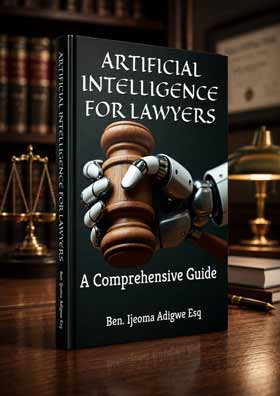 The book also examines Nigeria's legal ecosystem, focusing on the LPELR and NBA AI Guidelines. As a bonus, every purchase comes with a FREE eBook titled: How to Use the AI Features in LegalPedia and LawPavilion.
Ohio Books Ltd praises the publication, stating:
"....this is the only Nigerian book I know of on the topic."
How to Order:
📞 Call, Text, or WhatsApp: 08034917063 | 07055285878
📧 Email: benadigwe1@gmail.com
🌎 Website: www.benadigwe.com
Ebook Version: Access it directly online at https://selar.com/prv626
Authored by Ben Ijeoma Adigwe Esq., ACIarb (UK), LL.M, Dip. in Artificial Intelligence, Director at the Delta State Ministry of Justice, Asaba, Nigeria.
_______________________________________________________________________
The book also examines Nigeria's legal ecosystem, focusing on the LPELR and NBA AI Guidelines. As a bonus, every purchase comes with a FREE eBook titled: How to Use the AI Features in LegalPedia and LawPavilion.
Ohio Books Ltd praises the publication, stating:
"....this is the only Nigerian book I know of on the topic."
How to Order:
📞 Call, Text, or WhatsApp: 08034917063 | 07055285878
📧 Email: benadigwe1@gmail.com
🌎 Website: www.benadigwe.com
Ebook Version: Access it directly online at https://selar.com/prv626
Authored by Ben Ijeoma Adigwe Esq., ACIarb (UK), LL.M, Dip. in Artificial Intelligence, Director at the Delta State Ministry of Justice, Asaba, Nigeria.
_______________________________________________________________________