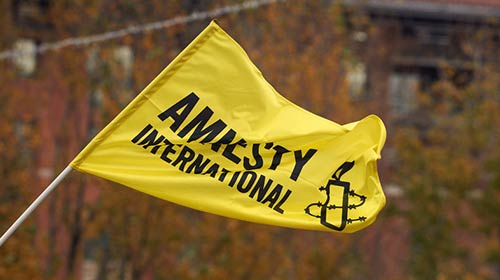
Amnesty International has called on the Federal Government to urgently investigate a series of gas leaks reported in the Bille community in Rivers State, warning that the situation poses a serious threat to the lives and health of residents.

In a statement issued on Monday, the human rights organisation said the suspected methane leaks had been contaminating drinking water sources and affecting the well-being of people in the coastal community in the oil-producing Niger Delta.
According to the group, fishermen in Bille first noticed unusual bubbling in October 2025 while working in a mangrove swamp and nearby river several kilometres from the town. The bubbling water was accompanied by a strong sulphurous smell.
Within a few days, similar incidents were reported at several other locations, including inside the community.
Some residents reportedly discovered that the air around the bubbling sites could be ignited, suggesting the presence of flammable gas.
Amnesty International Nigeria’s Country Director, Isa Sanusi, described the situation as deeply concerning and warned that the problem could worsen if authorities fail to act quickly.
“The alarming number of reports of gas leaks across the Bille community is harrowing, and the affected area appears to be expanding,” Sanusi said.
He added that the leaks had already begun to affect residents’ access to clean water and also disrupted activities in the community.
“The leaks are already contaminating the town’s drinking water, while some children at a local school have had to relocate after falling ill and experiencing vomiting,” he said.
Sanusi stressed that the Nigerian government has both a legal and moral obligation to safeguard residents from environmental harm and potential human rights violations.
“The government must immediately identify the source of the leak and stop it, or take other measures to secure the community from a potentially catastrophic incident,” he said.
The suspected leak sites are located close to several oil and gas installations in the Niger Delta, including pipelines and oil wells previously operated by Shell before the company divested from onshore operations in Nigeria in 2025.
However, the precise source of the methane leak remains unknown as investigations into the incident have yet to be concluded.
In December 2025, officials of the National Oil Spill Detection and Response Agency conducted air-quality tests at different locations within the affected area.
According to Amnesty International, the results showed that methane levels at one of the sites were about 10,000 times higher than normal background levels.
Community leaders say the findings highlight the severity of the threat facing residents.
Chairman of the Bille Council of Chiefs, Bennett Okpoki, said the situation had generated widespread anxiety among the people.
“Everyone in Bille is affected by the methane leak, and something needs to be done urgently to save the lives of the residents,” Okpoki said.
He lamented that despite the alarming results from the air-quality tests, authorities had yet to take concrete steps to address the situation.
“The tests have revealed that there is a high level of methane, and until now, the Nigerian government has not done anything to remedy this situation,” he said.
According to him, the delay suggested that the safety and welfare of residents were not receiving adequate attention from the authorities.
“We want the international community to step in and at least tell the government to do something about it,” Okpoki added.
Amnesty International also called on oil and gas companies operating in the region to cooperate fully with government authorities in determining the source of the methane leak and preventing further environmental harm.
Sanusi said that although it is not yet clear whether the leak is linked to oil industry infrastructure, companies operating in the area must assess whether their current or former facilities could be contributing to the problem.
“While it remains unknown whether oil and gas infrastructure has caused the methane leak, all oil and gas companies in the region must determine whether their current or former infrastructure could be contributing to the issue and fully cooperate with any investigation by Nigerian authorities,” he said.
He also noted that companies cannot avoid responsibility for environmental damage simply because they have sold or abandoned their facilities.
“The choice to divest from or abandon certain infrastructure does not absolve any company from the responsibility to clean up and remedy any harm it may have caused,” Sanusi said.
Amnesty International said it contacted Shell before releasing the statement to seek the company’s response.
According to the organisation, Shell said it no longer owns or operates onshore oil and gas infrastructure in the Niger Delta following the sale of its Nigerian subsidiary in 2025.
The rights group also said it reached out to ministers of state for petroleum resources to ask about the government’s plans to protect residents of the Bille community, but had not received a response as of the time of publication.
Similarly, the National Oil Spill Detection and Response Agency declined to provide details of its air-quality findings, stating that the information would only be released after investigations are completed.
Amnesty International noted that it had supported residents of Bille and another Niger Delta community, Ogale, for more than a decade following environmental damage caused by numerous oil spills linked to Shell’s operations in the region.
The organisation said the pollution devastated the environment, destroying fish populations, contaminating water sources and severely affecting the livelihoods of residents.
Both communities later filed a lawsuit in the United Kingdom against Shell over the alleged environmental damage.
In 2021, the UK Supreme Court ruled that the oil giant could be held liable for oil spills and pollution linked to its Nigerian subsidiary, paving the way for the case to proceed to trial.
The full trial is expected to begin in 2027.
Amnesty International said the unfolding methane leak crisis in Bille underscores the urgent need for stronger environmental monitoring and accountability in Nigeria’s oil-producing communities.
[A MUST HAVE] Evidence Act Demystified With Recent And Contemporary Cases And Materials

Available now for NGN 40,000 at ASC Publications, 10, Boyle Street, Onikan, Lagos. Beside High Court, TBS. Email publications@ayindesanni.com or WhatsApp +2347056667384. Purchase Link: https://paystack.com/buy/evidence-act-complete-annotation
______________________________________________________________________ “Enhance Legal Practice With Authoritative Reports” — Alexander Payne Offers Comprehensive Law Reports, Spanning Over A Century Of Nigerian Jurisprudence Interested buyers are encouraged to place their orders and enquiries via:
0704 444 4777, 0704 444 4999, 0818 199 9888
Website: www.alexandernigeria.com
Interested buyers are encouraged to place their orders and enquiries via:
0704 444 4777, 0704 444 4999, 0818 199 9888
Website: www.alexandernigeria.com