By Pat Onukwuli

The real test of a government spokesperson is fidelity to reality while defending policy, argues PAT ONUKWULI
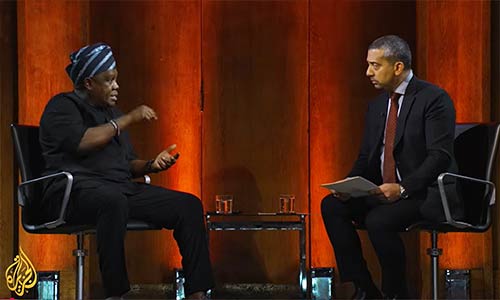
In politics, language is both shield and sword. It defends governments from the arrows of criticism, yet it can just as easily pierce the credibility of those who wield it carelessly. Words can illuminate reality or attempt to obscure it; they can clarify public understanding or cloud it with convenient fog. The recent Al Jazeera interview featuring presidential spokesperson Daniel Bwala, conducted by the famously relentless Mehdi Hasan, offered a masterclass, not in effective communication, but in the perilous art of political overreach.
The encounter, now widely circulated online, has been described by viewers as a “car crash.” The metaphor is apt. One could almost hear the screech of rhetorical brakes and the shattering of credibility as the interview unfolded. Bwala entered the studio with the unenviable task of defending the administration of Bola Ahmed Tinubu before a host renowned for forensic questioning. To sit across from Hasan on live television is not a casual conversation; it is a gladiatorial arena of facts, framing, and intellectual stamina.
And to his credit, Bwala began well. At first, he adopted a defensible posture. He acknowledged that events had overtaken some of his previous criticisms of Tinubu. Circumstances, he suggested, had changed; new realities had reshaped his assessment of the president’s performance. In politics, this is not a sin but a virtue. Intellectual evolution, when candidly explained, is preferable to stubborn ideological rigidity. To revise one’s judgement in light of new information is not hypocrisy but maturity, not a betrayal of principle but recognition of complexity.
Had Bwala remained on that terrain, he might have emerged from the encounter intact. But then came the fatal misstep; indeed, the cardinal sin of the entire episode. Instead of continuing along the narrow but credible path of contextual explanation, he veered into outright denial of statements he himself had previously made. In the age of the internet, that is an extraordinarily unwise strategy. The digital archive has a long memory. To deny what one had said is to wage war not merely against critics but against evidence itself. It is a battle no spokesperson can win.
A more honourable path was available. Rather than denying his earlier criticisms, Bwala could have acknowledged them openly and argued that his perspective had evolved. He could have said that circumstances, responsibilities, and access to new information had altered his judgement. That would have been intellectually defensible and politically credible. Instead of contradiction, there would have been continuity; instead of denial, explanation.
Political communication scholars have long warned against this mistake. The American strategist James Carville once captured part of the problem with characteristic bluntness: “When you’re explaining, you’re losing.” Yet there is an even deeper truth beneath that aphorism: when you deny the obvious, or worse, deny your own recorded words, you are not merely losing the argument; you are forfeiting the trust that makes persuasion possible in the first place.
Veracity is an expensive currency in public discourse. Once it is spent recklessly, it is almost impossible to replenish. What began as a legitimate defence of policy gradually sounded like an attempt to repaint reality itself. Nigerians who grapple daily with economic hardship do not require foreign journalists to tell them what their wallets already know. Inflation, fuel costs, and currency volatility are not abstract statistics; they are lived experiences.
To deny those experiences is to deny the public’s own testimony. In rhetoric, this creates what scholars call cognitive dissonance, a jarring clash between official narrative and lived reality. When the gap becomes too wide, the audience stops listening. The messenger loses authority, and the message collapses with him.
Greek mythology offers a powerful metaphor for this dynamic. In the story of Icarus, the young man fashions wings of wax and feathers to escape captivity. His father warns him not to fly too close to the sun. But intoxicated by the thrill of flight, Icarus ascends higher until the wax melts, and he plummets into the sea.
Political spin obeys a similar law of gravity. A spokesperson may rise impressively on the wings of eloquence and loyalty. Still, if he flies too close to the sun of exaggeration, or worse, the heat of denial, the wax of credibility melts. What follows is not a graceful descent but a spectacular collapse.
The tragedy of the interview is that it did not have to unfold this way. The stronger argument, the one Bwala briefly touched upon, was that policies often look different in hindsight than they do in opposition. Governance reveals complexities that campaigning conceals. A critic who later becomes a defender can plausibly explain that governing realities altered his perspective. This is not unusual; it is the ordinary evolution of political judgment.
But that argument depends on honesty about both the past and the present. It requires acknowledging earlier criticisms rather than denying them. It requires recognising the difficulties Nigerians face and defending the government’s strategy to overcome them. In other words, the task of the spin doctor is not to deny the storm but to persuade the public that the captain knows how to steer the ship through it.
Once denial replaces explanation, persuasion evaporates. Mehdi Hasan is a formidable interviewer, relentless, adversarial, and deeply prepared, and many seasoned politicians have struggled under his scrutiny. In that sense, Daniel Bwala deserves some credit for entering the arena. But courage alone is not enough. The real test of a government spokesperson is fidelity to reality while defending policy. Audiences may tolerate bias or disagreement; what they rarely forgive is the suggestion that their lived experiences, or the public record, are illusions. That is why the reaction to the interview was so visceral.
The lesson is simple. The most effective defence of any government begins by acknowledging what citizens already know to be true. Spin can frame facts, but it cannot erase them. When rhetoric tries to outrun reality, reality always wins, and credibility falls as swiftly as Icarus from the sky. Truth, therefore, is not optional in public life. It is the bedrock of morality, the compass of virtue, and the foundation of trust. Without it, persuasion becomes manipulation and leadership becomes mere theatre.
Dr. Onukwuli is a legal scholar and public affairs analyst. patonukwuli2003@yahoo.co.uk
[A MUST HAVE] Evidence Act Demystified With Recent And Contemporary Cases And Materials

Available now for NGN 40,000 at ASC Publications, 10, Boyle Street, Onikan, Lagos. Beside High Court, TBS. Email publications@ayindesanni.com or WhatsApp +2347056667384. Purchase Link: https://paystack.com/buy/evidence-act-complete-annotation
______________________________________________________________________ “Enhance Legal Practice With Authoritative Reports” — Alexander Payne Offers Comprehensive Law Reports, Spanning Over A Century Of Nigerian Jurisprudence Interested buyers are encouraged to place their orders and enquiries via:
0704 444 4777, 0704 444 4999, 0818 199 9888
Website: www.alexandernigeria.com
Interested buyers are encouraged to place their orders and enquiries via:
0704 444 4777, 0704 444 4999, 0818 199 9888
Website: www.alexandernigeria.com
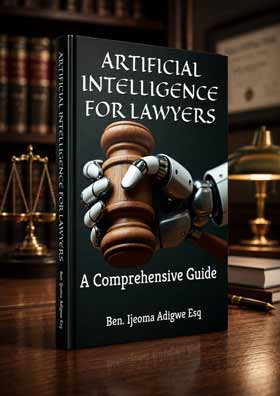 The book also examines Nigeria's legal ecosystem, focusing on the LPELR and NBA AI Guidelines. As a bonus, every purchase comes with a FREE eBook titled: How to Use the AI Features in LegalPedia and LawPavilion.
Ohio Books Ltd praises the publication, stating:
"....this is the only Nigerian book I know of on the topic."
How to Order:
📞 Call, Text, or WhatsApp: 08034917063 | 07055285878
📧 Email: benadigwe1@gmail.com
🌎 Website: www.benadigwe.com
Ebook Version: Access it directly online at https://selar.com/prv626
Authored by Ben Ijeoma Adigwe Esq., ACIarb (UK), LL.M, Dip. in Artificial Intelligence, Director at the Delta State Ministry of Justice, Asaba, Nigeria.
______________________________________________________________________
The book also examines Nigeria's legal ecosystem, focusing on the LPELR and NBA AI Guidelines. As a bonus, every purchase comes with a FREE eBook titled: How to Use the AI Features in LegalPedia and LawPavilion.
Ohio Books Ltd praises the publication, stating:
"....this is the only Nigerian book I know of on the topic."
How to Order:
📞 Call, Text, or WhatsApp: 08034917063 | 07055285878
📧 Email: benadigwe1@gmail.com
🌎 Website: www.benadigwe.com
Ebook Version: Access it directly online at https://selar.com/prv626
Authored by Ben Ijeoma Adigwe Esq., ACIarb (UK), LL.M, Dip. in Artificial Intelligence, Director at the Delta State Ministry of Justice, Asaba, Nigeria.
______________________________________________________________________