By Hon. Justice [Professor] Alaba Omolaye- Ajileye (Rtd) Visiting Professor National Open University Of Nigeria

- Introduction
The admissibility regime for computer-generated bank statements and electronic public documents under the Evidence Act 2011 remains a contested issue in Nigerian jurisprudence. The core issue centres on whether compliance with Section 84 alone suffices, or whether electronic bank statements and electronically-generated public documents must satisfy a dual statutory threshold—namely, both the regime governing bankers’ books (Sections 89–90), for statement of accounts, and Sections 102-104 for public documents and the special provisions regulating electronic evidence (Section 84). This issue can be sketched into a deeper question: Is Section 84 an autonomous gateway, or must it operate cumulatively with the traditional bankers’ books and public documents frameworks under the Evidence Act?
One school of thought holds that where there is compliance with Section 84, properly identifying the source of the electronic record, the manner of production, the particulars of the device involved, and the reliability of the computer system that produced the document, backed up by a certificate, such electronically-generated bank statements and public documents are properly authenticated without more. Conversely, another school of thought emphasises that modern bank statements are inherently computer-generated documents. As such, their admissibility is governed jointly by Sections 89–90 (Bankers’ Books Provisions) and Section 84 (Electronic Evidence Regime), read alongside Section 1 (Relevance).
- Survey of Case Law
In Kubor & Anor v. Dickson & Ors (2012) LPELR – 9817 (SC), the Supreme Court held that public documents electronically generated must comply with both Sections 84 and 104 of the Evidence Act. According to the apex court, every electronic public document must comply with Section 84 of the Evidence Act and must also be certified as required under Section 104 of the Act.
In Kalu & Anor v. Ohuabunwa & Ors, (2015) LPELR-26016 (CA), the Court of Appeal followed the Supreme Court’s decision in Kubor and Dickson (supra), where the data generated from the computer of the ICT Department of INEC Headquarters, Abuja, for Voter Accreditation figures for March 28, 2015, National Assembly Election in Abia North Senatorial District accompanied by a Certificate of Compliance made by the Head of ICT Unit at INEC Headquarters under Section 84(4) of the Evidence Act and also duly certified by the INEC Deputy Director, Legal, as a certified true copy by INEC, was held to have been properly admitted. Also in Abubakar & Anor v. INEC & Ors (2019) LPELR – 48488 (CA), it was held that computer printouts (Exhibits P87, P88, and P89), obtained from the website of the 1st respondent (INEC), were public documents and should have been certified by the 1st respondent, a public body in the custody of the public documents, as secondary evidence under Sections 102 and 104. Furthermore, in FRN v. Ojo & Anor (2018) LPELR-4554 (CA), it was held that information extracted by PW10, a forensic officer of EFCC, from the phone of the 1st Respondent was held inadmissible because such electronically generated evidence must be certified in accordance with Section 104 and must comply with the preconditions laid down in Section 84(2) of the Evidence Act.
In considering the admissibility of entries in books of accounts, electronic records in the course of business, or bank statements, Sections 51, 84, 89, and 90 of the Evidence Act are relevant. Significantly, Section 84 allows a statement to be admissible in a document produced by a computer. Under Section 89(h), secondary evidence of the existence, condition, or contents of an entry in a banker’s book is admissible. One of the conditions is that it is to be established that the copy has been examined with the original entry and found to be correct, for which proof must be given by someone who has examined the copy with the original entry and may be given orally or by affidavit.
In UBN v. Agbontaen (2018) LPELR-44160 (CA), the appellant had argued that the applicable provisions for admissibility of the entries are simply Sections 51, 89 (i) (h), and 90 (1) and not Section 84, but the respondents were of the contrary view, insisting that provisions of Section 84 of the Act were also applicable. The Court of Appeal, per Osaji JCA (as he then was), relying on Kubor v. Dickson (Supra), held that the bank statements sought to be tendered originated from computers and, whether tendered as original or secondary evidence, must comply with the requirements of Section 84 of the Evidence Act before they can be admitted.
In Attorney-General of the Federation v. Princewill Ugonna Anuebunwa (2022) LPELR-57750 (SC), the Supreme Court, by way of obiter, pronounced that a computerised bank statement of account would first be required to be certified by a bank officer to ensure that no one, illegally or without authorisation, tampered with the source data as officially imputed in the computer. Also, the court held further that certification must include that the computer was operational or in good working order when the document was generated.
The case, Daudu v FRN (2018)LPELR (SC), however, presents a different scenario. Certification under Sections 89 and 90 was held to be sufficient to meet the requirements of Section 84. Indeed, the certification in that case did not reflect on the face of the documents but was only presumed.
- The Real Issue
The real issue here is whether Section 84 operates as a general provision that supersedes the earlier admissibility threshold of documentary evidence, or must it be read harmoniously with special statutory provisions like those governing bankers’ books and public documents?
The position is taken that Section 84, in its magnificence, has not expressly abrogated the existing admissibility threshold of documentary evidence. Therefore, Section 84 should not be interpreted as rendering the bankers’ books provisions or provisions guiding the admissibility of public documents redundant.
A coherent reconciliation emerges when we distinguish between the nature of the document, governed by Sections 89–90 or Sections 102-104, and the mode of proving its electronic generation, governed by Section 84. Sections 89–90 and 102-104 determine the nature of the documents, whereas Section 84 determines the authenticity of the electronically-generated documents. Under this model, the provisions of Sections 89 and 90 (for Bankers Books) and Sections 102 -104 (for public documents) are complementary, with Section 84. If Section 84 alone were treated as sufficient in all cases, Sections 89–90 and Sections 102 -104 would become practically obsolete. That would violate the canon against statutory redundancy. Conversely, if Sections 89–90 and 102 -104 were treated as sufficient, without Section 84 compliance, the special safeguards for electronic authentication would be undermined. Therefore, the better position is cumulative through integrated compliance as adumbrated in Kubor v Dickson (supra). Considering the foregoing, the decision of the Supreme Court in Kubor v. Dickson and the apex court’s obiter dictum in Attorney-General of the Federation v. Princewill Ugonna Anuebunwa (supra), should be preferred to Daudu v FRN.
In respect of public documents, it is essential that Internet printouts of public documents be certified in accordance with Section84 and 104 of the Evidence Act 2011 because certification serves as the statutory guarantee of authenticity, integrity, and official provenance. Public documents are presumed genuine only when produced in the manner prescribed by law. An uncertified printout obtained from the website of a public institution lacks the formal assurance that it is a true and complete reproduction of the official record. Websites are susceptible to alteration, updates, administrative errors, cyber-intrusion, or unofficial uploads, and without certification, there is no evidential safeguard confirming the document’s source, accuracy, or date of extraction. Permitting parties to rely solely on self-generated website printouts, without certification, would undermine the reliability of documentary evidence, erode procedural safeguards, and expose the court to the risk of admitting inaccurate, manipulated, or incomplete records. Certification under Section 104, therefore, operates as a critical filter, preserving both the integrity of public records and the credibility of judicial proceedings.
- Conclusion
The apparent conflict between the authorities is not irreconcilable. The correct jurisprudential position is that Section 84 governs how electronically-generated documents are proved, while Sections 89–90, and Sections 102-104, govern what qualifies as admissible banker’s book evidence and the nature of public documents, respectively. When read harmoniously, both regimes must be satisfied in a manner that promotes reliability, fairness, and doctrinal coherence. Such an integrated interpretation resolves the jurisprudential conflict while preserving the integrity of Nigerian evidence law in this digital age.
 Interested buyers are encouraged to place their orders and enquiries via:
0704 444 4777, 0704 444 4999, 0818 199 9888
Website: www.alexandernigeria.com
Interested buyers are encouraged to place their orders and enquiries via:
0704 444 4777, 0704 444 4999, 0818 199 9888
Website: www.alexandernigeria.com

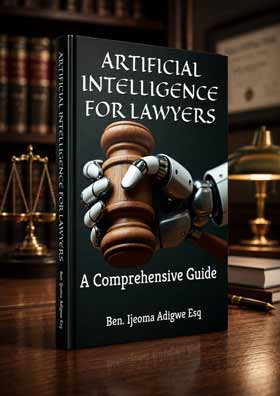 The book also examines Nigeria's legal ecosystem, focusing on the LPELR and NBA AI Guidelines. As a bonus, every purchase comes with a FREE eBook titled: How to Use the AI Features in LegalPedia and LawPavilion.
Ohio Books Ltd praises the publication, stating:
"....this is the only Nigerian book I know of on the topic."
How to Order:
📞 Call, Text, or WhatsApp: 08034917063 | 07055285878
📧 Email: benadigwe1@gmail.com
🌎 Website: www.benadigwe.com
Ebook Version: Access it directly online at https://selar.com/prv626
Authored by Ben Ijeoma Adigwe Esq., ACIarb (UK), LL.M, Dip. in Artificial Intelligence, Director at the Delta State Ministry of Justice, Asaba, Nigeria.
_______________________________________________________________________
The book also examines Nigeria's legal ecosystem, focusing on the LPELR and NBA AI Guidelines. As a bonus, every purchase comes with a FREE eBook titled: How to Use the AI Features in LegalPedia and LawPavilion.
Ohio Books Ltd praises the publication, stating:
"....this is the only Nigerian book I know of on the topic."
How to Order:
📞 Call, Text, or WhatsApp: 08034917063 | 07055285878
📧 Email: benadigwe1@gmail.com
🌎 Website: www.benadigwe.com
Ebook Version: Access it directly online at https://selar.com/prv626
Authored by Ben Ijeoma Adigwe Esq., ACIarb (UK), LL.M, Dip. in Artificial Intelligence, Director at the Delta State Ministry of Justice, Asaba, Nigeria.
_______________________________________________________________________