*Calls it Betrayal Of Pro-Democracy Struggle

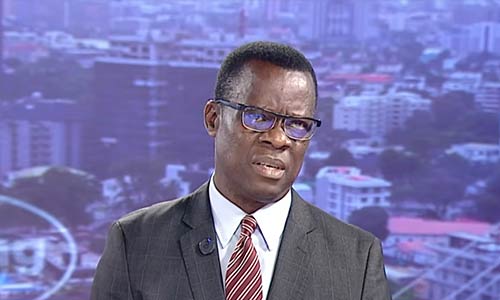
Former Cross River State Resident Electoral Commissioner and lawyer, Mike Igini, has made an impassioned appeal to President Bola Tinubu to reject the newly passed Electoral Act (Repeal and Re-Enactment) Bill 2026, warning that the proposed law could undermine Nigeria’s democratic process and betray the struggles of pro-democracy activists.
Igini made the call on Wednesday during an interview on Arise Television, following the passage of the bill by the Nigerian Senate on Tuesday after tense debates over Clause 60, which allows manual collation as a backup to electronic transmission of election results.
“It is my indeed humble recommendation to Mr. President that you are a man of history. You were a senior man to very many of us in the struggle at a time when the journey of Nigeria and the prospect of democracy was less certain,” Igini said, his voice heavy with emotion.
“What is going to be presented before you is a recipe for chaos. It’s a recipe to undermine all that you have done when we were in the trenches. What is put before you? Please take it back. Don’t sign it.”
The former electoral official, who has spent over 30 years working on electoral reforms including a decade of practical service in INEC, recalled past political struggles in which election outcomes were determined by voters rather than state power.
“And also remember that, at a time when the PDP was in office and when we were in office and they were saying that there was going to be a federal might, some of us stood out to say no. In 2015, it’s going to be the might of people, not federal might, but the might of the people through the ballot that should determine what will happen. You should be a man of history,” he said.
In a deeply personal reflection, Igini explained why he had retreated from public commentary on electoral matters for the past two years.
“For the past two years, I have decided to switch stuff painfully with respect to anything to do with our country. And I put my television on Chinese station, not because I hear Chinese,” Igini revealed.
“Because I have spent over 30 years of my life, 10 practical years in INEC, together with other Nigerians, on how to remove the history of our election from the poetry of frustration and pain, so that we can give meaning and purpose to the ballot as the best means of the expression of the will of the people in a democracy.”
He continued: “If after a decade of effort in this direction we are sent back to where we are… To now find that all that we did are now in vain. That’s why I regret, I don’t regret that I wasted my 10 years in the service of the fatherland because I would have been a dead man by now. My colleague Ikano was killed, the family wiped out because he wanted to do the right thing for our country.”
Igini noted that he had turned down all consultancy requests after leaving office in 2022, declaring it “unethical” to take appointments from anyone after being part of developing INEC’s processes.
“There comes a time, no matter what, we have no other country other than Nigeria. I would have left when I was in university, but I stayed back because I wanted a country for us, despite being locked up by a bachelor, kept everywhere, and all that,” he said.
The former commissioner provided a detailed history of Nigeria’s battle for credible elections, tracing efforts from Professor Maurice Iwu’s era through Professor Attahiru Jega’s administration.
“The resistance against a credible election in Nigeria has been long-standing. Dr. Guobadia was the first to set up the ICT unit in the INEC. At that time they used the OMR to try to sanitize the process. From there to Iwu’s era, where you have to use DDC, machine capture machine. Iwu set up the VSATs across 774 local governments for transmission of results of the 2007 election. It was sabotage. All the billions that were spent, wasted,” Igini recounted.
He explained how Section 49 and Section 52 of previous electoral acts were “clear election rigging provisions” that reformers fought for 20 years to remove, only to see those gains potentially reversed.
“By 2015, by the time we brought the card reader, card reader was not a voting machine. Card reader was meant to deal with Section 49 that says that a presiding officer, once you are a voter who is registered in a polling unit, once you come, if he is satisfied, he should be given what he called a ballot to vote. That was where police started buying voter’s cards, rehearsing everything, rigging elections. We needed to sanitize it.”
However, the Supreme Court declared that the smart card reader, though “a beautiful device,” should have been written in the Electoral Act—a decision Igini described as having “thrown everything in disarray.”
Igini was particularly critical of the Supreme Court’s recent ruling that declared IREV (INEC Result Viewing Portal) as merely “an amusement center, a viewing center, of no effect.”
“I disagree with that decision. It is contrary to the whole line of authorities, the decision by the Supreme Court itself, because regulations and guidelines made by the commission, pursuant to Section 160, as well as Section 148 of the act, they have the force of law. They are subsidiary legislation,” Igini argued.
He emphasized that INEC is “the only regulator of election in the Federal Republic of Nigeria” and that “the first primary responsibility of every regulator is law making, rule making.”
Igini recalled how President Goodluck Jonathan’s administration amended the constitution in 2011 to ensure that INEC’s powers “to make rules all the way regulation procedure shall not be subject to the direction of the president of the Federal Republic of Nigeria.”
In a statement issued on Sunday, Igini presented empirical evidence showing that loopholes permitting alterations during manual collation have historically worked against serving lawmakers, particularly those who had lost the backing of their political parties.
“Most of them did not return and where you don’t return, the only fallback position would have been in a robust system that you have put in place to be able to secure you. That is why it is very important,” he stated.
He urged lawmakers to compare the list of those elected in 2019 with those elected in 2023 to understand their own vulnerability.
“There’s nothing about Sky Mowgli because, you see, it is the home of a coward that people usually gather to point at the tomb of yesterday’s warrior,” Igini said cryptically, suggesting that those who fail to protect electoral integrity will themselves become victims.
Igini warned that allowing manual collation as a backup creates an avenue for manipulation.
“When you say that give an option to a presiding officer that if there is no network, there will be no network because the capacity to connive with the state, to connive with mobile network operators not to allow network to go on is there. I don’t want to mention a state. In 2007 and 2023, that state ensured that on governorship election, they jammed the entire system so that nobody could get in touch with what they were doing.”
He emphasized that even with electronic transmission, the recruitment of ad-hoc staff remains crucial: “At every state, in every state of the Federation, ad-hocs will be deployed, depending on the number of local governments. For example, in Akwa Ibom, I deployed over 28,000 Nigerians. How many staff do you have? These are the people that are going to conduct the election. When you now give them this type of latitude, it’s going to be abused. There will be no network. That is what is going to happen in that election.”
Igini expressed disappointment that the electoral reform process failed to address fundamental issues.
“I had thought that the reform we are talking about, that’s the reason I didn’t want to participate. I was thinking that it would be about how to reform and show that the onus of proof of how well election is conducted should be on the election management body. Two, I had thought that disposition of election tribunal matters before people are sworn in will be what we’ll be looking at. We didn’t see that at all. Where is electoral offenses tribunal that for the past 20 years it will not be there?”
The former commissioner pointed to the United Kingdom as a model, noting that “for a period of almost 100 years, there was no post-election adjudication in United Kingdom.”
“That is the lesson that we must take from United Kingdom. Britain that even introduced Nigeria into election rigging… Politicians, they are scared of the court in England because in the absence of strict and purposive interpretation of the law… every provision of electoral act sponsored by INEC is to deal with the mischief. It is now the duty of the court to advance the remedy that have been preferred to deal with that remedy. And not to do what they are doing right now, working with politicians, agreeing with them to do what is being done.”
The former electoral official warned that the decision before legislators could directly affect the credibility of future elections and their own political fortunes ahead of the 2027 general elections.
According to him, closing such gaps through mandatory real-time electronic transmission would strengthen transparency and help restore public confidence in the electoral process overseen by the Independent National Electoral Commission.
Igini concluded with a vision for Nigeria’s democratic future: “That is the only way we can have a democracy that we are proud of. That is the only way we can build a society where there will be opportunity for all and responsibility from all.”
As the bill awaits presidential assent, Igini’s passionate intervention represents the voice of electoral administrators who have spent decades fighting to build credible electoral systems in Nigeria, now watching anxiously to see whether their life’s work will be preserved or dismantled.
[A MUST HAVE] Evidence Act Demystified With Recent And Contemporary Cases And Materials

Available now for NGN 40,000 at ASC Publications, 10, Boyle Street, Onikan, Lagos. Beside High Court, TBS. Email publications@ayindesanni.com or WhatsApp +2347056667384. Purchase Link: https://paystack.com/buy/evidence-act-complete-annotation
______________________________________________________________________ “Enhance Legal Practice With Authoritative Reports” — Alexander Payne Offers Comprehensive Law Reports, Spanning Over A Century Of Nigerian Jurisprudence Interested buyers are encouraged to place their orders and enquiries via:
0704 444 4777, 0704 444 4999, 0818 199 9888
Website: www.alexandernigeria.com
Interested buyers are encouraged to place their orders and enquiries via:
0704 444 4777, 0704 444 4999, 0818 199 9888
Website: www.alexandernigeria.com
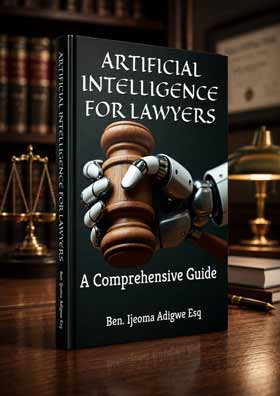 The book also examines Nigeria's legal ecosystem, focusing on the LPELR and NBA AI Guidelines. As a bonus, every purchase comes with a FREE eBook titled: How to Use the AI Features in LegalPedia and LawPavilion.
Ohio Books Ltd praises the publication, stating:
"....this is the only Nigerian book I know of on the topic."
How to Order:
📞 Call, Text, or WhatsApp: 08034917063 | 07055285878
📧 Email: benadigwe1@gmail.com
🌎 Website: www.benadigwe.com
Ebook Version: Access it directly online at https://selar.com/prv626
Authored by Ben Ijeoma Adigwe Esq., ACIarb (UK), LL.M, Dip. in Artificial Intelligence, Director at the Delta State Ministry of Justice, Asaba, Nigeria.
______________________________________________________________________
The book also examines Nigeria's legal ecosystem, focusing on the LPELR and NBA AI Guidelines. As a bonus, every purchase comes with a FREE eBook titled: How to Use the AI Features in LegalPedia and LawPavilion.
Ohio Books Ltd praises the publication, stating:
"....this is the only Nigerian book I know of on the topic."
How to Order:
📞 Call, Text, or WhatsApp: 08034917063 | 07055285878
📧 Email: benadigwe1@gmail.com
🌎 Website: www.benadigwe.com
Ebook Version: Access it directly online at https://selar.com/prv626
Authored by Ben Ijeoma Adigwe Esq., ACIarb (UK), LL.M, Dip. in Artificial Intelligence, Director at the Delta State Ministry of Justice, Asaba, Nigeria.
______________________________________________________________________