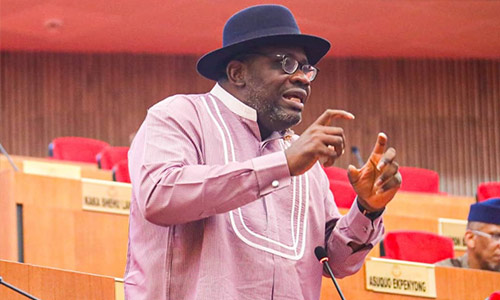
The Nigerian Senate has defended its latest amendments to the Electoral Act, insisting that the changes serve the best interest of the country, even as a member of the Senate Committee on Electoral Matters declared that Nigeria has not reached a stage where electronic voting can be implemented at polling units.


During an emergency plenary on Tuesday, the upper legislative chamber reversed its earlier rejection of electronic transmission of election results and approved a new provision allowing presiding officers at polling units to electronically transmit results to the Independent National Electoral Commission’s (INEC) Result Viewing Portal (IREV). However, the amendment notably omits the phrase “real-time” and retains Form EC8A as the primary document for result collation in cases where internet connectivity fails.
The decision has drawn sharp criticism from opposition figures, civil society groups and election transparency advocates, who argue that retaining a manual backup component could undermine the credibility of future elections.
Speaking on Channels Television’s Politics Today on Tuesday, Senate spokesman and Ekiti South lawmaker, Senator Yemi Adaramodu, dismissed the criticism as overblown.
“Anyone who loves Nigeria will know that what we have done today is the best for Nigeria,” Adaramodu said.
He described critics of the amendment as “melodramatic” and stressed that lawmaking demands thoroughness and careful deliberation.
“We don’t play to the gallery. The minor minority that are so melodramatic about it — we don’t look at them to make laws because principles of lawmaking are not just something like eating amala,” Adaramodu said.
He further stated that the Senate would not be intimidated over the real-time transmission debate, adding that the legislative process was rigorous and consultative.
“We don’t do something that we just wake up just on impulse and just say something, and then you say you have made a law. You have to be very thorough. You have to be very painstaking,” the senator said.
“It must be so painstakingly done that the flaws must not be so latent to the extent that it can repudiate whatever good trust that Nigerians will have in our system.”
Adaramodu argued that the differing opinions generated by the amendment reflect the health of Nigeria’s democracy.
“Like we know in Nigeria, and everywhere else where democracy is thriving — and we want democracy to thrive — there will be shades of opinions. There will be shadows of ideas, and then we have to listen to all. So that’s what happened,” he added.
Meanwhile, Senator Seriake Dickson, a member of the Senate Committee on Electoral Matters, cautioned against what he described as an overemphasis on “real-time” transmission of election results.
Speaking on ARISE News amid the ongoing debates, Dickson argued that the country’s electoral credibility cannot be guaranteed merely by adopting electronic voting technology or fixating on real-time result uploads.
“The country is not operating real-time electronic voting. The notion and fixation of real-time shouldn’t be because that is not something we are practising,” Dickson said.
He maintained that transparency in elections goes beyond technological buzzwords and that the constant reference to “real-time” transmission is misplaced.
The amendment has continued to generate strong reactions across the political spectrum. Some stakeholders are demanding the removal of the manual backup clause entirely, arguing it opens the door for manipulation. Others defend it as a necessary safeguard against the reality of Nigeria’s uneven internet infrastructure and the risk of technical failures on election day.
The development comes amid heightened national attention on electoral reforms ahead of future general elections, with Nigerians closely watching whether the revised Electoral Act will strengthen or weaken confidence in the country’s democratic process.
 The book also examines Nigeria's legal ecosystem, focusing on the LPELR and NBA AI Guidelines. As a bonus, every purchase comes with a FREE eBook titled: How to Use the AI Features in LegalPedia and LawPavilion.
Ohio Books Ltd praises the publication, stating:
"....this is the only Nigerian book I know of on the topic."
How to Order:
📞 Call, Text, or WhatsApp: 08034917063 | 07055285878
📧 Email: benadigwe1@gmail.com
🌎 Website: www.benadigwe.com
Ebook Version: Access it directly online at https://selar.com/prv626
Authored by Ben Ijeoma Adigwe Esq., ACIarb (UK), LL.M, Dip. in Artificial Intelligence, Director at the Delta State Ministry of Justice, Asaba, Nigeria.
_______________________________________________________________________
The book also examines Nigeria's legal ecosystem, focusing on the LPELR and NBA AI Guidelines. As a bonus, every purchase comes with a FREE eBook titled: How to Use the AI Features in LegalPedia and LawPavilion.
Ohio Books Ltd praises the publication, stating:
"....this is the only Nigerian book I know of on the topic."
How to Order:
📞 Call, Text, or WhatsApp: 08034917063 | 07055285878
📧 Email: benadigwe1@gmail.com
🌎 Website: www.benadigwe.com
Ebook Version: Access it directly online at https://selar.com/prv626
Authored by Ben Ijeoma Adigwe Esq., ACIarb (UK), LL.M, Dip. in Artificial Intelligence, Director at the Delta State Ministry of Justice, Asaba, Nigeria.
_______________________________________________________________________
“Order Justice Omolaye-Ajileye’s Electronic Evidence Books Now” — Essential Guides On Evidence Act, Case Law And Digital Proof
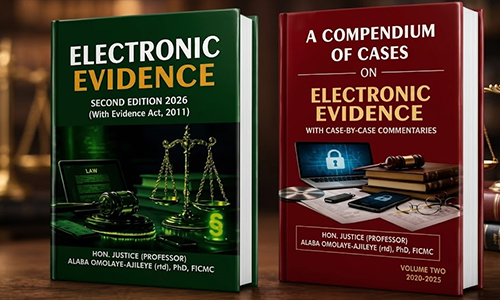

 Interested buyers are encouraged to place their orders and enquiries via:
0704 444 4777, 0704 444 4999, 0818 199 9888
Website: www.alexandernigeria.com
Interested buyers are encouraged to place their orders and enquiries via:
0704 444 4777, 0704 444 4999, 0818 199 9888
Website: www.alexandernigeria.com