By Dr. O. G. Ogbom, Esq.
Abstract
Taxation in Nigeria is strictly a creation of statute, and the liability of taxpayers arises only within the confines of enabling legislation. In recent years, increased revenue drives by tax authorities have resulted in heightened scrutiny of taxpayers’ affairs, making lawful tax planning more critical than ever. This case and statutory review examines the legal mechanisms available for the minimisation of tax liability in Nigeria, with particular reference to the Personal Income Tax Act, Companies Income Tax Act, and recent fiscal reforms. The paper analyses relevant judicial and Tax Appeal Tribunal decisions that clarify the scope of allowable deductions, reliefs, capital allowances, and limitation periods for tax assessments. It further distinguishes lawful tax avoidance from impermissible tax evasion, highlighting interpretative principles adopted by Nigerian courts in resolving tax disputes. The review demonstrates that effective tax planning depends not only on a technical understanding of statutory provisions but also on procedural compliance and proper documentation. It concludes that Nigerian tax law, when correctly applied, offers substantial opportunities for lawful tax minimisation, while underscoring the importance of judicial oversight in maintaining the balance between revenue generation and taxpayer protection.
Keywords: Tax planning; Tax avoidance; Nigerian tax law; Capital allowances; Tax Appeal Tribunal
- Introduction
Tax liability in Nigeria is imposed strictly by statute, and no tax may be levied or collected except in accordance with the law. This foundational principle has been consistently upheld by Nigerian courts and underpins all discussions on tax planning. The distinction between lawful tax avoidance and unlawful tax evasion remains central to professional tax practice. While evasion attracts civil and criminal sanctions, avoidance when properly structured is recognised as legitimate.
The current tax environment, characterised by aggressive audits and revenue expansion policies, has increased the relevance of statutory interpretation and judicial precedent in determining the limits of lawful tax minimisation.
- Statutory Framework for Tax Liability
The principal statutes governing direct taxation in Nigeria include the **Personal Income Tax Act (PITA)¹ and the Companies Income Tax Act (CITA)². These statutes define taxable persons, chargeable income, exemptions, allowable deductions, and applicable reliefs.
Under PITA, tax is imposed on individuals, partnerships, trustees, and estates in respect of income accruing in, derived from, or brought into Nigeria.³ CITA imposes tax on the profits of companies accruing in or derived from Nigeria.⁴ In both regimes, taxable income is not synonymous with gross receipts; rather, it is net income determined after statutory deductions and reliefs.
- Personal Income Tax: Reliefs and Exemptions
One of the most significant tax-minimisation mechanisms under PITA is the Consolidated Relief Allowance (CRA). Section 33 of PITA provides for a combination of a fixed relief and a percentage of gross income, thereby reducing chargeable income.
In Citibank Nigeria Ltd v Lagos State Internal Revenue Service,⁵ the Tax Appeal Tribunal clarified that only income items falling within the statutory definition of “gross income” may be aggregated for CRA computation. Statutorily exempt income listed under the Third Schedule to PITA, including severance benefits for loss of employment, does not form part of gross income for this purpose. This decision reinforces the principle that tax authorities cannot expand liability beyond express statutory language.
- Corporate Tax Planning and Capital Allowances
Capital allowances constitute a major relief under CITA. Section 24 and the Second Schedule to CITA permit companies to deduct qualifying capital expenditure in arriving at assessable profits. Capital allowances are designed to encourage investment and prevent double taxation of capital.
In Ardova Plc v Federal Inland Revenue Service,⁶ the Tribunal held that a taxpayer is not obliged to claim the maximum allowable capital allowance in any given year of assessment. The decision affirms that capital allowance claims are elective, allowing companies to strategically manage taxable profits, provided statutory limits are observed.
- Allowable Deductions and the WREN Test
Section 24 of CITA allows deductions for expenses that are wholly, exclusively, reasonably and necessarily (WREN) incurred in the production of taxable income. The application of this test has been judicially considered in several cases.
In Tetra Pak West Africa Ltd v FIRS,⁷ demurrage charges incurred due to port congestion were held to be deductible, as they satisfied the WREN criteria despite arising from operational inefficiencies. This case demonstrates the courts’ pragmatic approach to business realities when interpreting deductible expenses.
- Limitation Periods and Tax Assessments
Statutory limitation periods serve as an important taxpayer protection. Section 66 of PITA restricts the period within which tax authorities may raise additional assessments, except in cases of fraud, wilful default, or neglect.
In Citibank Nigeria Ltd v Rivers State Board of Internal Revenue,⁸ the Tribunal held that the burden rests on the tax authority to prove fraud or wilful default before reopening time-barred assessments. This decision underscores the importance of procedural safeguards in tax administration.
- Distinction Between Avoidance and Evasion
Nigerian tax jurisprudence maintains a clear distinction between lawful tax avoidance and unlawful evasion. Courts have consistently held that a taxpayer is entitled to arrange affairs to minimise tax exposure, provided the arrangement complies with statutory provisions.
The judicial approach aligns with the long-standing common law principle that taxing statutes must be construed strictly, and ambiguities resolved in favour of the taxpayer.
- Conclusion
This review demonstrates that Nigerian tax law provides structured and lawful mechanisms for the minimisation of tax liability through reliefs, allowances, deductions, and procedural protections. Judicial and tribunal decisions play a critical role in clarifying statutory intent and restraining administrative excesses. Effective tax planning in Nigeria therefore requires not only statutory literacy but also a sound appreciation of judicial interpretation and compliance obligations.
- Personal Income Tax Act, Cap P8, Laws of the Federation of Nigeria 2004 (as amended).
- Companies Income Tax Act, Cap C21, Laws of the Federation of Nigeria 2004 (as amended).
- PITA, s 3.
- CITA, s 9.
- Citibank Nigeria Ltd v Lagos State Internal Revenue Service (2019) TAT/LZ/PIT/019.
- Ardova Plc v Federal Inland Revenue Service (2021) TAT/LZ/CIT/021.
- Tetra Pak West Africa Ltd v Federal Inland Revenue Service (2018) TAT/LZ/CIT/012.
- Citibank Nigeria Ltd v Rivers State Board of Internal Revenue (2020) TAT/PH/PIT/004.
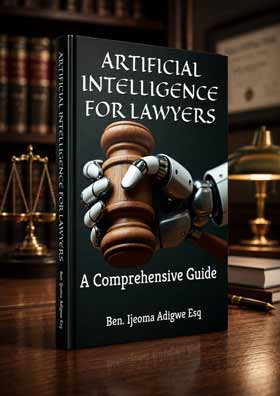 The book also examines Nigeria's legal ecosystem, focusing on the LPELR and NBA AI Guidelines. As a bonus, every purchase comes with a FREE eBook titled: How to Use the AI Features in LegalPedia and LawPavilion.
Ohio Books Ltd praises the publication, stating:
"....this is the only Nigerian book I know of on the topic."
How to Order:
📞 Call, Text, or WhatsApp: 08034917063 | 07055285878
📧 Email: benadigwe1@gmail.com
🌎 Website: www.benadigwe.com
Ebook Version: Access it directly online at https://selar.com/prv626
Authored by Ben Ijeoma Adigwe Esq., ACIarb (UK), LL.M, Dip. in Artificial Intelligence, Director at the Delta State Ministry of Justice, Asaba, Nigeria.
_______________________________________________________________________
“Enhance Legal Practice With Authoritative Reports” — Alexander Payne Offers Comprehensive Law Reports, Spanning Over A Century Of Nigerian Jurisprudence
The book also examines Nigeria's legal ecosystem, focusing on the LPELR and NBA AI Guidelines. As a bonus, every purchase comes with a FREE eBook titled: How to Use the AI Features in LegalPedia and LawPavilion.
Ohio Books Ltd praises the publication, stating:
"....this is the only Nigerian book I know of on the topic."
How to Order:
📞 Call, Text, or WhatsApp: 08034917063 | 07055285878
📧 Email: benadigwe1@gmail.com
🌎 Website: www.benadigwe.com
Ebook Version: Access it directly online at https://selar.com/prv626
Authored by Ben Ijeoma Adigwe Esq., ACIarb (UK), LL.M, Dip. in Artificial Intelligence, Director at the Delta State Ministry of Justice, Asaba, Nigeria.
_______________________________________________________________________
“Enhance Legal Practice With Authoritative Reports” — Alexander Payne Offers Comprehensive Law Reports, Spanning Over A Century Of Nigerian Jurisprudence
 Interested buyers are encouraged to place their orders and enquiries via:
0704 444 4777, 0704 444 4999, 0818 199 9888
Website: www.alexandernigeria.com
Interested buyers are encouraged to place their orders and enquiries via:
0704 444 4777, 0704 444 4999, 0818 199 9888
Website: www.alexandernigeria.com