By Habeeb Gobir, Esq

On 22 December 2025, the Court of Appeal delivered its judgment in Amanyi Mohammed v. Sproxil Nigeria Ltd & Ors, affirming the decision of the Federal High Court which dismissed the Appellant’s claims for copyright infringement in respect of a work described as the “Zapper Anti-Piracy Code”.
The appeal was resolved on the Appellant’s failure to establish copying. The Court approached the case through settled copyright principles, particularly the idea–expression dichotomy and the requirement of originality, and found that the Appellant’s complaint was directed at an unprotectable idea rather than protectable expression.
While the judgment itself does not acknowledge any particular difficulty in applying these principles, it nevertheless provides a useful basis for examining how traditional copyright concepts operate when applied to technical and system-based works. The reasoning of the Court invites closer scrutiny of whether an analysis that is sufficient for non-technical works is equally adequate in cases involving functional and technical creativity.
This article reviews the decision of the Court of Appeal and considers what it reveals, perhaps unintentionally, about the current limits of copyright protection for functional works in Nigeria.
Brief Facts of the Case
The Appellant, Amanyi Mohammed, claimed copyright over a work titled “Zapper Anti-Piracy Code“, which he described as a literary work in the form of a computer programme. His grievance was that the Respondents, particularly Sproxil Nigeria Limited and others, infringed his copyright by deploying a mobile-based authentication system that allegedly replicated his work. At the Federal High Court, his claims were dismissed. On appeal, the Court of Appeal affirmed that dismissal.
At first glance, the judgment reads like a straightforward application of settled copyright principles. On closer examination, however, it exposes unresolved tensions in Nigerian copyright law, particularly around idea versus expression and the meaning of originality in functional works.
The Court’s Core Reasoning
The Court’s reasoning can be distilled into three main findings.
First, the Court held that copyright protects expression, not ideas. The Appellant’s complaint, in the Court’s view, was really about the Respondents adopting a similar idea for product authentication using mobile phones, rather than copying the Appellant’s actual literary expression.
Second, the Court found that the Appellant failed to prove copying. Throughout cross-examination, he could not identify any specific words, structure, presentation, or portion of his work that had been reproduced by the Respondents. Assertions that “the entire work” was copied or that it appeared in a newspaper article were not supported by evidence.
Third, the Court held that the Appellant’s work lacked originality, partly because similar authentication methods were already in use internationally and in Nigeria before the Appellant allegedly conceived the idea. On this basis, the Court concluded that the work did not qualify for copyright protection.
On these grounds, the Court rejected reliance on the presumption of infringement under section 43 of the Copyright Act and dismissed the appeal.
Idea Versus Expression: A Correct Principle, Too Easily Applied
There is no dispute that the law draws a distinction between ideas and expression. That principle is foundational. Two people can take the same idea and express it differently, and each expression may be protected. However, this case exposes how unsatisfactory that distinction can become when applied mechanically to technical or system-based works.
The Court kept repeating the familiar line that copyright protects expression and not idea. As a general rule, that statement is correct. In fact, in many cases involving novels, essays, music, or other non-technical works, stopping at that principle is often enough. In those kinds of works, expression is usually obvious. You can see it in the words, the style, the arrangement, and the overall presentation.
But this case was not about a poem or a novel. It was about a technical, system-based work.
Once the work in issue is technical, the analysis cannot stop at the idea versus expression label. Expression in technical works is rarely about elegant language. It usually lies in how the system is structured, how its components interact, the sequence of steps it follows, and the logic through which it produces its result. Computer programs are even expressly recognised as literary works under section 2 of the Copyright Act, which already tells us that the law accepts that expression in such works will look different.
When another system mirrors these elements closely, even if dressed in different language or code, it becomes difficult to say that only an “idea” has been taken.
The Court did not engage with this complexity. Instead, it treated the Appellant’s complaint as a simple attempt to monopolise an idea. While that may ultimately be a fair characterisation of how the case was presented, it avoids the harder question: how much re-expression is enough before appropriation becomes unfair?
If copyright protection allows someone to take another person’s carefully developed conceptual framework and simply re-express it in a different form, then the protection risks becoming illusory for creators of functional works.
Copyright law has also never said that copying must be literal. You do not need to reproduce a paragraph or line of code word for word before infringement can arise. What matters is whether a substantial part of the work has been taken. That principle is well settled and has long been accepted by Nigerian courts following authorities like Francis Day & Hunter Ltd v. Bron [1963] Ch. 587 (Eng.), where the court made it clear that infringement is about substance, not exact duplication.
Explaining the Doctrines the Court Did Not Engage With
There are established doctrines applicable to functional and technical works which the Court did not consider in its judgment. In cases involving functional and technical works, certain well-recognised doctrines guide the assessment of copyright infringement. Let’s examine some of these doctrines:
- Non-Literal Copying:
Non-Literal Copying is a copyright doctrine often used by Courts in other jurisdictions. The doctrine provides that, copyright infringement does not require verbatim reproduction. A work can be infringed even where no sentence, line of code, or paragraph is copied word for word. This is what is referred to as non-literal copying.
Non-literal copying recognises that expression can exist beyond the surface form of a work. In technical and system-based works, especially computer programs, expression often lies in the arrangement of components, the sequence of operations, the internal logic of the system, and the way different elements interact to achieve a result.
Nigerian copyright law supports this approach. Section 2 of the Copyright Act recognises literary works, including computer programs, and protects them once they are fixed and original. Nothing in the Act limits protection to literal text alone.
Although Nigerian courts have not fully developed a standalone doctrine of non-literal copying in software cases, the principle is implicit in decisions such as Francis Day & Hunter Ltd v. Bron (1963) Ch 587, which Nigerian courts have repeatedly relied on. In that case, the court held that infringement depends on whether the defendant has taken a substantial part of the plaintiff’s work, not whether the copying is exact.
The key point is that copyright looks at substance, not disguise.
In this case, the Court focused almost entirely on the absence of verbatim copying. It did not ask whether the Respondents may have taken the Appellant’s expressive structure or system logic. .
- Substantial Similarity
Closely linked to non-literal copying is the doctrine of substantial similarity. Substantial similarity asks a simple question: has the defendant taken so much of the plaintiff’s protected expression that the later work is, in substance, derived from the earlier one? This does not mean the works must be identical. It means the similarities must relate to protected expression, not merely to ideas, themes, or functional outcomes.
In Designers Guild Ltd v. Russell Williams (Textiles) Ltd (2000) 1 WLR 2416, the House of Lords made it clear that courts must look at the cumulative effect of similarities and determine whether what was taken represents a substantial part of the claimant’s work. Nigerian courts regularly rely on this principle.
Applied to technical works, substantial similarity does not focus on outcomes alone, but on whether the underlying expressive choices, such as workflow, structure, and architecture, have been replicated.
In Amanyi Mohammed v. Sproxil Nigeria Ltd & Ors, the Court framed the issue as one of shared ideas rather than shared substance. It did not ask whether the Respondents’ system was substantially similar to the Appellant’s work in its expressive framework. That inquiry was never undertaken.
- Abstraction Analysis
Closely connected to this is abstraction analysis. Once you are dealing with technical works, the court has to step back and strip the work down in layers. You separate what is purely functional or inevitable from what reflects personal choice and creative judgment. At each level, it asks what elements are purely functional or inevitable, and what elements reflect creative choice.
This approach was articulated clearly in Computer Associates International Inc v. Altai Inc (1992) 982 F.2d 693 (2d Cir), a leading software copyright case. While this is a United States decision, its reasoning has been influential globally in software copyright analysis.
The process works in three broad stages:
– First, abstract the work into its constituent structural elements.
– Second, filter out elements dictated by efficiency, industry standards, or functional necessity.
– Third, compare what remains to see whether protected expressive elements have been taken.
Nothing in Nigerian copyright law prevents such an approach. Section 2 of the Copyright Act protects expression, and abstraction analysis is simply a tool for identifying what qualifies as expression in complex works.
In this case, the Court did not attempt any abstraction at all. It did not separate functional elements from potentially creative ones. It treated the system as a single undifferentiated idea, which short-circuited deeper analysis.
- The Merger Principle
The merger principle operates as a limiting doctrine.
It applies where an idea can only be expressed in one way, or in very few ways. In such cases, copyright protection is denied because protecting the expression would effectively grant monopoly over the idea itself.
But where there are multiple ways to design a system, and an author chooses a particular structure, sequence, or arrangement, that choice can attract protection. The Court in this case did not ask whether mobile authentication systems could be designed in different ways, or whether the Appellant’s work reflected discretionary choices beyond technical necessity. That inquiry would have determined whether the Appellant’s expression merged with the idea or stood apart from it.
That said, all of this does not save the Appellant.
Even if the Court had gone into substantial similarity, non-literal copying, abstraction, or merger, the Appellant still did not give the Court anything solid to work with. He did not break his work down. He did not show which parts were creative choices and which parts were just functional. He did not explain how those same choices appeared in the Respondents’ system.
At the end of the day, courts cannot do that work for a party. They cannot guess. They cannot build a case that was not properly presented to them.
So the real problem here is not that the Court does not understand copyright law. It is that the Court applied only the most basic layer of it, largely because the Appellant never pushed the case beyond that level.
Originality and the Slippery Use of “State of the Art”
The more troubling aspect of the judgment lies in its treatment of originality.
Copyright originality is not novelty. Unlike patent law, copyright does not ask whether a work is new to the world. It asks whether the work originated from the author and involved sufficient skill, labour, and judgment.
A work does not lose originality merely because similar ideas existed elsewhere, whether in another country or another industry. What matters is whether the author copied.
The Court reliance on evidence that similar authentication systems existed before the Appellant’s work is a subtly importation of a patent-style reasoning into copyright analysis. The language of “state of the art” sits uncomfortably in copyright law.
Where the Appellant Truly Failed
Despite these concerns, it is difficult to fault the outcome of the case. The Appellant failed at a basic evidential level. He did not:
- identify the specific expressive elements of his work,
- distinguish creative choices from functional necessities,
- demonstrate non-literal copying through structure or logic, or
- provide expert evidence to guide the Court.
Instead, his case remained framed around the assertion that the Respondents used his idea. Nigerian courts, quite rightly, will not speculate or reconstruct a party’s case for them. Even a court inclined to adopt a more nuanced approach to non-literal copying could not have done so on the evidence before it.
The Notification Certificate Point
The Court was clearly correct in holding that the Nigerian Copyright Commission notification certificate does not confer validity or ownership of copyright. It merely acknowledges that a work has been notified. This aspect of the judgment aligns with settled law and avoids a dangerous misunderstanding that continues to surface in practice.
Final Thoughts
This judgment is both sound and unsatisfying. Sound, because the Appellant failed to prove infringement and the Court was right to dismiss the claim.
Unsatisfying, because it highlights how poorly current copyright doctrine accommodates modern, functional, system-based creativity. The law protects drafting more easily than thinking. It is far easier to protect prose than architecture, logic, or technical design.
Until Nigerian courts develop a clearer framework for analysing non-literal copying in technical works, creators in these spaces will continue to fall into a gap, not because their work lacks creativity, but because the law struggles to see it.
About the Author
Habeeb Gobir is a Nigerian lawyer with a practice focus on intellectual property, technology, and commercial law. He has a particular interest in the intersection of copyright law and emerging technologies, and regularly writes on the practical and doctrinal challenges posed by modern, system-based innovation under Nigerian law.
He can be reached via: Habeebgobir2@gmail.com or WhatsApp: +234 8108527278
 Interested buyers are encouraged to place their orders and enquiries via:
0704 444 4777, 0704 444 4999, 0818 199 9888
Website: www.alexandernigeria.com
Interested buyers are encouraged to place their orders and enquiries via:
0704 444 4777, 0704 444 4999, 0818 199 9888
Website: www.alexandernigeria.com

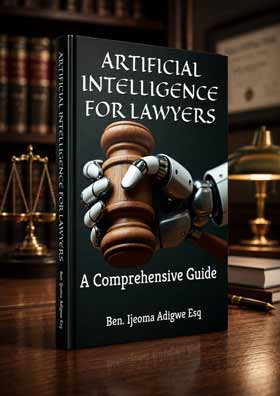 The book also examines Nigeria's legal ecosystem, focusing on the LPELR and NBA AI Guidelines. As a bonus, every purchase comes with a FREE eBook titled: How to Use the AI Features in LegalPedia and LawPavilion.
Ohio Books Ltd praises the publication, stating:
"....this is the only Nigerian book I know of on the topic."
How to Order:
📞 Call, Text, or WhatsApp: 08034917063 | 07055285878
📧 Email: benadigwe1@gmail.com
🌎 Website: www.benadigwe.com
Ebook Version: Access it directly online at https://selar.com/prv626
Authored by Ben Ijeoma Adigwe Esq., ACIarb (UK), LL.M, Dip. in Artificial Intelligence, Director at the Delta State Ministry of Justice, Asaba, Nigeria.
_______________________________________________________________________
The book also examines Nigeria's legal ecosystem, focusing on the LPELR and NBA AI Guidelines. As a bonus, every purchase comes with a FREE eBook titled: How to Use the AI Features in LegalPedia and LawPavilion.
Ohio Books Ltd praises the publication, stating:
"....this is the only Nigerian book I know of on the topic."
How to Order:
📞 Call, Text, or WhatsApp: 08034917063 | 07055285878
📧 Email: benadigwe1@gmail.com
🌎 Website: www.benadigwe.com
Ebook Version: Access it directly online at https://selar.com/prv626
Authored by Ben Ijeoma Adigwe Esq., ACIarb (UK), LL.M, Dip. in Artificial Intelligence, Director at the Delta State Ministry of Justice, Asaba, Nigeria.
_______________________________________________________________________