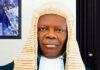
Senior Advocate of Nigeria, Oba Maduabuchi, has stated that corruption within Nigeria’s judiciary did not originate from judges but was largely driven by desperate politicians and litigants, particularly during the 2003 general elections when political actors were determined to retain power at all costs.


Speaking on Arise News Night on Monday, Maduabuchi reacted to recent allegations by Justice Emeka Nwite of the Federal High Court, who complained in open court that unnamed lawyers and litigants had attempted to influence him in the ongoing N8.7 billion money laundering trial involving former Attorney-General of the Federation, Abubakar Malami (SAN).
According to Maduabuchi, while corruption undeniably exists in the judiciary, it is often exaggerated and misunderstood, with responsibility unfairly placed solely on judges.
“There is corruption in the judiciary. If I say no, I will be telling myself lies,” he said. “But the judiciary does not corrupt itself. It is people who go to corrupt the judiciary.”
He traced the deepening of judicial corruption to the political climate of 2003, when electoral desperation reached alarming levels.
“The corruption started from politicians who were desperate. In 2003, when the PDP wanted to retain power by all means, that was when corruption assumed very unpleasant proportions,” he said, noting that former President Olusegun Obasanjo was unpopular at the time and political pressure on the courts intensified.
Maduabuchi explained that this development negatively affected lawyers who relied strictly on legal scholarship and courtroom advocacy.
“Those of us who read our books and prepare our cases began to lose out to those who know how to approach judges,” he said.
He identified two categories of lawyers in Nigeria’s legal system.
“There are lawyers who know the law, and there are lawyers who know the judge,” he said. “If you are a lawyer who knows the law, you limit yourself to the courtroom. But if you are one who knows the judge, when you charge your fees, you include what you will pass on to the judge.”
While acknowledging corruption, he emphasised that many judges still demonstrate integrity and reject improper approaches.
“There are judges who will laugh at you and say, ‘Please, when I finish, if you like, come and show gratitude,’” he said, adding that even such statements should be discouraged.
On Justice Nwite’s public allegation, Maduabuchi expressed strong reservations, describing it as ill-advised and damaging.
“It is a very unfortunate statement to make because it leaves too much to the imagination,” he said. “How did they get into his house? A judge has orderlies. He lives in a gated house. Before anyone enters, the gate man must inform him.”
He stressed that judicial ethics forbid a judge from seeing a lawyer handling a matter before him without the opposing counsel present.
“If lawyers came to his house to discuss a case before him, the first blame goes to the judge who allowed them,” he said. “Under our ethics, a judge should never see one side alone.”
Maduabuchi further questioned why anyone would believe the judge was approachable in the first place.
“What gave them the impression that this judge is amenable?” he asked.
On the Malami case, he argued that Justice Nwite should consider stepping aside to preserve the integrity of the proceedings.
“With this development, Justice Nwite should recuse himself,” he said. “Otherwise, there will be speculation everywhere. People will begin to ask questions.”
He noted that the judge raised the allegation after granting bail in a case involving serious allegations, including terrorism financing, which could fuel public suspicion.
“If he didn’t collect anything, people will ask why he granted bail,” Maduabuchi said. “Once you make such a statement, speculation is inevitable.”
On the role of the National Judicial Council (NJC), he said the body’s hands were tied because no names were mentioned.
“The NJC cannot investigate shadows,” he said. “No judge, no lawyer, no person was named.”
He added that corruption allegations in the judiciary are often linked to political cases rather than routine legal matters.
“When you hear corruption, it is usually political cases,” he said.
Maduabuchi identified political interference in judicial appointments as a root cause of systemic problems and stressed the need for structural reform.
“How do you clean up the judiciary? You change how judges are appointed,” he said.
He acknowledged recent improvements, including publicising the names of prospective judges to allow for objections, similar to the process for appointing Senior Advocates of Nigeria.
“That process recently pruned away about 34 or 35 people,” he noted.
He also proposed aggressive monitoring by security agencies, particularly in high-profile cases.
“When a judge is handling a sensitive case like Malami’s, his phone should be bugged,” he said. “The DSS should listen. If nothing happens, you stop. But if they hear arrangements being made, you trail the person and catch them with a smoking gun.”
According to him, concerns about invasion of privacy should not override the need to protect the integrity of the justice system.
“When someone is handling a political case or sitting as a tribunal chairman, I don’t see why you shouldn’t bug him,” he said.
Maduabuchi further cautioned against casting aspersions on senior lawyers involved in the case, noting that Malami’s defence counsel, Chief Joseph Daudu (SAN), is widely respected.
“J.B. Daudu will not go and give a judge bribe,” he said, adding that Justice Nwite’s remarks unfairly cast suspicion on unnamed counsel.
He warned that the judge’s comments had broader ramifications.
“There are five senior advocates in that case. Which one did he mean?” he asked. “That statement is deeper than it appears.”
On allegations that corruption extends to the Supreme Court, Maduabuchi defended the apex court, describing it as both a court of justice and policy.
“The Supreme Court sometimes gives judgments to stabilise the polity,” he said, citing the famous 1979 presidential election case, where the court explicitly warned that its decision should not be cited as precedent.
He argued that ambiguous judgments are not always a product of corruption but may reflect judicial policy choices.
“There is corruption, yes, but not as widespread as people say,” he maintained.
On judges’ welfare, Maduabuchi acknowledged historical challenges but said improved remuneration alone cannot eliminate corruption.
“In the past, judges’ salaries were so poor that lawyers filled their fuel tanks,” he recalled. “But even today, whoever wants to be corrupt will be corrupt, regardless of what you give them.”
He concluded by stressing that Nigeria still has upright judges and that sweeping generalisations only damage public confidence.
“As Justice Nwite himself said, all judges are not the same,” Maduabuchi said.
[A MUST HAVE] Evidence Act Demystified With Recent And Contemporary Cases And Materials

Available now for NGN 40,000 at ASC Publications, 10, Boyle Street, Onikan, Lagos. Beside High Court, TBS. Email publications@ayindesanni.com or WhatsApp +2347056667384. Purchase Link: https://paystack.com/buy/evidence-act-complete-annotation
______________________________________________________________________ “Enhance Legal Practice With Authoritative Reports” — Alexander Payne Offers Comprehensive Law Reports, Spanning Over A Century Of Nigerian Jurisprudence Interested buyers are encouraged to place their orders and enquiries via:
0704 444 4777, 0704 444 4999, 0818 199 9888
Website: www.alexandernigeria.com
Interested buyers are encouraged to place their orders and enquiries via:
0704 444 4777, 0704 444 4999, 0818 199 9888
Website: www.alexandernigeria.com
 The book also examines Nigeria's legal ecosystem, focusing on the LPELR and NBA AI Guidelines. As a bonus, every purchase comes with a FREE eBook titled: How to Use the AI Features in LegalPedia and LawPavilion.
Ohio Books Ltd praises the publication, stating:
"....this is the only Nigerian book I know of on the topic."
How to Order:
📞 Call, Text, or WhatsApp: 08034917063 | 07055285878
📧 Email: benadigwe1@gmail.com
🌎 Website: www.benadigwe.com
Ebook Version: Access it directly online at https://selar.com/prv626
Authored by Ben Ijeoma Adigwe Esq., ACIarb (UK), LL.M, Dip. in Artificial Intelligence, Director at the Delta State Ministry of Justice, Asaba, Nigeria.
______________________________________________________________________
The book also examines Nigeria's legal ecosystem, focusing on the LPELR and NBA AI Guidelines. As a bonus, every purchase comes with a FREE eBook titled: How to Use the AI Features in LegalPedia and LawPavilion.
Ohio Books Ltd praises the publication, stating:
"....this is the only Nigerian book I know of on the topic."
How to Order:
📞 Call, Text, or WhatsApp: 08034917063 | 07055285878
📧 Email: benadigwe1@gmail.com
🌎 Website: www.benadigwe.com
Ebook Version: Access it directly online at https://selar.com/prv626
Authored by Ben Ijeoma Adigwe Esq., ACIarb (UK), LL.M, Dip. in Artificial Intelligence, Director at the Delta State Ministry of Justice, Asaba, Nigeria.
______________________________________________________________________