*Warns BVN Data Will Detect Evasion Patterns

Tax Identification Numbers (TINs) are not required for strictly personal bank accounts under Nigeria’s new tax reforms. They become mandatory only if the account is used for business transactions, according to the clarification by the Presidential Committee on Fiscal Policy and Tax Reforms.
Chairman of the committee, Taiwo Oyedele, explained this during a session with the management of LEADERSHIP Newspaper in Abuja over the weekend. He advised bank customers to conduct a self-assessment, noting that authorities can detect business-related activity through Bank Verification Number (BVN) patterns.
He stated that individuals using personal bank accounts for business transactions must obtain a TIN, adding that tax authorities leveraging BVN data can detect evasion patterns such as multiple random inflows from customers and outflows to suppliers.
“You need a tax ID for your bank account if that bank account is used for business transactions. If you are not using your account for business, you do not need to attach your tax ID. If you do not get your tax ID, the authorities will know.”
According to him, the requirement is rooted in the 2020 Finance Act, effective from 13 January 2020. It now carries more weight due to new digital intelligence systems that identify business activity in personal accounts, including those belonging to spouses or children used to hide income. He said this ensures compliant taxpayers are not disadvantaged.
Oyedele emphasized self-compliance. “If you know that you are using your account for business, get a tax ID. If you do not get a tax ID, because we have your BVN, we can find out,” he warned. He added that flagged accounts trigger strict tax enforcement.
“When the system detects that different random people are paying into the account and you are also paying various random people, maybe your suppliers, the authorities will know that this is a business account. The tax man will come to you, and it will not be friendly at that point, because it means you have not been honest.”
He noted that some banks already enforce this rule proactively.
The measure targets evasion by individuals who channel business revenue through personal accounts to avoid taxes. He said this undermines the progressivity being introduced, which exempts low earners up to N100,000 monthly from Pay As You Earn (PAYE) beginning January 2026, while ensuring higher earners pay their fair share.
“If we agree that poor people should not pay, let them not pay. Do not allow rich people to hide, because the system will collapse,” he said.
Oyedele lamented the widespread misinformation surrounding the new tax regime, set to take effect on 1 January 2026.
“If you go on the street now and ask any young person, they will tell you there is a 30 per cent tax in the capital market, because that is what they have been told,” he said.
He highlighted reforms aimed at boosting capital market participation and attracting investment. These reforms exempt portfolios and sales under N150 million, which covers about 99 per cent of investors, from capital gains tax. This encourages small and medium investors to participate without tax pressure.
He explained that if an investor’s portfolio or share sales do not exceed N150 million in a year, they are exempt from capital gains tax. Reinvestments made by foreign investors are also exempt, encouraging long-term investments.
Bonus shares are now exempt from withholding tax, while stamp duties on share transfers have been abolished, reducing transaction costs and encouraging trading.
He said these investor-friendly reforms are producing measurable results, with foreign portfolio inflows into the Nigerian capital market reaching N2.1 trillion as of October 2025.
Foreign investors who exited the market around 2022 have begun returning in large numbers, he added, reflecting renewed confidence. Despite this, he noted that the average age of investors remains 45, suggesting that younger Nigerians, heavily invested in volatile cryptocurrencies and stablecoins totaling about 60 billion dollars, are missing out.
Oyedele urged young Nigerians to shift from crypto to equities in the capital market, citing superior dollar returns of 50 per cent and available tax exemptions.
“Young people, leave crypto. This is where to make more money. It is tax-exempt and the returns are better. If you can even clean just 20 billion dollars of that virtual currency into the capital market, it will change our story.”
He explained that Nigeria inherited a dire economic situation in May 2023 when President Bola Tinubu took office. Foreign reserves were below 4 billion dollars, over 7 billion dollars was owed on FX forward contracts, international cards could not process even 20-dollar subscriptions, and airlines such as Emirates had stopped flights due to repatriation issues.
Oil theft had reduced onshore and shallow-water production by 80 per cent, dropping output below 1 million barrels per day. NNPC subsidies had consumed equity crude, royalties, petroleum profit taxes, and even collateralized future production, leaving only a small fraction unencumbered and risking fuel shortages by late 2023.
He added that government revenue was under 10 per cent of GDP, with 7 per cent consumed by debt servicing, which led to the printing of 22.7 trillion naira, plus 7 trillion naira in interest, totalling 30 trillion naira and worsening inflation.
He said reforms such as FX flotation, PMS subsidy removal and tax overhauls reversed the trend. The country achieved over 7 billion dollars in trade surpluses, and the Central Bank became a net forex buyer for ten months. Card limits were restored to 6,000 dollars, and oil production rose to 1.7 million barrels per day (including condensate) with theft reduced to 5 per cent.
The new tax laws introduce progressivity, exempting earners up to N100,000 monthly from PAYE entirely, lowering the burden for those earning between N100,000 and N1.8 million, which represents 98 per cent of Nigerians. Only higher incomes face marginal increases. This addresses the previous structure where 96 per cent of personal income tax revenue came from the formal corporate sector.
He also stated that essentials such as food, health, education, transport and rent will become zero-rated under VAT, allowing full refunds on production costs and helping reduce cost-push inflation.
“From January, this bottle of water becomes zero-rated. Any VAT that you have incurred to produce the water will be refunded.”
Businesses will benefit from a reduction in Company Income Tax of up to 25 per cent, with input VAT credits now extended to services.
“You have vehicles, your camera, even when you buy airtime on your phone now, from January next year, you can claim it back because you use your phone for your business.”
Oyedele advised businesses to keep proper records. “Nobody gives you VAT credit because you simply said you need it. You must provide documentation. Your finance people should be very busy now.”
He listed additional reliefs, which include cash-basis VAT and withholding tax remittance, where bad debts are exempt until paid; 30-day refunds after netting input against output VAT, with 200 per cent penalties for false claims; no minimum tax unless profitable; and harmonised single-digit taxes and levies.
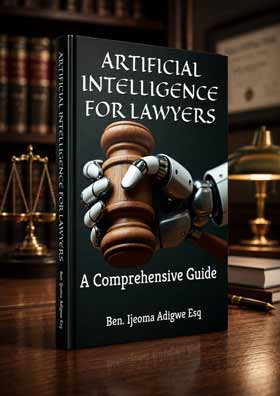 The book also examines Nigeria's legal ecosystem, focusing on the LPELR and NBA AI Guidelines. As a bonus, every purchase comes with a FREE eBook titled: How to Use the AI Features in LegalPedia and LawPavilion.
Ohio Books Ltd praises the publication, stating:
"....this is the only Nigerian book I know of on the topic."
How to Order:
📞 Call, Text, or WhatsApp: 08034917063 | 07055285878
📧 Email: benadigwe1@gmail.com
🌎 Website: www.benadigwe.com
Ebook Version: Access it directly online at https://selar.com/prv626
Authored by Ben Ijeoma Adigwe Esq., ACIarb (UK), LL.M, Dip. in Artificial Intelligence, Director at the Delta State Ministry of Justice, Asaba, Nigeria.
_______________________________________________________________________
“Enhance Legal Practice With Authoritative Reports” — Alexander Payne Offers Comprehensive Law Reports, Spanning Over A Century Of Nigerian Jurisprudence
The book also examines Nigeria's legal ecosystem, focusing on the LPELR and NBA AI Guidelines. As a bonus, every purchase comes with a FREE eBook titled: How to Use the AI Features in LegalPedia and LawPavilion.
Ohio Books Ltd praises the publication, stating:
"....this is the only Nigerian book I know of on the topic."
How to Order:
📞 Call, Text, or WhatsApp: 08034917063 | 07055285878
📧 Email: benadigwe1@gmail.com
🌎 Website: www.benadigwe.com
Ebook Version: Access it directly online at https://selar.com/prv626
Authored by Ben Ijeoma Adigwe Esq., ACIarb (UK), LL.M, Dip. in Artificial Intelligence, Director at the Delta State Ministry of Justice, Asaba, Nigeria.
_______________________________________________________________________
“Enhance Legal Practice With Authoritative Reports” — Alexander Payne Offers Comprehensive Law Reports, Spanning Over A Century Of Nigerian Jurisprudence
 Interested buyers are encouraged to place their orders and enquiries via:
0704 444 4777, 0704 444 4999, 0818 199 9888
Website: www.alexandernigeria.com
Interested buyers are encouraged to place their orders and enquiries via:
0704 444 4777, 0704 444 4999, 0818 199 9888
Website: www.alexandernigeria.com