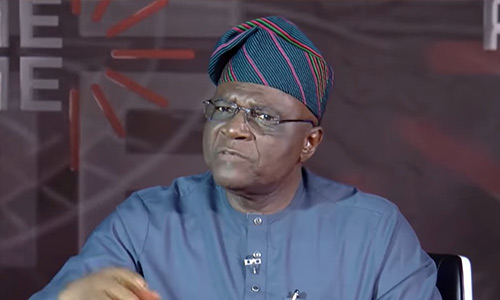
Bayo Onanuga, Special Adviser to President Bola Tinubu on Information and Strategy, has defended the president’s decision to amend the recent presidential pardon list, describing it as an act of courage and accountability rather than a display of weakness. He also defended the administration’s handling of the controversial prerogative of mercy list, dismissing criticisms of a “flip-flop” as a sign of responsive leadership.

Onanuga further rebuked media speculation over an alleged coup attempt, calling it “rumours” driven by clickbait, while describing recent changes to Nigeria’s military leadership as a routine measure aimed at strengthening national security.
The interview, held amid ongoing debates over governance and national stability, comes weeks after President Tinubu’s initial pardon list comprising over 100 convicts, including those jailed for drug trafficking, kidnapping, fraud, and violent crimes ignited public outrage. Critics, including former Vice President Atiku Abubakar, lambasted the decision as “too little, too late,” accusing the president of reviewing the list only after widespread backlash forced a U-turn. Abubakar, in a pointed statement, quipped that Tinubu had “cancelled his own pardon for drug traffickers, kidnappers, and other hardened criminals” only after Nigerians “shouted loud enough to wake him up from his moral slumber,” raising concerns about accountability in a nation grappling with corruption and insecurity.
Onanuga, however, framed the reversal not as an admission of error but as evidence of Tinubu’s humility and attentiveness. “This president is not one that is afraid to reverse himself,” he said. “He’s a human being; he can make mistakes, and he listens to the public. He wakes up in the morning, and the first thing he does is read all the Nigerian papers and watch TV to know what’s going on.” He emphasized that the initial list, approved after consultation with the Council of State, drew criticism primarily over high-profile cases such as that of Mariam Sanda, who was convicted of murdering her husband and sentenced to death.
Describing Sanda’s case as a “crime of passion” complicated by her role as a mother to two young daughters, Onanuga highlighted Tinubu’s “compassion” as a driving force. “The court found her guilty… but her case was a bit complicated by the fact that she has two kids,” he noted, adding that the victim’s biological father later pleaded for her release to care for the children. The revised list commuted Sanda’s death sentence to 12 years while reducing terms for some drug offenders—though Onanuga clarified these were “clemencies,” not full pardons. He defended the inclusion of figures such as former House of Representatives member Abdulmumin Jibrin (referred to as “La’an” in the discussion), who had already served his sentence for a $500,000 bribery conviction, as an act of rehabilitation for those who had shown remorse.
Addressing broader concerns about undermining the rule of law and separation of powers, Onanuga insisted the moves align with Section 175 of the 1999 Constitution, which grants the president mercy powers post-conviction. “The same constitution says the president has the power to exercise prerogative of mercy after the judiciary has completed its own task,” he argued, noting that even governors hold similar authority. He acknowledged calls from senior lawyers to repeal the section, citing its potential to erode trust in law enforcement, but deferred reforms to the National Assembly, which is currently reviewing the constitution. “Let them take their suggestion to the National Assembly to amend the constitution,” Onanuga said. “Our country keeps evolving; things keep changing.”
To prevent future controversies, the administration has transferred oversight of the Prerogative of Mercy Committee’s secretariat from the Ministry of Special Duties to the Ministry of Justice, ensuring “the minister can have oversight” and apply stricter guidelines. Onanuga stressed the committee’s composition of “senior, reputable Nigerians” and the president’s reliance on their fact-based recommendations, including clemency for young offenders in their 20s or teens convicted of minor crimes like illegal mining. “You want to waste them?” he asked rhetorically.
Shifting to security, Onanuga described the recent replacement of service chiefs as a “routine change” prompted by Tinubu’s concerns over the 16-year Boko Haram insurgency, which began in 2009. “The president is concerned about the way the security situation is being addressed,” he explained. “He told the new service chiefs that they must do everything possible to make sure this country ends this war.” He explicitly denied links to circulating rumours of a coup attempt, labelling them baseless speculation that could scare off investors and harm the economy.
Drawing on his journalism background, Onanuga urged media restraint, invoking the Latin phrase cui bono (“to whose benefit?”) to question the value of unverified stories. He cited examples such as false reports of the Niger Delta Development Commission’s managing director being arrested—despite the individual appearing live on TV the same day—and exaggerated casualty figures in Niger State attacks (initially reported as “scores” but confirmed as seven). “The media are gatekeepers… not everything is fit to print,” he cautioned, attributing sensationalism to “clickbait” and a lack of formal training among some reporters. While acknowledging global distrust in governments, Onanuga called for “patriotic” caution: “If you write about a coup attempt, do you know what the cost for Nigeria is? It will drive away investors. The media, with their own hands, will destroy the country.”
As Nigeria contends with economic pressures and insurgencies, Onanuga portrayed Tinubu as a leader guided by public feedback and compassion—strengths, he argued, that outweigh perceptions of inconsistency. “He’s not a superman… he corrects himself and then moves on. That’s one of his strengths,” Onanuga concluded.
 Interested buyers are encouraged to place their orders and enquiries via:
0704 444 4777, 0704 444 4999, 0818 199 9888
Website: www.alexandernigeria.com
Interested buyers are encouraged to place their orders and enquiries via:
0704 444 4777, 0704 444 4999, 0818 199 9888
Website: www.alexandernigeria.com
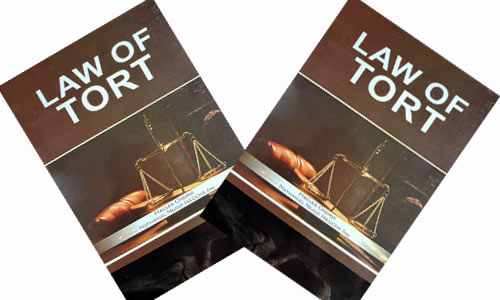 The book, titled The Law of Torts in Nigeria: A Functional Approach, authored by Professor Hagler Sunny Okorie Ph.D and Ikeocha, Nathaniel Ngozi Esq, offers law students, practitioners, and academics a comprehensive guide to understanding and applying tort law in Nigerian courts. Interested buyers can place orders via the following contact numbers: 08028636615, 08037667945, 08032253813, or +234 902 196 2209.
_______________________________________________________________________
The book, titled The Law of Torts in Nigeria: A Functional Approach, authored by Professor Hagler Sunny Okorie Ph.D and Ikeocha, Nathaniel Ngozi Esq, offers law students, practitioners, and academics a comprehensive guide to understanding and applying tort law in Nigerian courts. Interested buyers can place orders via the following contact numbers: 08028636615, 08037667945, 08032253813, or +234 902 196 2209.
_______________________________________________________________________
 ARTIFICIAL INTELLIGENCE FOR LAWYERS: A COMPREHENSIVE GUIDE
Reimagine your practice with the power of AI “...this is the only Nigerian book I know of on the topic.” — Ohio Books Ltd
Authored by Ben Ijeoma Adigwe, Esq., ACIArb (UK), LL.M, Dip. in Artificial Intelligence, Director, Delta State Ministry of Justice, Asaba, Nigeria.
Bonus:
Get a FREE eBook titled “How to Use the AI in Legalpedia and Law Pavilion” with every purchase.
ARTIFICIAL INTELLIGENCE FOR LAWYERS: A COMPREHENSIVE GUIDE
Reimagine your practice with the power of AI “...this is the only Nigerian book I know of on the topic.” — Ohio Books Ltd
Authored by Ben Ijeoma Adigwe, Esq., ACIArb (UK), LL.M, Dip. in Artificial Intelligence, Director, Delta State Ministry of Justice, Asaba, Nigeria.
Bonus:
Get a FREE eBook titled “How to Use the AI in Legalpedia and Law Pavilion” with every purchase.
How to Order: 📞 Call, Text, or WhatsApp: 08034917063 | 07055285878 📧 Email: benadigwe1@gmail.com 🌐 Website: www.benadigwe.com
Ebook Version: Access directly online at: https://selar.com/prv626
________________________________________________________________________ [A MUST HAVE] Evidence Act Demystified With Recent And Contemporary Cases And Materials