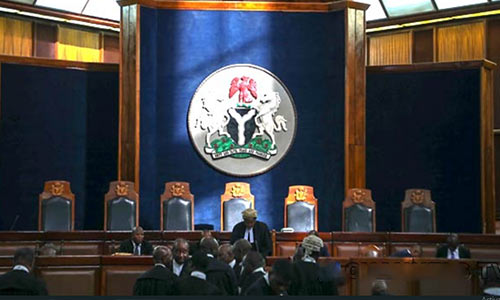
The Supreme Court has held that complaints of breach or likely breach of fair hearing by quasi-judicial bodies cannot be enforced under the Fundamental Rights (Enforcement Procedure) Rules.

The apex court gave the ruling in ABALAKA v. Minister of Health & Ors (2025) LPELR-81491(SC), where it clarified that Section 36(1) of the 1999 Constitution applies strictly to proceedings before courts or tribunals established by law, not departmental panels or bodies merely acting judicially or quasi-judicially.
Delivering the lead judgment, Justice Emmanuel Akomaye Agim, JSC, explained that although allegations that a quasi-judicial body violated or was likely to violate rules of natural justice are legally cognizable, such claims cannot be brought under fundamental rights enforcement.
According to him, “Section 36(1) of the 1999 Constitution deals with the determination of civil rights and obligations of a person in cases before a court or tribunal established by law and constituted in such a manner as to secure its independence and impartiality. It does not extend to departmental or ad hoc panels.”
The court stressed that the proper avenue for redress in such situations is through judicial review processes, including writs of certiorari, prohibition, declarations, or other civil actions under the High Court (Civil Procedure) Rules.
Justice Agim stated:
“A complaint that the proceedings and decisions of the Respondents violate or are likely to violate the rules of natural justice against him and his general legal right to fair hearing is not a complaint that any of the provisions of Chapter IV has been, is being, or is likely to be contravened… The Respondent can seek redress for such violation by the ordinary or general processes for seeking remedy for infractions of legal rights and obligations in the High Court.”
By this ruling, the Supreme Court has reaffirmed the limitation of fundamental rights enforcement to violations arising only from judicial bodies properly established by law, while preserving the right of litigants to challenge decisions of quasi-judicial panels through other recognized legal procedures.
 Interested buyers are encouraged to place their orders and enquiries via:
0704 444 4777, 0704 444 4999, 0818 199 9888
Website: www.alexandernigeria.com
Interested buyers are encouraged to place their orders and enquiries via:
0704 444 4777, 0704 444 4999, 0818 199 9888
Website: www.alexandernigeria.com

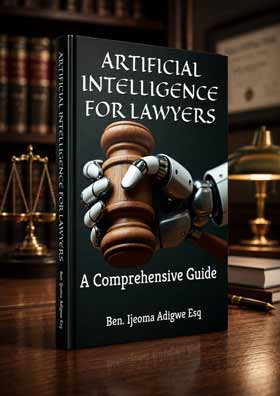 The book also examines Nigeria's legal ecosystem, focusing on the LPELR and NBA AI Guidelines. As a bonus, every purchase comes with a FREE eBook titled: How to Use the AI Features in LegalPedia and LawPavilion.
Ohio Books Ltd praises the publication, stating:
"....this is the only Nigerian book I know of on the topic."
How to Order:
📞 Call, Text, or WhatsApp: 08034917063 | 07055285878
📧 Email: benadigwe1@gmail.com
🌎 Website: www.benadigwe.com
Ebook Version: Access it directly online at https://selar.com/prv626
Authored by Ben Ijeoma Adigwe Esq., ACIarb (UK), LL.M, Dip. in Artificial Intelligence, Director at the Delta State Ministry of Justice, Asaba, Nigeria.
_______________________________________________________________________
The book also examines Nigeria's legal ecosystem, focusing on the LPELR and NBA AI Guidelines. As a bonus, every purchase comes with a FREE eBook titled: How to Use the AI Features in LegalPedia and LawPavilion.
Ohio Books Ltd praises the publication, stating:
"....this is the only Nigerian book I know of on the topic."
How to Order:
📞 Call, Text, or WhatsApp: 08034917063 | 07055285878
📧 Email: benadigwe1@gmail.com
🌎 Website: www.benadigwe.com
Ebook Version: Access it directly online at https://selar.com/prv626
Authored by Ben Ijeoma Adigwe Esq., ACIarb (UK), LL.M, Dip. in Artificial Intelligence, Director at the Delta State Ministry of Justice, Asaba, Nigeria.
_______________________________________________________________________