By Victor Anayochukwu Jonah Esq.

INTRODUCTION
Democracy thrives on strong institutions, none more vital than an independent judiciary. In the United States, despite political polarization, the judiciary has withstood pressure from both the executive and legislature—anchored by a collective national identity and enduring institutional ethos dating back to July 4, 1776 (“We hold these truths to be self-evident, that all men are created equal…”).
Nigeria’s judiciary once commanded some reverence. However, since the inception of the Fourth Republic, a slow erosion of ethical judicial stewardship has set in. Ironically, landmark Supreme Court judgments like those in Obi v. INEC and Amaechi v. INEC sparked the imperceptible rise of politically entangled appointments and tepid responses to constitutional infractions.
The current legal limbo surrounding the declaration of emergency rule in Rivers State—unchallenged since March 2025—underscores this retreat. The judiciary appears inert, even as democratic integrity unravels. Meanwhile, recent Supreme Court expedience in less politically inconvenient matters further exposes a pattern of selective engagement.
The time has come to lift the sacred veil shielding the judiciary, not to desecrate the institution, but to reawaken it to its constitutional obligations.
LESSONS FROM THE CONTINENT: JUDICIAL COURAGE BEYOND NIGERIA
Nigeria once stood tall across Africa—championing democracy in South Africa, Sierra Leone, and The Gambia. Today, the self-proclaimed “giant of Africa” is humbled by the democratic strides of smaller nations.
In 2020, Malawi’s courts annulled a presidential election marred by irregularities—despite the ruling party’s dominance. In Kenya, the Supreme Court twice rebuked the sitting administration: first, by nullifying a presidential election in 2017; and later, upholding the victory of an opposition candidate in 2022—against the president’s express preference.
These judicial moments were not acts of rebellion, but of fidelity to the rule of law. In contrast, most Nigerians would scarcely believe such rulings possible in their own country, especially where federal interests are concerned. The disillusionment is deep, and the faith in legal redress sorely diminished.
RIVERS STATE: WHERE THE JUDICIARY LOST ITS VOICE
The March 2025 declaration of emergency rule in Rivers State came after months of calculated political tension orchestrated by powerful actors in Abuja. Yet far greater bloodshed in states like Benue elicited no such response—highlighting selective alarmism rooted in power politics.
Worse still, the judiciary’s silence is compounded by troubling rumors: social media is awash with allegations of improper associations between top judicial officers and political figures at the heart of the Rivers crisis. Such clouds of impropriety, even if unproven, cast shadows long enough to obscure public confidence.
Rather than offer principled resistance, Governor Fubara has capitulated—his image one of sorrowful defeat rather than defiant leadership. But the judiciary’s own failure to check these unfolding abuses speaks louder than any act of gubernatorial cowardice
COMPARING RECENT INVOCATION OF THE SUPREME COURT’S ORIGINAL JURISDICTION
In February 2023, despite procedural challenges, several state governors invoked the original jurisdiction of the Supreme Court over the Naira redesign policy of the Central Bank of Nigeria—lumped together with the Federal Government—in A.G. of Kaduna State & 2 Ors v. A.G. of the Federation (SC/CV/162/2023). The Court commendably treated the matter as one of national urgency and delivered a decisive ruling within less than 30 days.
Similarly, the contentious case on Local Government autonomy in Attorney-General of the Federation v. Attorneys-General of the 36 States (SC/CV/343/2024)—a decision now self-eroded by federal desperation in Rivers State through the President’s appointment of a sole Administrator—was pursued by the Supreme Court via an accelerated process, widely reported across conventional media.
One would expect even greater speed in the handling of the case filed by PDP governors, even if only for academic purpose as anticipated in many quarters, given the presidential onslaught on the sovereign will of a sub-national entity. On the contrary, the slow pace of progress has created the impression that the Court may have deliberately stepped back, allowing the President to perfect his political gamesmanship with his allies.
It must be reiterated that when institutions such as the judiciary lend themselves to ping-pong games by politicians, you produce effeminates like Fubara—where elections are rigged in broad daylight, and judges pretend to live on the moon, isolated from the pulse of the nation. No repercussions, no reprimand. You cultivate a leadership class like the impish emperor of Obiakpor, struggling to outcompete Hitler in theatrical autocracy. This, in turn, instills negative leadership qualities into the psyche of innocent young minds with generational repercussion.
CONCLUSION
The Nigerian people, to whom sovereignty is constitutionally bequeathed, must snap out of lethargy and the social media cacophony—perceived by oppressors as therapeutic indulgence for the oppressed and a trap for their victims—and courageously demand accountability from the judiciary. The antiquated days of sacredness and secrecy are gone. The other two arms of government, peopled by fluid elements whose raw and untamed nature craves absolute power, will only fall in line when pressured by an awakened citizenry. Exemplary democracies across the world have shown that, regardless of the brutality inflicted on democratic norms, true collapse begins only when the judiciary is weakened. Time and again, avaricious and self-serving leaders slip through the cracks in their pursuit of unchecked rule, yet the judiciary remains democracy’s greatest asset and bulwark. Its absence in this trying time for Nigeria signals impending doom—unless checked not by politicians, who are direct beneficiaries of dysfunction, but by the resolute will of the people.
VICTOR ANAYOCHUKWU JONAH ESQ., Victorjonah89@yahoo.com
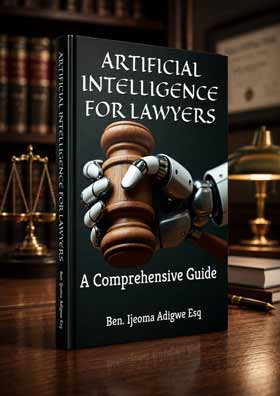 The book also examines Nigeria's legal ecosystem, focusing on the LPELR and NBA AI Guidelines. As a bonus, every purchase comes with a FREE eBook titled: How to Use the AI Features in LegalPedia and LawPavilion.
Ohio Books Ltd praises the publication, stating:
"....this is the only Nigerian book I know of on the topic."
How to Order:
📞 Call, Text, or WhatsApp: 08034917063 | 07055285878
📧 Email: benadigwe1@gmail.com
🌎 Website: www.benadigwe.com
Ebook Version: Access it directly online at https://selar.com/prv626
Authored by Ben Ijeoma Adigwe Esq., ACIarb (UK), LL.M, Dip. in Artificial Intelligence, Director at the Delta State Ministry of Justice, Asaba, Nigeria.
______________________________________________________________________
[A MUST HAVE] Evidence Act Demystified With Recent And Contemporary Cases And Materials
The book also examines Nigeria's legal ecosystem, focusing on the LPELR and NBA AI Guidelines. As a bonus, every purchase comes with a FREE eBook titled: How to Use the AI Features in LegalPedia and LawPavilion.
Ohio Books Ltd praises the publication, stating:
"....this is the only Nigerian book I know of on the topic."
How to Order:
📞 Call, Text, or WhatsApp: 08034917063 | 07055285878
📧 Email: benadigwe1@gmail.com
🌎 Website: www.benadigwe.com
Ebook Version: Access it directly online at https://selar.com/prv626
Authored by Ben Ijeoma Adigwe Esq., ACIarb (UK), LL.M, Dip. in Artificial Intelligence, Director at the Delta State Ministry of Justice, Asaba, Nigeria.
______________________________________________________________________
[A MUST HAVE] Evidence Act Demystified With Recent And Contemporary Cases And Materials

 Interested buyers are encouraged to place their orders and enquiries via:
0704 444 4777, 0704 444 4999, 0818 199 9888
Website: www.alexandernigeria.com
Interested buyers are encouraged to place their orders and enquiries via:
0704 444 4777, 0704 444 4999, 0818 199 9888
Website: www.alexandernigeria.com