By Simeon Akala, LLB

INTRODUCTION
When a man dies intestate i.e without an existing Will written by him as a testamentary document, the predominant question is what then regulates how his property devolves on his demise. Under Customary law of Benin Kingdom properties owned by the deceased patriarchs are often shared according to the custom and traditions, hence the succession of property is done in accordance with the prevalent native law of where he hails, excluding Islamic customary practice. In addition, there have been court judgements that women can now exercise rights of ownership of properties of their deceased father, these are what will be analyzed in this article vis-a-vis Igiogbe customary law practice which posits that by inheritance, only the eldest male child of the deceased can inherit specific property once a man dies intestate.
EXEGESIS OF IGIOGBE CUSTOMARY LAW PRACTICE
In Nigeria, customary laws of various cultural entities are recognizable and enforceable, as it forms the essence and foundation upon which they conduct their daily affairs. These are practices that exist and apparently has past on from one generation to the other. The Supreme court in Zaidan v. Mohssen (1973) 11 S.C.1, held customary law to be:
“Any system of law, not being common law and not being a law enacted by any competent legislature in Nigeria but which is enforceable and binding within Nigeria as between the parties subject to its sway.”
Similarly, Obaseki J.S.C, in Oyewumi v. Ogunesan (1990) 3 NWLR (Pt. 137) 182 at 207, enthused that:
“The organic or living law of the indigenous people of Nigeria regulating their lives and transactions….”
Furthermore, Igiogbe customary law practice has its native threshold in the Benin Kingdom. This practice allows only the eldest son right of inheritance of the ‘igiogbe’ of his deceased father, as against other children. To put more poignantly, the male child of the deceased is conferred with the exclusive right of ownership of the property belonging to the deceased father. Conversely, the igiogbe does not pass while the man is still alive. Mr. K.S. Okeaya-Inneh, SAN in his book titled “Benin-Native Law and Custom at a glance” at page 30 posited that:
“It must be noted that the principal dwelling house of a Benin man only becomes his “Igiogbe”, after his demise.”
The igiogbe is so significant as it relates to property inheritance in Benin, so much that it cannot be disposed in a Will by a testator as against his eldest son, not even family elders can take away this vested right on the eldest male child. In case of Idehen V. Idehen (1991) 6 NWLR 382, it was held that a testator or a Benin man cannot, by a WILL, give the “Igiogbe” to any one else but the eldest surviving male child.The Supreme Court has held in plethora of cases this position in Arase V. Arase (1981) 5 SC. 33; Oke V. Oke (1974) 3 SC 1; Olowu V. Olowu (1985) 3 NWLR (pt. 13) 372.
The Court has taken judicial notice of this customary law practice, See Imade V. Otabor (1998) 4 NWLR (Pt. 544) 20. Egharevba V. Okunghae (2001) 11 NWLR (Pt. 724) 318; Lawal- Osula V. Lawal – Osula (1995) I NWLR (Pt. 544) 20, and Agidigbi V. Agidigbi (1996) 6 NWLR (Pt.454) 30
In the case of Agidigbi V. Agidigbi (1992) 2 NWLR (PT. 221) at 313, the Supreme
Court held as follows:-
“The opening phrase “subject to any customary law relating thereto” in Section 3(1) of the WILLS Law of the Defunct Bendel State is only a qualification of the subject matter of the property disposed of or intended to be disposed by will, and is not a qualification of the testator’s capacity to make a Will. See the following cases. OKE V. OKE (SUPRA), OLOWU
VS. OLOWU (SUPRA), IDEHEN V. IDEHEN (SUPRA).”
Again, in Osula V. Osula (1995) 3 NWLR (PT. 382) AT 276, Belgore J.S.C. held thus:-
“All that the Will Law seek to achieve, which I believe it amply achieved, is to make disposition in a Will a possibility for every citizen of former Western Nigeria of which Bendel State was part, every person can make a Will but that capacity is subject to the entrenched Native Law and Custom.”
To buttress further, in an unreported case of UGBO V. ASEMOTA in suit No. B/491/79 delivered on 30/3/74, the Oba of Benin, His Royal Highness, Oba Akenzua II testified on the issue of igiogbe.
In addition, it was also elucidated as reported in the Handbook, materials and case on Benin Land Law by Honourable Justice R.A.I. Ogbobine (Rtd.) at pages 36 – 37. Where
the Oba of Benin states under
cross-examination thus:
“If a man shares his property before his death, the family could reverse it on his death. If the man leaves many houses, they could be distributed among the children but if it is only one house, the house belongs to his eldest surviving son absolutely. As absolute owner he does what he likes with it in his life time. He may therefore sell or make a gift of the Igiogbe in his life time.”
Lastly, despite the igiogbe is exclusively reserved for the eldest male child, does it presupposes that we cannot also make a case for its applicability in respect of an eldest child who is female? The Court has given strings of Judicial authorities that widow, women/girl child can now inherit properties of husbands and deceased father, see Ukeje V. Ukeje, Mojekwu V. Mojekwu. What then happens to the igiogbe when there is only female who is the eldest child of the deceased? Is she constitutionally covered to also inherit just like the male counterpart. These are questions that have arouse in many school of thoughts in jurisprudence, if it is not outrightly discriminatory as entrenched in Sections 42 (1) & (2) of the 1999 Constitution of the Federal Republic of Nigeria, also if it does not amount to an infringement of the rights of the females to inherit properties, looking at the weight of this issue, hopefully our Court may consider otherwise.
Simeon Akala holds LL.B degree from Faculty of Law, Ambrose Alli University, Ekpoma, Edo State. He enjoys lecturing, writing and speaking. His penchant interest in practice are Public Law, Human Rights, Electoral Law, International Humanitarian Law
Contact: simeonakala217@gmail.com, 08110468699
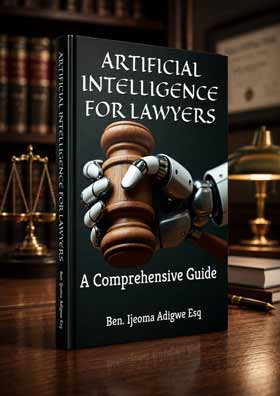 The book also examines Nigeria's legal ecosystem, focusing on the LPELR and NBA AI Guidelines. As a bonus, every purchase comes with a FREE eBook titled: How to Use the AI Features in LegalPedia and LawPavilion.
Ohio Books Ltd praises the publication, stating:
"....this is the only Nigerian book I know of on the topic."
How to Order:
📞 Call, Text, or WhatsApp: 08034917063 | 07055285878
📧 Email: benadigwe1@gmail.com
🌎 Website: www.benadigwe.com
Ebook Version: Access it directly online at https://selar.com/prv626
Authored by Ben Ijeoma Adigwe Esq., ACIarb (UK), LL.M, Dip. in Artificial Intelligence, Director at the Delta State Ministry of Justice, Asaba, Nigeria.
______________________________________________________________________
[A MUST HAVE] Evidence Act Demystified With Recent And Contemporary Cases And Materials
The book also examines Nigeria's legal ecosystem, focusing on the LPELR and NBA AI Guidelines. As a bonus, every purchase comes with a FREE eBook titled: How to Use the AI Features in LegalPedia and LawPavilion.
Ohio Books Ltd praises the publication, stating:
"....this is the only Nigerian book I know of on the topic."
How to Order:
📞 Call, Text, or WhatsApp: 08034917063 | 07055285878
📧 Email: benadigwe1@gmail.com
🌎 Website: www.benadigwe.com
Ebook Version: Access it directly online at https://selar.com/prv626
Authored by Ben Ijeoma Adigwe Esq., ACIarb (UK), LL.M, Dip. in Artificial Intelligence, Director at the Delta State Ministry of Justice, Asaba, Nigeria.
______________________________________________________________________
[A MUST HAVE] Evidence Act Demystified With Recent And Contemporary Cases And Materials

 Interested buyers are encouraged to place their orders and enquiries via:
0704 444 4777, 0704 444 4999, 0818 199 9888
Website: www.alexandernigeria.com
Interested buyers are encouraged to place their orders and enquiries via:
0704 444 4777, 0704 444 4999, 0818 199 9888
Website: www.alexandernigeria.com