By Amb. Hameed Ajibola Jimoh, Esq.
ACArb. (Chartered Arbitrator), MTI Accredited Mediator, CGArb. (Global Peace and Conflict Resolution and Management Expert), FIGPCM, LPC, PC-WCM, FIMC, CMC, CMS and Notary Public for Nigeria
The Law, especially the Legal Practitioners’ Act, 2004-herein after referred to as the LPA, has designated ‘the Chief Registrar of the Supreme Court of Nigeria’ to be the ‘only statutory public authority or person so appointed to receive and collect the annual practicing fees being prescribed by the appropriate authority under the LPA. Also, under the LPA, the Chief Registrar of the Supreme Court has been further tasked to always publish ‘List’ of all the lawyers that have paid their practicing fees in a particular year of practice and it is only a lawyer on this ‘List’ so published that will be qualified to practice as a lawyer in that year in any court of law or by extension, do all that a lawyer does as a lawyer and by virtue of his status as such, which includes but not limited to the following: (a) conduct or take part in any proceedings in the court, judicial tribunal, or panel of enquiry; (b) sign any documents, pleadings, affidavits, depositions, application, instruments, agreements, deeds, letters, memoranda, reports, legal opinions or similar documents and processes; or (c) file any such documents as a legal practitioner legal officer or adviser of any Government Department or Ministry or any company or corporation. It is important to note that this ‘List’ is to be paid for by every lawyer whose name is on the ‘List’, hence, the ‘List’ becomes synonymous with ‘Practicing Licence’. Respectfully, since the enactment of the LPA in this regard, ‘the past Chief Registrars of the Supreme Court (to the best of my knowledge), have not been publishing this ‘List’ and no lawyer has been required to pay for any such ‘List’! For instance, too, I am a lawyer called to the Nigerian Bar and so enrolled in the year 2014 (now of 12 years post-call as a lawyer). I am not aware that this ‘List’ has ever been printed and published by the Chief Registrar of the Supreme Court and I have not paid any fee for any such ‘List’. The only thing that I know is that the past Chief Registrars of the Supreme Court, with due respect to them, have been delegating their statutory public duties in this regard of collecting practicing fees and issuing practice licence to lawyers to the Nigerian Bar Association-herein after referred to as NBA- (a privately registered association of lawyers), all in the name of ‘collaboration with NBA’, which, in my humble submission, ought not to be so! Now, in my humble submission and analysis, I discovered that the draftsmen of the LPA regarding the ‘List’ to be printed and paid for might have had the intention of providing a means of ‘Internally Generated Revenue-herein after referred to as IGR- for the Supreme Court of Nigeria. However and shockingly, the past Chief Registrars of the Supreme Court have, with due respect to them, cost the Supreme Court such a huge loss of such IGR annually! Hence, this paper humbly draws the attention of My Lord, the Chief Justice of Nigeria to these losses and for My Lord, to start to formulate or direct such formulation necessary and appropriate policies that would implement and or initiate this generation of this IGR for the purposes of the affairs of the Supreme Court. My Lord needs not allow ‘domination’ by the NBA in its IGR in this regard as it is a ‘statutory public obligation’ that can not be delegated to any other person (private or public). Hence, this topic.
First and foremost, Internally Generated Revenue (IGR) refers to the revenue that a government raises within its own jurisdiction, as opposed to revenue received from external sources like federal or state allocations. In the context of Nigeria, IGR is a crucial source of revenue for any public body or establishment including state, local and of course, the Supreme Court of Nigeria, which complements statutory revenue allocations. So, in my humble submission, the IGR is a lot of benefits for the Supreme Court.
Furthermore, and respectfully, in my humble submission, the practice of law or the legal profession is an issue of statute by which only the National Assembly of Nigeria has been Constitutionally empowered to ‘designate’ by the Constitution of the Federal Republic of Nigeria, 1999 (as amended)-herein after referred to as the Constitution. Item 49 of the Part I of the Second Schedule to the Constitution is clear on this point when it provides thus
‘Professional Occupation as may be designated by the National Assembly’.
Also, by section 4(1), (2) and (3) of the Constitution, further provides on the exclusive powers of the National Assembly to make laws on the Professional Occupation of the legal practice or the legal profession when it provides thus
‘4.—(1) The legislative powers of the Federal Republic of Nigeria shall be vested in a National Assembly for the Federation which shall consist of a Senate and a House of Representatives.
(2) The National Assembly shall have power to make laws for the peace, order and good government of the Federation or any part thereof with respect to any matter included in the Exclusive Legislative List set out in Part I of the Second Schedule to this Constitution.
(3) The power of the National Assembly to make laws for the peace, order and good government of the Federation with respect to any matter included in the Exclusive Legislative List shall, save as otherwise provided in this Constitution, be to the exclusion of the Houses of Assembly of States.’.
Now, sequel to the provisions of the Constitution above, the National Assembly has enacted the Legal Practitioners’ Act, 2004-herein after referred to as LPA, designating the legal profession and making laws on who is a lawyer as well as the practice of the law of a lawyer including the qualifications for the issuance of the practice licence of a lawyer. Thus, Section 2 of the LPA has provided on who is entitled to practice law when it provides in section 2(1) of the Act thus
‘2. (1) Subject to the provisions of this Act, a person shall be entitled to practise as a barrister and solicitor if, and only if, his name is on the roll.’.
Furthermore, section 7(1) of the LPA is clear on the issue of who is to be enrolled as a lawyer (as relevant in the present context of Nigerian lawyers) where it provides thus
‘7. (1) Subject to the provisions of this section, a person shall be entitled to have his name enrolled if, and only if-
(a) he has been called to the Bar by the Benchers; and
(b) he produces a certificate of his call to the Bar to the registrar.
My research carried out discovered that there are about between Two Hundred Thousand (200,000) and Two Hundred and Fifty Thousand (250,000) lawyers enrolled by the Supreme Court of Nigeria till date; the list might be above though, by now. This assessment might not be accurate, with due respect. Nevertheless, I shall use this calculation of number of lawyers referred to above in this paper.
Furthermore, Section 8(1) of the LPA has granted every legal practitioner the right of audience (in other words, the right to practice law as a lawyer) in all courts of law sitting in Nigeria, when it provides thus
- (1) Subject to the provisions of the next following subsection and of any enactment in force in any part of Nigeria prohibiting or restricting the right of any person to be represented by a legal practitioner in proceedings before the Supreme Court or the Sharia Court of Appeal or any area or customary court, a legal practitioner shall have the right of audience in all courts of law sitting in Nigeria. (Underlining is mine for emphasis).
Furthermore, in my humble submission, section 8(2) of the LPA has laid down the conditions for legal practice and for issuance of annual practice licence to a lawyer and who is to collect annual practicing fees from lawyers (and issue receipts for the payments) and issue the said practice licence annually to the effect that ‘the Chief Registrar of the Supreme Court of Nigeria’ shall carry out all these functions, where it provides thus
(2) No legal practitioner (other than such a person as is mentioned in subsection (3) of section 2 of this Act) shall be accorded the right of audience in any court in Nigeria in any year, UNLESS HE HAS PAID TO THE REGISTRAR IN RESPECT OF THAT YEAR, A PRACTISING FEE–
(a) in the case of a Senior Advocate of Nigeria, of N200;
(b) in the case of a person of 15 or more years standing as a legal practitioner at the beginning of that year, not being a Senior Advocate of Nigeria, of N100;
(c) in the case of a person of more than 10 but less than 15 years standing as a legal practitioner at the beginning of that year, not being a Senior Advocate of Nigeria, of N75;
(d) in the case of a person of more than 5 but not more than 10 years standing as a legal practitioner at the beginning of that year, of N40; and
(e) in any other case, of N20.
(3) The Attorney-General of the Federation may, after consultation with the Bar Council, from time to time vary the various rates of practising fees specified in subsection (2) of this section.
(4) The registrar shall-
(a) issue to every person by whom a practising fee is paid in respect of any year a receipt for the fee in the prescribed form; and
(b) as soon as reasonably practicable after the end of January in each year and thereafter from time to time during the year as he considers appropriate cause to be printed in the prescribed form and put on sale a list or supplementary list of the legal practitioners by whom practising fees have been paid in respect of that year; and
(c) pay over to the association as soon as may be after the end of each year a sum equal to nine tenths of the aggregate amount of the practising fees received by him in pursuance of this section during the year, and a receipt purporting to be issued and list purporting to be printed in pursuance of this subsection in respect of any year shall be evidence that the person named in the receipt or, as the case may be, that any person named in the list has paid to the registrar the practising fee in respect of that year.
(5) Legal practitioners appearing before any court, tribunal or person exercising jurisdiction conferred by law to hear and determine any matter (including an arbitrator) shall take precedence among themselves according to the table of precedence set out in the First Schedule to this Act.’ (Underlining is mine for emphasis).
Furthermore, the interpretation of ‘Registrar’ in the above Section 8 of the LPA has been defined under section 24 of the LPA to mean ‘the Chief Registrar of the Supreme Court’. In fact, as can be observed, what amounts to practicing licence for a lawyer to be entitled to practice as a lawyer in a particular year is ‘printed in the prescribed form’ a list or supplementary list of the legal practitioners by whom practising fees have been paid in respect of that year. Therefore, in my humble submission, this ‘prescribed List’ could be gazetted by the Supreme Court and can therefore be purchased by lawyers at a prescribed fee. Even members of the public too could apply to the Supreme Court for Copies which would further strengthen the IGR of the Supreme Court. This is because, this list is not free of charge but shall be paid for but the Supreme Court has unfortunately been losing revenue in this regard.
Now, on the IGR likely generatable by the Supreme Court annually, respectfully, assuming, the Supreme Court of Nigeria charges for instance, the sum of One Thousand Naira (N1,000.00) for the list or the gazetted list, and there are over Two Hundred Thousand (200,000) lawyers applying for this list annually (which may also be electronically generated upon the payment of the chargeable practicing fee and the fee to obtain the list), (that is if Two Hundred Thousand (200,000) lawyers are multiplied by the sum of One Thousand Naira (N1,000.00) for the list or the gazetted list; that is a total of Two Hundred Million Naira (N200,000,000.00) by calculation that the Supreme Court would generate in this regard (aside the moneys that the it will generate from other members of the public (private and public) who might apply for the list of lawyers). Therefore, one can imagine the millions of naira that the Supreme Court would have generated from that ‘list’ alone in a year and one can further imagine the Billions of Naira that the Supreme Court has been losing as ‘INTERNAL GENERATED REVENUE (IGR) from that ‘list’ alone!
I therefore humbly call on My Lord, the Chief Justice of Nigeria (being the Head of the Supreme Court), to take appropriate steps towards securing its IGR as provided by law and to direct the current Chief Registrar of the Supreme Court to effectively and efficiently perform his statutory public duties in this regard as mandated by the LPA!
Finally, it is my utmost belief, most respectfully, that the Supreme Court would make use of the recommendations made by this paper and take the appropriate actions towards ensuring and or enforcing its IGR policies in this regard.
Email: hameed_ajibola@yahoo.com 08168292549.
[A MUST HAVE] Evidence Act Demystified With Recent And Contemporary Cases And Materials

Available now for NGN 40,000 at ASC Publications, 10, Boyle Street, Onikan, Lagos. Beside High Court, TBS. Email publications@ayindesanni.com or WhatsApp +2347056667384. Purchase Link: https://paystack.com/buy/evidence-act-complete-annotation
______________________________________________________________________ “Enhance Legal Practice With Authoritative Reports” — Alexander Payne Offers Comprehensive Law Reports, Spanning Over A Century Of Nigerian Jurisprudence Interested buyers are encouraged to place their orders and enquiries via:
0704 444 4777, 0704 444 4999, 0818 199 9888
Website: www.alexandernigeria.com
Interested buyers are encouraged to place their orders and enquiries via:
0704 444 4777, 0704 444 4999, 0818 199 9888
Website: www.alexandernigeria.com
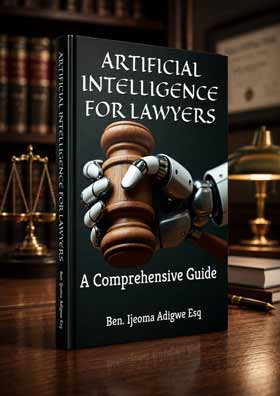 The book also examines Nigeria's legal ecosystem, focusing on the LPELR and NBA AI Guidelines. As a bonus, every purchase comes with a FREE eBook titled: How to Use the AI Features in LegalPedia and LawPavilion.
Ohio Books Ltd praises the publication, stating:
"....this is the only Nigerian book I know of on the topic."
How to Order:
📞 Call, Text, or WhatsApp: 08034917063 | 07055285878
📧 Email: benadigwe1@gmail.com
🌎 Website: www.benadigwe.com
Ebook Version: Access it directly online at https://selar.com/prv626
Authored by Ben Ijeoma Adigwe Esq., ACIarb (UK), LL.M, Dip. in Artificial Intelligence, Director at the Delta State Ministry of Justice, Asaba, Nigeria.
______________________________________________________________________
The book also examines Nigeria's legal ecosystem, focusing on the LPELR and NBA AI Guidelines. As a bonus, every purchase comes with a FREE eBook titled: How to Use the AI Features in LegalPedia and LawPavilion.
Ohio Books Ltd praises the publication, stating:
"....this is the only Nigerian book I know of on the topic."
How to Order:
📞 Call, Text, or WhatsApp: 08034917063 | 07055285878
📧 Email: benadigwe1@gmail.com
🌎 Website: www.benadigwe.com
Ebook Version: Access it directly online at https://selar.com/prv626
Authored by Ben Ijeoma Adigwe Esq., ACIarb (UK), LL.M, Dip. in Artificial Intelligence, Director at the Delta State Ministry of Justice, Asaba, Nigeria.
______________________________________________________________________