By Victor Sunday
Introduction
Earlier this year, the Nigerian Civil Aviation Authority (NCAA) charged a female Ibom Air passenger to court for obstructing flight operations due to her unruly conduct. While addressing the issue, the Director of Public Affairs and Consumer Protection, Micheal Achimugu, stated, “The regulations state firmly that no provocation justifies violence at the airport. Certain acts, especially holding up the movement of an aircraft through means of violence, could be interpreted as terrorism depending on the severity (to be determined by the police).”
In the similar twist of event, recently, a viral video surfaced on social media of a prominent Nigerian who missed his flight from Lagos to Abuja and allegedly resorted to barricading the terminal’s entrance and obstructing other passengers from entering the terminal. Such action caused significant disruption to flight operations and rendered passengers stranded.
What Does the Law Say?
Under the Criminal Code Act which applies to the southern part of Nigeria, it is an offence. According to section 459A of the Criminal Code Act, it states “Any person who, by any unlawful act, obstructs, causes an alteration to be made in the course of, or in any way whatsoever hinders or impedes the movement of any aircraft, which is in motion on or in flight over any aerodrome, is guilty of a misdemeanor and is liable to imprisonment for two years.”
Under the Penal Code which applies to the northern part of Nigeria, it is also an offence pursuant to section 472 of the Penal Code. A reproduction of the said section states, “Whoever, by any unlawful act obstructs, causes an alteration to be made in the course of or in any way whatsoever hinders or impedes the movement of any aircraft, which is in motion on or in flight over any aerodrome shall be punished with imprisonment which may extend to two years or with fine or with both.”
Based on the aforementioned, under the Criminal Code, a violation of section 459A makes the offender liable to imprisonment for two years while under the Penal Code such infraction attracts a penalty of two years imprisonment (maximum), or an option of fine, or both depending on the jurisdiction.
Opinion
The writer believes the above provisions are firmly grounded on the right to freedom of movement, a fundamental human right enshrined under section 41 of the 1999 Constitution of the Federal Republic of Nigeria (as amended). So important is this right that the court per Helen Moronkeji Ogunwumiju, JSC in the case of Abu v. State (2024) LPELR-62381(SC) pronounced eloquently, “…every right constituted under Chapter IV of the 1999 CFRN (as altered) derives its foundation from the right to freedom of movement. We are born to move and our right to move is a basic right which enables human beings forage for food and greener pastures to farm or feed our cattle. Thus, the right to move is intertwined with the right to life and liberty and freedom of movement.”
Even though the right is not absolute as it may be restricted within the confines of the law, it is a natural right. Restricting other passengers based on your grievances or whims might be as well denying them the right to life and liberty. As the writer and ardent republican, Victor Hugo, puts it, “The liberty of one citizen ends where the liberty of another citizen begins.”
Conclusion
It is important to restate that the disruption of flight operations in a bid to register one’s displeasure, anger, or whatnot is an offence punishable with prison term. Therefore, it is important for passengers to exercise restraint and go through the appropriate channels to communicate their displeasure or discontent instead of resorting to impeding or obstructing flight. On the other hand, airlines should be proactive in tackling challenges which may arise before or in the course of flight operations, and such should be communicated with a disposition which suggests that like the Biblical High Priest, they can be touched by the feelings of their passengers’ infirmities.
Victor Sunday is a fresh law graduate, youth advocate, writer and orator.
 Interested buyers are encouraged to place their orders and enquiries via:
0704 444 4777, 0704 444 4999, 0818 199 9888
Website: www.alexandernigeria.com
Interested buyers are encouraged to place their orders and enquiries via:
0704 444 4777, 0704 444 4999, 0818 199 9888
Website: www.alexandernigeria.com

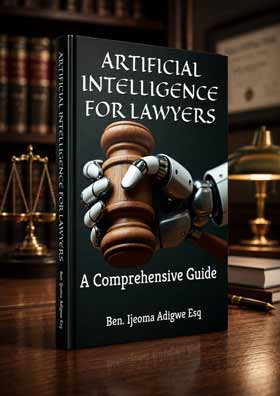 The book also examines Nigeria's legal ecosystem, focusing on the LPELR and NBA AI Guidelines. As a bonus, every purchase comes with a FREE eBook titled: How to Use the AI Features in LegalPedia and LawPavilion.
Ohio Books Ltd praises the publication, stating:
"....this is the only Nigerian book I know of on the topic."
How to Order:
📞 Call, Text, or WhatsApp: 08034917063 | 07055285878
📧 Email: benadigwe1@gmail.com
🌎 Website: www.benadigwe.com
Ebook Version: Access it directly online at https://selar.com/prv626
Authored by Ben Ijeoma Adigwe Esq., ACIarb (UK), LL.M, Dip. in Artificial Intelligence, Director at the Delta State Ministry of Justice, Asaba, Nigeria.
_______________________________________________________________________
The book also examines Nigeria's legal ecosystem, focusing on the LPELR and NBA AI Guidelines. As a bonus, every purchase comes with a FREE eBook titled: How to Use the AI Features in LegalPedia and LawPavilion.
Ohio Books Ltd praises the publication, stating:
"....this is the only Nigerian book I know of on the topic."
How to Order:
📞 Call, Text, or WhatsApp: 08034917063 | 07055285878
📧 Email: benadigwe1@gmail.com
🌎 Website: www.benadigwe.com
Ebook Version: Access it directly online at https://selar.com/prv626
Authored by Ben Ijeoma Adigwe Esq., ACIarb (UK), LL.M, Dip. in Artificial Intelligence, Director at the Delta State Ministry of Justice, Asaba, Nigeria.
_______________________________________________________________________