(Being the Text of a Paper Presented by Ekemini Udim, Esq at the 2025 Bar Week Plenary of the Nigerian Bar Association, Uyo Branch)
By Ekemini Udim
Muhammadu Buhari was in retirement when a group of politicians, led by Nigeria’s current President, knocked at his door in Daura and beckoned on him to run for the office of President of Nigeria. He accepted the invitation and began consultations and campaigns. When he later emerged as the flagbearer of the APC, he chose Prof. Yemi Osinbajo as his running mate. They campaigned on a joint ticket and won and, on May 29, 2015, they were sworn in as President and Vice President of Nigeria respectively. Buhari served for eight years. Osinbajo also served for eight years. The rest today is history. A few weeks ago, Prof. Osinbajo’s name returned to limelight after he made a speech at the Bar Week in Bayelsa State, the same event we are holding here today. His comment was not about the politics of Nigeria. It was not about Trump’s immigration policy in America nor was it about the love lost between Donald J. Trump and Elon Musk. It was about an issue that has become deeply concerning; the decadence in our profession and the loss of confidence and public trust. In his words, he stated thus, inter alia:
‘’The legal profession is crumbling under the weight of corruption, ethical violation and poor standings. Stories of counsel acting as conduit for the giving of bribes to judicial officers are rife. The perception that our system of justice is corrupt and the bar and bench are culpable is enough damage.’’
In March, 2017, Hon. Justice Stephen Okon retired from the Akwa Ibom State Judiciary as Chief Judge of the State and, a professor of Law was invited to deliver a lecture in his honour and the name of that professor is Prof. Nsongurua Udombana. Udombana is a foremost professor of International Law who has taught in many universities in Nigeria and abroad and who has had the privilege of serving as Dean of Law and Pro-Chancellor of Ritman University. The title of his lecture might embarrass you. He called it, ‘’The Noble Profession in the Dock.’’ This title alone has said so much. The dock is not for the nobles. It is not a good place to be. But Prof. Udombana had reasons to coin the title the way he did. He had seen so much and had read so much about the ignoble activities of members of our profession.
At page 26 of his lecture manual, Prof. Udombana noted thus: ‘’The unthinkables of yesterday have become realities of today. And we cannot blame the society for perceiving lawyers as people who rip off and betray their clients or engage in corrupt practices to perpetrate and perpetuate injustice or collude with politicians to suppress voters’ mandate. The regularity with which professional misconduct is levelled against our members should give us cause for concern. Indeed, our profession has degenerated to the level where, a few years ago, Bar Examination Questions allegedly leaked at the Nigerian Law School. It was not so at the beginning; indeed, such acts were unthinkable.’’
The Judges of our various courts have also had reasons to comment on the conduct of our colleagues that appear before them. One of such cases is the case of All Nigeria People’s Party v. The Resident Electoral Commission, Akwa Ibom State (2008) 8 N.W.L.R (Pt. 1090) 453. Here, the Court of Appeal had occasion to deprecate the conduct of a legal practitioner when it held thus:
‘’In the instant case, rather than deposing to an affidavit, the National Secretary of the ANPP, with the apparent connivance and encouragement of the appellants’ counsel, chose to shamefully resort to writing a letter to the Chairman of the Tribunal. The scenario, evinced through the proceedings at the lower Tribunal, is a show of shame. No honourable men should be credited with it.’’
As of June 8, 2025, the Nigerian Bar Association has 129 branches spread across the nation. Each of these branches has a disciplinary committee. As a matter of fact, this committee is so important to the Bar to the extent that, if any other committee should be dispensed with, it should not be the disciplinary committee. Chairmen and members are appointed into the committees and their primary responsibility is to receive petitions and complaints against members of the Bar, investigate such complaints and make appropriate recommendations for discipline of members that have been found wanting. Suffice it to say that the chairmen and members of this committee, in most of the branches across the federation, have seen it all regarding the level of decadence in our profession. After reading some petitions they shudder in disbelief and wonder whether what they read has indeed taken place in the congregation of honourable men and women. When they eventually go into hearing, they mostly go back home without being able to immediately get over the shock.
There is also the public outcry against our profession. Most landlords now consult lawyers to recover rent from lawyers. Clients have had to go to court for orders to compel their lawyers to refund money, money that was given to the lawyer in trust for the benefit of the client. Our colleagues have also stood trial for serious offences, including capital offences. Members of the public have also accused our colleagues of colluding to adulterate the streams of justice. Colleagues have also betrayed fellow colleagues. The list is endless.
Most people have also lost confidence in the bench. We have had the unfortunate spectacle of watching a few judicial officers in the dock, standing trial on allegations of corrupt practices. Some persons can say that this was good in the sense that the law is no respecter of anyone and that it is in keeping with the time-tested position of equality before the law. But the impact and the perception of the public about the judicial officer in the dock can only be better imagined than expressed.
The take home from all of these – the recent comment by Prof. Yemi Osinbajo, the earlier comment by Prof. Nsongurua Udombana, the comments by Judges in decided authorities, the experiences of chairmen and members of the disciplinary committees of the bar and the comments from the public about lawyers and about the justice system, is that, all is not well with the image of our profession. There is loss of confidence in several quarters. There is loss of trust. Like Chinua Achebe had noted in his best-selling book, ‘’things have really fallen apart’’ and the centre is barely holding.
Where and How did We Get it Wrong?
Our Faculties of Law: I think that the first place is in the training of aspirants in our universities. Some Faculties of Law have lowered their standards to levels that have become worrisome. It is good for all students to pass exams but there is something wrong in passing everyone, even those that do not merit to pass. In some universities, no one is allowed to fail; everyone must be promoted to the next class. What we garbage in is what we are likely going to garbage out in the profession. Do not forget that these students will be the lawyers and judges of tomorrow.
Law School: When I was in Law School, I read as though my life depended on it. Indeed, it depended on it. I had no other option than to take the vocational training seriously. I never knew that examination papers could leak. I did not also know that people could disguise themselves and enter into the exams hall to write exams for students. I was thus shocked beyond description when I read the Daily Trust Newspaper of 3 December, 2010 which carried this heading: ‘’Exam Leakage – Law School Cancels Award Ceremony.’’ In its publication of 6 September, 2016, The Nation Newspaper carried a bold headline which read thus: ‘’Lawyers Shocked by Exam Malpractices at Law School.’’ We have also heard of people being arrested for impersonation lately. There was the popular case of a university law lecturer who was caught writing resit exams for a law student. When people become lawyers through exam malpractice, they are prone to carry over the same malpractice into the profession.
Neglect of the Code: Most of us have neglected the fine provisions of the Rules of Professional Ethics. Some have not opened it again after Law School. So we no more understand what qualifies for ‘’conduct unbecoming of a legal practitioner.’’ We bulldoze into the profession as though there are no codes of conduct. We mix clients’ money with our personal funds. We show no courtesy to the courts. We forget our duties to the clients, to the court and to society. We operate as though we are above the law and the codes that regulate our profession.
Some lawyers charge peanuts: Some of our colleagues have taken a vow with poverty. They discredit other lawyers who insist on appropriate billing from clients. They rush over briefs and charge peanuts, even from those that have the financial capacity to pay. For this category of lawyers, the approved scale of charges for legal practitioners is just a meaningless piece of paper. Let me use the street language ‘’these are the lawyers that spoil things for us.’’ They can accept anything as fee for work done or about to be done. The downside is that these set of lawyers mostly live in penury and they fall easily to temptation whenever a lump sum is placed at their care for the client.
Erosion of societal norms: The Bar is a microcosm of the larger society and what happens in society has a direct reflection on the calibre of professionals produced into the society. The moral decadence in our society today and the erosion of societal norms and values have certainly affected the calibre of professionals produced for the bar and the bench.
Recruitment of judicial officers: We still have not gotten it right in this area. This is why every appointment of judicial officers has been met with outcry in recent times. It has sadly reached a point in our country that one must have a father in Abraham for him or her to be appointed to the bench, even to the lowest bench on the hierarchy of courts. This does not allow for proper filtering to get the best possible hands for the job.
Shall we continue this way?
No. We must all rise to redeem the image of our profession and of the justice system so as to restore public trust and confidence. The profession of law is too important to society to be allowed to be destroyed by a few. We must protect the image of the profession and keep its immaculate sacrosanct nature to prevent it from being stained more by the few that continue to drag the profession in the mud. Therefore, I hereby make the following recommendations:
- Our Faculties of Law must be strengthened for better productivity. The code of professional conduct should be taught in universities so as to timeously expose aspirants to the bar on how to be and how not to be a lawyer. When unserious students fail their courses, they should be allowed to repeat.
- The Law School should be innovative in its training. Where any course content has lost relevance with contemporary realities, such content should be replaced. We need to have lawyers that can face today and the future. Examination malpractice must be an anathema in the Law School. Those caught – be they students or lecturers or members of staff – should be shown the way out of the system and prosecuted. It gladdens the heart to know that CCTV cameras are now deployed to examination halls by the law school. This is good news.
- There should be continuous professional development and training for lawyers to improve skills and ethical practice, ensuring they meet public expectations. Let us not assume that the codes are there for all to know. The bar should put machineries in place by organising seminars on the Rules of Professional Conduct. Senior lawyers and Judges should be invited.
- There must be consequences for bad behaviour. This will demonstrate and engender commitment to professional integrity.
- We also need public awareness and enlightenment on the role of lawyers in society. This can help correct the negative impressions some members of society have about lawyers.
- We should also establish avenues for clients and the public to provide feedback on legal services, ensuring continuous improvement based on community input.
- We must also catch them young. Young lawyers may be carried away by many things in the profession. We, the senior members must accept it as a sacred duty to put them through the dos and don’ts of the profession. We should school them on what they should do in practice. We must also show good examples. We should tell them that they have no reason to put clients’ funds to personal use. We should tell them to engender trust and confidence in their clients. They are the hope and future of our profession. When we have a crop of well-groomed and well-behaved young men and women in the profession, it is a guarantee that the profession will safely transit from us to the next generation while maintaining ethical values and standards and sustaining public trust and confidence.
- The bar must have a say in who becomes a Judge and Magistrate and the input of the bar should be respected and not taken as merely cosmetic or merely intended to fulfil all righteousness.
- We must advocate for reforms in the judiciary and the legal system to address inefficiencies, corruption and delays that contribute to public disillusionment.
Conclusion:
One of the greatest gifts to the legal profession across the globe was the birth of a man known as Lord Denning. He was both a Judge and, an adviser to the body of lawyers. He simplified the law and also made sense of legal principles. I choose to end this lecture by quoting his words in one of his writings titled ‘’The Honest Lawyer’’ wherein he wrote thus: ‘’If there is one thing more important than any other in a lawyer, it is that he should be honest. He must be honest with his clients. He must be honest with his opponent. He must be honest with the court. Above all, he must be honest with himself.’’ It is now for you and I to ask ourselves the questions: “How honest am I to my client?”, “How honest am I to the opposing counsel?”, “How honest am I to the court?”, “How honest am I, even to myself?”.
God bless you all for your time.
Ekemini Udim is a Barrister and Solicitor of the Supreme Court of Nigeria. He holds a Bachelor of Laws degree (LL.B) from the University of Uyo and a Master of Laws degree (LL.M) from Liverpool John Moores University, United Kingdom. He has published 5 law books which are widely used by legal practitioners, Judges and researchers across Nigeria. He is a Notary Public and Senior Partner of Justice Chambers, a firm of legal practitioners and consultants. He believes that law should be used for the betterment of society. He is reachable on: ekeminiudimforjustice@gmail.com
 Interested buyers are encouraged to place their orders and enquiries via:
0704 444 4777, 0704 444 4999, 0818 199 9888
Website: www.alexandernigeria.com
Interested buyers are encouraged to place their orders and enquiries via:
0704 444 4777, 0704 444 4999, 0818 199 9888
Website: www.alexandernigeria.com

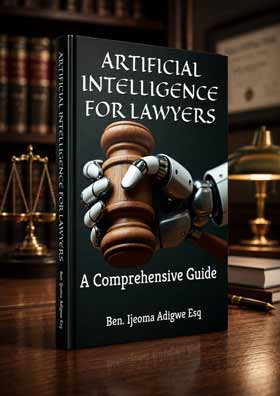 The book also examines Nigeria's legal ecosystem, focusing on the LPELR and NBA AI Guidelines. As a bonus, every purchase comes with a FREE eBook titled: How to Use the AI Features in LegalPedia and LawPavilion.
Ohio Books Ltd praises the publication, stating:
"....this is the only Nigerian book I know of on the topic."
How to Order:
📞 Call, Text, or WhatsApp: 08034917063 | 07055285878
📧 Email: benadigwe1@gmail.com
🌎 Website: www.benadigwe.com
Ebook Version: Access it directly online at https://selar.com/prv626
Authored by Ben Ijeoma Adigwe Esq., ACIarb (UK), LL.M, Dip. in Artificial Intelligence, Director at the Delta State Ministry of Justice, Asaba, Nigeria.
_______________________________________________________________________
The book also examines Nigeria's legal ecosystem, focusing on the LPELR and NBA AI Guidelines. As a bonus, every purchase comes with a FREE eBook titled: How to Use the AI Features in LegalPedia and LawPavilion.
Ohio Books Ltd praises the publication, stating:
"....this is the only Nigerian book I know of on the topic."
How to Order:
📞 Call, Text, or WhatsApp: 08034917063 | 07055285878
📧 Email: benadigwe1@gmail.com
🌎 Website: www.benadigwe.com
Ebook Version: Access it directly online at https://selar.com/prv626
Authored by Ben Ijeoma Adigwe Esq., ACIarb (UK), LL.M, Dip. in Artificial Intelligence, Director at the Delta State Ministry of Justice, Asaba, Nigeria.
_______________________________________________________________________