By Festus Ogun, Esq

Introduction
The decision of the High Court of Lagos State in David Ayooluwa Akindoyin v. Joint Admissions and Matriculation Board (JAMB) Suit No: ID/18508MFHR/2024 (unreported) delivered by Hon. Justice A.M. Lawal on December 30 2024 represents a significant shift in our child right’s jurisprudence and has far-reaching implications on our tottering educational system.
The brief facts are that: David Ayooluwa Akindoyin (“the Applicant”), a 15-year-old boy, was admitted to study Computer Engineering at Redeemer’s University. However, he could not get his official admission letter from JAMB (“the Respondent”) because of an age policy that requires candidates seeking admission to higher institutions in Nigeria to be at least 16 years old. The Applicant was refused admission letter despite his excellent performance in his WAEC and JAMB papers.
It was the contention of the Applicant, who sued through his father, that JAMB’s action was contrary to Section 42 of the 1999 Constitution of the Federal Republic of Nigeria, which prohibits discrimination and the Child Rights Act, which provides for the need to prioritize the child’s best interests in all circumstances. The Applicant argued that JAMB policy was not in the interest of the Nigerian child.
JAMB, in its defense, insisted that the age requirement was a legitimate administrative guideline applicable to all candidates and that the Lagos State High Court lacked jurisdiction over the matter, arguing that only the Federal High Court could adjudicate on cases involving federal agencies. Interestingly, JAMB argued that there was no violation of human rights as Section 42 of the Constitution did not expressly provide that “discrimination on the ground of age” is unlawful.
Legal Issues and Judicial Reasoning
On jurisdiction, JAMB argued that the Lagos State High Court lacks the jurisdiction to adjudicate on the matter, citing Section 251 of the Constitution, which grants exclusive jurisdiction to the Federal High Court in matters involving federal agencies. However, the court overruled the objection on the basis that the Federal and State High Courts enjoy concurrent jurisdiction on matters for enforcement of fundamental rights. The court was right.
Now to the meat of the case: The central legal issue was whether JAMB’s refusal to issue an admission letter to the Applicant constituted discrimination under Section 42 of the Constitution. While “age” is not explicitly mentioned among the grounds for discrimination listed under Section 42 in the Constitution, the court took a broader interpretation of the provision. The Court held that arbitrary age restrictions, especially when applied inconsistently and without considering individual merit, could indeed amount to discrimination. The court also drew strength from international legal instruments such as Article 26 of the Universal Declaration of Human Rights (UDHR) and the Child Rights Act, both of which emphasize the right to education and the importance of prioritizing the child’s best interests.
The court found that JAMB’s application of its age policy was inconsistent and unfair; the Applicant was allowed to register for JAMB examination, sat for the test, received his results, and even change his institution to Redeemer’s University with JAMB’s approval. At no point during these process did JAMB raise any objection based on his age. It was only after Redeemer’s University had offered him admission that JAMB refused to issue the admission letter, citing an age policy. The Court, quite courageously, held the actions of JAMB to be procedurally unfair and constitutes a violation of the Applicant’s right to fair hearing under Section 36 of the Constitution.
Interestingly, the Court took judicial notice of the fact that there are children who, despite their young age, displayed exceptional intelligence and maturity, making them fit for university education. My Lord cited examples of young Nigerian prodigies like Joshua Agboola, Esther Okade, and David Balogun, who achieved sterling academic feats far beyond what was expected of their tender ages. It was the view of the Court that imposing rigid age restrictions without giving room for exceptions unfairly penalizes gifted children and stifles their academic potential.
Significance of the Judgment
Following the court’s decision, JAMB announced in 2025 that gifted candidates under the age of 15 would be allowed to register for the UTME. To qualify for admission into tertiary institutions, these candidates must score at least 280 in the UTME and excel in their Senior Secondary Certificate Examination (SSCE) and post-UTME screenings. Subsequently, the agency introduced a new prompt on its registration portal where underage candidates must acknowledge their status by selecting: “I understand that I am underage and would like to apply for normal UTME as an exceptionally brilliant candidate.” This change directly responds to the court’s recognition of the need for flexibility in applying age-based admission policies. A win, if you ask me.
The biggest perk: the right to education in Nigeria has now moved from a policy objective under Chapter 2 of the Constitution to a fundamental right, enforceable under the Constitution – at least, as far as the issue of discrimination is concerned. This decision has the potential of influencing not just educational policies but also legal approach on issues relating the right to education in Nigeria.
This author considers the recognition of the legal rights of gifted children in Nigeria as one worthy of commendation. By explicitly acknowledging that gifted children deserve special consideration under the Child Rights Act, there is an obvious shift in how educational institutions should accommodate students with exceptional academic abilities, regardless of their age.
Conclusion
In the final analysis, this judgment has a positive impact on educational rights in Nigeria. This judgment, when considered alongside the decision of the High Court of Delta State in Aikpopko Martins v JAMB Suit No W/311/FHR/2024 (Unreported), reinforces the position that the 16-year minimum age admission policy of JAMB violates Sections 18 and 42 of the 1999 Constitution and thereby unconstitutional. By challenging rigid, discriminating age policies and recognizing exceptional academic talent, this judgment has expounded the jurisprudence on the right to education as a fundamental human right and set the stage for more inclusive educational practices.
Festus Ogun is a human rights lawyer and Managing Partner at FOLEGAL, Lagos. festusogunlaw@gmail.com
[A MUST HAVE] Evidence Act Demystified With Recent And Contemporary Cases And Materials

Available now for NGN 40,000 at ASC Publications, 10, Boyle Street, Onikan, Lagos. Beside High Court, TBS. Email publications@ayindesanni.com or WhatsApp +2347056667384. Purchase Link: https://paystack.com/buy/evidence-act-complete-annotation
______________________________________________________________________ “Enhance Legal Practice With Authoritative Reports” — Alexander Payne Offers Comprehensive Law Reports, Spanning Over A Century Of Nigerian Jurisprudence Interested buyers are encouraged to place their orders and enquiries via:
0704 444 4777, 0704 444 4999, 0818 199 9888
Website: www.alexandernigeria.com
Interested buyers are encouraged to place their orders and enquiries via:
0704 444 4777, 0704 444 4999, 0818 199 9888
Website: www.alexandernigeria.com
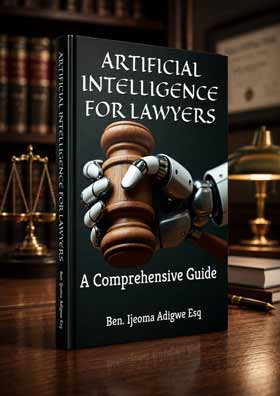 The book also examines Nigeria's legal ecosystem, focusing on the LPELR and NBA AI Guidelines. As a bonus, every purchase comes with a FREE eBook titled: How to Use the AI Features in LegalPedia and LawPavilion.
Ohio Books Ltd praises the publication, stating:
"....this is the only Nigerian book I know of on the topic."
How to Order:
📞 Call, Text, or WhatsApp: 08034917063 | 07055285878
📧 Email: benadigwe1@gmail.com
🌎 Website: www.benadigwe.com
Ebook Version: Access it directly online at https://selar.com/prv626
Authored by Ben Ijeoma Adigwe Esq., ACIarb (UK), LL.M, Dip. in Artificial Intelligence, Director at the Delta State Ministry of Justice, Asaba, Nigeria.
______________________________________________________________________
The book also examines Nigeria's legal ecosystem, focusing on the LPELR and NBA AI Guidelines. As a bonus, every purchase comes with a FREE eBook titled: How to Use the AI Features in LegalPedia and LawPavilion.
Ohio Books Ltd praises the publication, stating:
"....this is the only Nigerian book I know of on the topic."
How to Order:
📞 Call, Text, or WhatsApp: 08034917063 | 07055285878
📧 Email: benadigwe1@gmail.com
🌎 Website: www.benadigwe.com
Ebook Version: Access it directly online at https://selar.com/prv626
Authored by Ben Ijeoma Adigwe Esq., ACIarb (UK), LL.M, Dip. in Artificial Intelligence, Director at the Delta State Ministry of Justice, Asaba, Nigeria.
______________________________________________________________________