In a major blow to former President Donald Trump’s economic agenda, a U.S. federal court has struck down his sweeping global tariff regime, ruling that he lacked the authority to unilaterally impose import taxes on nearly every trading partner of the United States.

The Court of International Trade, sitting in New York, held that Trump’s use of the International Emergency Economic Powers Act (IEEPA) to justify the tariffs was unconstitutional. The three-judge panel concluded that the U.S. Constitution reserves the power to regulate international commerce exclusively to Congress and that the emergency law cited did not override that separation of powers.
The decision stemmed from two consolidated lawsuits—one filed by the nonpartisan Liberty Justice Center on behalf of small businesses affected by the tariffs, and the other by a coalition of twelve U.S. state governments led by New York Attorney General Letitia James.
The court also blocked a separate set of tariffs imposed on countries including China, Mexico, and Canada, which the Trump administration claimed were necessary to combat drug trafficking and illegal immigration. However, the ruling did not address tariffs related to specific goods such as cars, steel, and aluminum, which are governed by other laws.
“The law is clear: no president has the power to single-handedly raise taxes whenever they like,” said Attorney General James, praising the court’s decision as a win for constitutional governance.
The White House swiftly criticized the decision. Deputy Press Secretary Kush Desai stated, “It is not for unelected judges to decide how to properly address a national emergency,” signalling that the administration will appeal the ruling. The court has given the federal government 10 days to comply with the order, though the White House has asked for a stay while it pursues an appeal.
The case is likely to head to the Supreme Court, and analysts suggest that even if the ruling is upheld, Trump could explore other legal avenues to reintroduce targeted tariffs—albeit with more procedural hurdles. For example, under existing trade laws, the president may impose limited tariffs for short durations in response to specific trade imbalances or national security concerns.
The ruling sparked a positive reaction in global financial markets. U.S. and Asian stocks rose in early trading, while European markets remained largely flat. Businesses affected by the tariffs welcomed the court’s decision but were advised by trade experts that the levies would remain in place temporarily until the legal process concludes.
John Leonard, a former senior official at the U.S. Customs and Border Protection (CBP), said refunds could be issued if the tariffs are ultimately ruled invalid. “For now, importers will still be required to pay the duties,” he noted.
The decision could complicate ongoing trade negotiations between the U.S. and other countries. Analysts from Capital Economics warned that the ruling would likely stall the Trump administration’s push to secure fast-track deals during the 90-day tariff pause, as other countries may now wait for more legal certainty.
Of particular interest is a recently announced UK-US agreement that includes tariff reductions on key British exports such as cars, steel, and aluminium. While that part of the deal remains unaffected, the broader 10% tariff on most UK goods now hangs in the balance.
The UK government has not officially commented on the court ruling but reiterated its commitment to ensuring British businesses benefit from the bilateral agreement “as quickly as possible.”
On April 2, 2025, Trump introduced a dramatic new tariff policy, dubbed “Liberation Day,” imposing a 10% baseline duty on imports from most nations, with steeper rates for others—including U.S. allies. He claimed the move would revive domestic manufacturing, protect American jobs, and force fairer trade terms.
But the policy faced immediate backlash from international partners, U.S. states, and import-reliant businesses. Thursday’s court ruling now marks the most significant legal rebuke of that policy to date, potentially reshaping how future administrations approach trade and executive power.
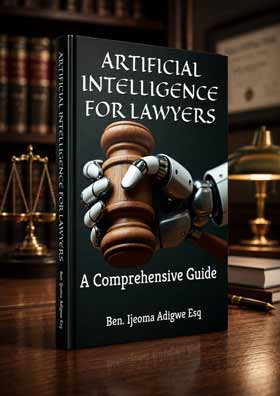 The book also examines Nigeria's legal ecosystem, focusing on the LPELR and NBA AI Guidelines. As a bonus, every purchase comes with a FREE eBook titled: How to Use the AI Features in LegalPedia and LawPavilion.
Ohio Books Ltd praises the publication, stating:
"....this is the only Nigerian book I know of on the topic."
How to Order:
📞 Call, Text, or WhatsApp: 08034917063 | 07055285878
📧 Email: benadigwe1@gmail.com
🌎 Website: www.benadigwe.com
Ebook Version: Access it directly online at https://selar.com/prv626
Authored by Ben Ijeoma Adigwe Esq., ACIarb (UK), LL.M, Dip. in Artificial Intelligence, Director at the Delta State Ministry of Justice, Asaba, Nigeria.
_______________________________________________________________________
“Enhance Legal Practice With Authoritative Reports” — Alexander Payne Offers Comprehensive Law Reports, Spanning Over A Century Of Nigerian Jurisprudence
The book also examines Nigeria's legal ecosystem, focusing on the LPELR and NBA AI Guidelines. As a bonus, every purchase comes with a FREE eBook titled: How to Use the AI Features in LegalPedia and LawPavilion.
Ohio Books Ltd praises the publication, stating:
"....this is the only Nigerian book I know of on the topic."
How to Order:
📞 Call, Text, or WhatsApp: 08034917063 | 07055285878
📧 Email: benadigwe1@gmail.com
🌎 Website: www.benadigwe.com
Ebook Version: Access it directly online at https://selar.com/prv626
Authored by Ben Ijeoma Adigwe Esq., ACIarb (UK), LL.M, Dip. in Artificial Intelligence, Director at the Delta State Ministry of Justice, Asaba, Nigeria.
_______________________________________________________________________
“Enhance Legal Practice With Authoritative Reports” — Alexander Payne Offers Comprehensive Law Reports, Spanning Over A Century Of Nigerian Jurisprudence
 Interested buyers are encouraged to place their orders and enquiries via:
0704 444 4777, 0704 444 4999, 0818 199 9888
Website: www.alexandernigeria.com
Interested buyers are encouraged to place their orders and enquiries via:
0704 444 4777, 0704 444 4999, 0818 199 9888
Website: www.alexandernigeria.com