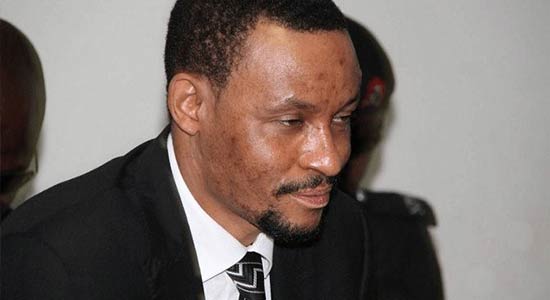
Justice Danladi Yakubu Umar, the embattled Chairman of the Code of Conduct Tribunal (CCT), has quietly withdrawn his lawsuit challenging the controversial appointment of Dr. Mainasara Umar Kogo as his successor—an appointment made by President Bola Ahmed Tinubu, allegedly in violation of constitutional procedures.

In Suit No: FHC/ABJ/CS/1796/2024, filed at the Federal High Court, Abuja, Justice Umar—alongside several civil society groups—had sought to nullify Dr. Kogo’s appointment. The respondents in the suit included President Tinubu, the Attorney-General of the Federation Lateef Fagbemi (SAN), Senate President Godswill Akpabio, the National Assembly, the National Judicial Council (NJC), and the Federal Judicial Service Commission (FJSC), among others.
However, in a surprising turn, a “Notice of Discontinuance” dated March 20, 2025, and signed by Umar’s legal team—M.M. Maidoki, A.G. Salisu, and Jibrin S. Jibrin—was filed, formally ending the legal challenge.
Sources told PRNigeria that Justice Umar withdrew the suit following intense pressure from family members and respected elders from Toro, his hometown in Bauchi State, who urged him to prioritize family honour and avoid further political tensions.
A member of Umar’s legal team disclosed that although they firmly believed that President Tinubu, the National Assembly, and Secretary to the Government of the Federation (SGF) Senator George Akume had acted unlawfully, they ultimately advised him to withdraw the case for his safety and to protect his family’s integrity.
The controversy surrounding Justice Umar’s removal sparked serious constitutional debates involving the Presidency, the National Assembly, and the SGF. President Tinubu had first announced Dr. Kogo’s appointment in July 2024 through his spokesman Ajuri Ngelale, even though Umar’s tenure had not yet expired.
Further fuelling suspicion, Dr. Kogo’s official appointment letter, signed by SGF George Akume, was dated January 20, 2025, but backdated to November 27, 2024—an irregularity that drew criticism from legal scholars and political analysts.
The National Assembly also added to the confusion by initially citing an incorrect constitutional provision and misstating the appointee’s name—errors they later corrected—leading many to conclude that Umar’s removal was politically motivated rather than based on proven misconduct.
The move was widely condemned by legal experts. Senior Advocates of Nigeria (SANs) such as Prof. Mamman Lawan Yusufari, Dr. Wahab Shittu, and Prof. Yemi Akinseye George argued that under the Fifth Schedule of the 1999 Constitution, only the National Judicial Council (NJC) and the Federal Judicial Service Commission (FJSC) are empowered to nominate and recommend candidates for appointment to the CCT—not the President acting unilaterally.
There is no public evidence that the NJC, chaired by Chief Justice of Nigeria Justice Kudirat Kekere-Ekun, recommended any successor. Similarly, there is no indication that the National Assembly achieved the two-thirds majority required to lawfully remove Justice Umar.
The removal move was reportedly initiated at the behest of the Presidency, culminating in the litigation now withdrawn. Notably, President Tinubu, Attorney-General Fagbemi, and other key officials had already filed their statements of defence before the case was discontinued.
Justice Umar has previously presided over politically sensitive cases, including the 2012 trial of then-Lagos State Governor Bola Tinubu over alleged false asset declarations. Though he discharged Tinubu, he did not acquit him—an outcome some believe might have complicated Tinubu’s later political rise.
With the lawsuit now withdrawn, it remains uncertain whether Justice Umar will formally step aside or seek alternative legal or political means to contest Dr. Kogo’s appointment.
The Code of Conduct Tribunal (CCT) is a specialized court responsible for enforcing ethical standards among Nigerian public officers. It is empowered to try politicians, civil servants, judges, and others accused of breaching the Code of Conduct, including false asset declarations, foreign account ownership, conflicts of interest, and corruption-related misconduct. Upon conviction, the Tribunal can impose penalties such as removal from office, disqualification from holding public office for up to ten years, and the forfeiture of assets acquired unlawfully.
 Interested buyers are encouraged to place their orders and enquiries via:
0704 444 4777, 0704 444 4999, 0818 199 9888
Website: www.alexandernigeria.com
Interested buyers are encouraged to place their orders and enquiries via:
0704 444 4777, 0704 444 4999, 0818 199 9888
Website: www.alexandernigeria.com

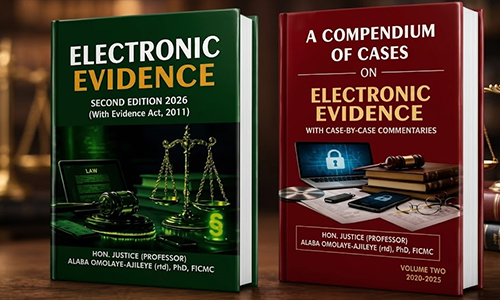
“Order Justice Omolaye-Ajileye’s Electronic Evidence Books Now” — Essential Guides On Evidence Act, Case Law And Digital Proof
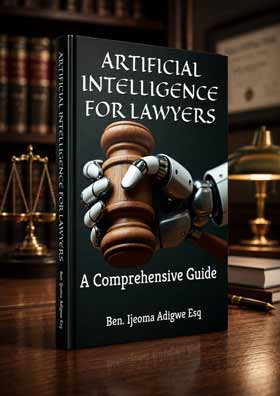 The book also examines Nigeria's legal ecosystem, focusing on the LPELR and NBA AI Guidelines. As a bonus, every purchase comes with a FREE eBook titled: How to Use the AI Features in LegalPedia and LawPavilion.
Ohio Books Ltd praises the publication, stating:
"....this is the only Nigerian book I know of on the topic."
How to Order:
📞 Call, Text, or WhatsApp: 08034917063 | 07055285878
📧 Email: benadigwe1@gmail.com
🌎 Website: www.benadigwe.com
Ebook Version: Access it directly online at https://selar.com/prv626
Authored by Ben Ijeoma Adigwe Esq., ACIarb (UK), LL.M, Dip. in Artificial Intelligence, Director at the Delta State Ministry of Justice, Asaba, Nigeria.
_______________________________________________________________________
The book also examines Nigeria's legal ecosystem, focusing on the LPELR and NBA AI Guidelines. As a bonus, every purchase comes with a FREE eBook titled: How to Use the AI Features in LegalPedia and LawPavilion.
Ohio Books Ltd praises the publication, stating:
"....this is the only Nigerian book I know of on the topic."
How to Order:
📞 Call, Text, or WhatsApp: 08034917063 | 07055285878
📧 Email: benadigwe1@gmail.com
🌎 Website: www.benadigwe.com
Ebook Version: Access it directly online at https://selar.com/prv626
Authored by Ben Ijeoma Adigwe Esq., ACIarb (UK), LL.M, Dip. in Artificial Intelligence, Director at the Delta State Ministry of Justice, Asaba, Nigeria.
_______________________________________________________________________