The Chief Justice of Nigeria (CJN), Justice Kudirat Kekere-Ekun, on Monday said the judiciary had become a prime target for cyberattacks due to the sensitive case files, personal information, and classified government data it handles.


She warned that with the adoption of digital innovations to enhance the efficiency, accessibility, and transparency of court processes, “we must also recognize the risks associated with online systems, particularly cyber threats and data breaches.”
The CJN, who spoke at the opening session of a Hybrid National Workshop for Information and Communication Technology (ICT) staff members of various courts in the country, organized by the National Judicial Institute (NJI) in Abuja, stressed that strong cybersecurity frameworks must be implemented to safeguard judicial data from unauthorized access, hacking, and corruption.
She said: “Judicial ICT staff must be trained in cybersecurity best practices, encryption technologies, and secure data storage solutions.
“Protecting the integrity of court records is paramount, as any compromise could have far-reaching legal and national security implications.
“It is important to acknowledge that the National Judicial Council (NJC) has taken various proactive steps to ensure the judiciary keeps pace with technological advancements.
“One such initiative is the Judiciary Information Technology Policy (JITPO), which has provided a framework for the deployment and utilization of ICT in our courts.
“This policy is currently undergoing revision to incorporate emerging digital trends, address identified gaps, and ensure its continued relevance in enhancing the efficiency and security of judicial processes.
“The ongoing efforts to refine JITPO underscore the judiciary’s commitment to continuous improvement in the adoption of technology for justice delivery.
“Digital transformation in the judiciary cannot be achieved in isolation. It requires collaborative partnerships between the judiciary, legal practitioners, technology experts, policymakers, and international organizations.
“Public-private partnerships can play a crucial role in developing customized digital solutions for Nigeria’s judicial system.
“As technology continues to evolve, we must also encourage homegrown innovations tailored to our unique legal and socio-economic realities. I urge judicial ICT personnel to explore local technological solutions, software development, and research initiatives that enhance the efficiency, security, and accessibility of our justice system.”
Highlighting some of technology’s advantages in the administration of justice, the CJN decried that most courtrooms in the country have limited access to reliable internet connectivity.
“Technology plays a multifaceted role in the administration of justice. It enhances the speed at which cases are heard and determined, thereby reducing backlog and delays.
“It also ensures greater transparency and accountability, allowing for the efficient tracking of cases, seamless documentation of judicial proceedings, and improved access to legal resources.
“One of the most significant areas where technology has proven invaluable is electronic case management. By automating case filing, record-keeping, and retrieval processes, courts can minimize human error, enhance workflow, and reduce paperwork.
“This ensures that judges and court administrators can focus on adjudication rather than being overburdened by administrative inefficiencies.
“Furthermore, digital innovations such as Artificial Intelligence (AI) and Machine Learning are revolutionizing legal research and judgment writing.
“AI-powered legal databases provide instant access to case laws, precedents, and statutes, significantly reducing research time and improving the accuracy of legal reasoning.
“While these advancements hold immense promise, it is crucial to acknowledge and address the digital divide within the legal sector.
“Some courtrooms across Nigeria remain constrained by limited access to reliable internet connectivity, inadequate digital infrastructure, and a lack of technical expertise among judicial staff.
“To bridge this gap, the judiciary must prioritize capacity-building initiatives that equip judicial officers and ICT personnel with the requisite skills to operate digital systems effectively.
“Training workshops such as this serve as a cornerstone for continuous learning, ensuring that all stakeholders are adequately prepared to navigate the digital future of the judiciary,” she added.
In his welcome address, the NJI Administrator, Justice Salisu Abdullahi, said the workshop, which had the theme “The Digital Evolution of Judicial Systems: Technology, Access, and Efficiency,” underscored the role of digital technologies in modernizing and strengthening the judicial system.
“The aim of organizing this workshop annually is to equip court personnel with the necessary skills and knowledge to keep pace with technological advancements, and to ensure that they can effectively leverage technology in their roles, thus contributing to a more efficient and modern judicial system,” Justice Abdullahi stated.
 Interested buyers are encouraged to place their orders and enquiries via:
0704 444 4777, 0704 444 4999, 0818 199 9888
Website: www.alexandernigeria.com
Interested buyers are encouraged to place their orders and enquiries via:
0704 444 4777, 0704 444 4999, 0818 199 9888
Website: www.alexandernigeria.com

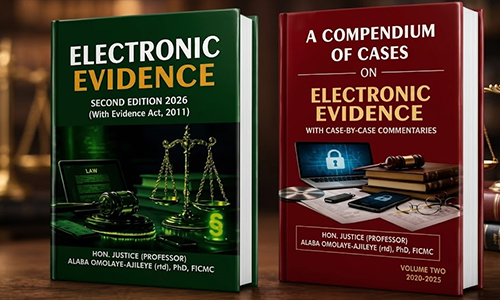
“Order Justice Omolaye-Ajileye’s Electronic Evidence Books Now” — Essential Guides On Evidence Act, Case Law And Digital Proof
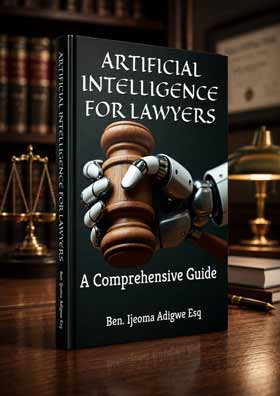 The book also examines Nigeria's legal ecosystem, focusing on the LPELR and NBA AI Guidelines. As a bonus, every purchase comes with a FREE eBook titled: How to Use the AI Features in LegalPedia and LawPavilion.
Ohio Books Ltd praises the publication, stating:
"....this is the only Nigerian book I know of on the topic."
How to Order:
📞 Call, Text, or WhatsApp: 08034917063 | 07055285878
📧 Email: benadigwe1@gmail.com
🌎 Website: www.benadigwe.com
Ebook Version: Access it directly online at https://selar.com/prv626
Authored by Ben Ijeoma Adigwe Esq., ACIarb (UK), LL.M, Dip. in Artificial Intelligence, Director at the Delta State Ministry of Justice, Asaba, Nigeria.
_______________________________________________________________________
The book also examines Nigeria's legal ecosystem, focusing on the LPELR and NBA AI Guidelines. As a bonus, every purchase comes with a FREE eBook titled: How to Use the AI Features in LegalPedia and LawPavilion.
Ohio Books Ltd praises the publication, stating:
"....this is the only Nigerian book I know of on the topic."
How to Order:
📞 Call, Text, or WhatsApp: 08034917063 | 07055285878
📧 Email: benadigwe1@gmail.com
🌎 Website: www.benadigwe.com
Ebook Version: Access it directly online at https://selar.com/prv626
Authored by Ben Ijeoma Adigwe Esq., ACIarb (UK), LL.M, Dip. in Artificial Intelligence, Director at the Delta State Ministry of Justice, Asaba, Nigeria.
_______________________________________________________________________