By Muhammad Awwal Zakari

In Nigeria’s public discourse today, political actors and fellow citizens have become increasingly charged, expressing their frustrations over judicial decisions. The one irksome phrase that has emerged from this climate is “Judicial banditry”, a phrase that has sparked both controversy and legal concerns. While it may seem like a sort of rhetorical expression or political exaggeration, the implications of this phrase are far-reaching and legally dangerous. Its usage is as a matter of fact and law, contemptuous in Nigeria.
Let’s dive into the following reasons why this is so;
First, this amounts to Direct Assault on the Integrity of the Judiciary. The phrase “judicial banditry” implies that judges or the judiciary act like bandits (unlawfully, violently, and with corrupt intent). Not only is more than criticism but a grave and defamatory accusation of the Judiciary as a legally empowered institution. It insinuates that judicial officers engage in dishonest or criminal behavior, which undermines the public’s confidence in the judiciary’s ability to deliver justice. The judiciary is the guardian of the rule of law, and such inflammatory labels can erode public trust in the legal system, leading to instability and loss of faith in constitutional processes.
Second, it is an act of scandalizing the Court “Contempt of Court” and Nigerian law, in tandem with the common law principles, recognizes the concept of contempt of court. This occurs when someone makes statements or publications that degrade, insult, or otherwise bring the court into disrepute. Using a phrase like “judicial banditry” falls squarely within this realm. The purpose of contempt laws is not to shield the judiciary from criticism, but to protect its authority and credibility, which are essential for justice to function.
Third, the tendency for people to prejudge cases in Court. The ‘sub judice’ rule prohibits public comments that might prejudice ongoing judicial proceedings. If the phrase “judicial banditry” is used in reaction to a judgment that is under appeal or still subject to review, it could amount to interference with the administration of justice. Public figures, particularly politicians, lawyers and media commentators are expected to exercise restraint and allow the legal process to take its course.
Fourth, such an expression is an affront to Constitutional Order. By reference to Section 6 of the Constitution of the Federal Republic of Nigeria 1999 establishes the judicial powers of the Federation. The judiciary is meant to operate independently and impartially. When individuals label its actions as banditry, they are not only attacking judges personally but also challenging the very foundation of constitutional democracy. Such conduct can amount to an abuse of freedom of expression, which is not absolute, especially when it threatens public order and judicial integrity.
On Contempt of Court, it has been stated with consummate clarity, in the case of ANAKWENZE V. TAPP INDUSTRY LTD (1991) 7 NWLR (Pt. 202) 177, that, protecting Judicial dignity; “Contempt of court exists to protect the dignity of the court in order to ensure that justice shall be done. It prohibits acts and words which tend to obstruct the due administration of justice, otherwise the rights and indeed the liberty of individuals would perish. Although the power to punish for contemptuous cases belongs to the court, such power must be used or employed sparingly.”
Also, in EZEWANKWO V. STATE (2015) 2 NWLR (Pt. 1443) 265, distinction has been made between various Contempt: “Contempt is commonly classified as civil contempt and criminal contempt. Criminal contempt are also two: contempt committed in the face of the court; (a) and (b) contempt committed out of court.The catalogue of criminal contempt in and out of court is not exhaustive however, it includes, as in the instant case, libel on Judges, courts or their officers.”
Ultimately, there have been instances in Nigeria where individuals were cautioned, fined, or even sanctioned for contemptuous remarks about the judiciary. The courts have consistently affirmed that while constructive criticism is allowed, defamatory and inciteful language will not be tolerated. As the judiciary continues to play a pivotal role in shaping Nigeria’s democratic journey, it is imperative that citizens, especially public influencers, engage in responsible dialogue.
In conclusion, the usage of Words matter especially when they are directed at institutions that hold the fabric of a nation together. Describing judicial actions as “banditry” is more than a verbal jab, it is a contemptuous act that can attract legal implications. In a time when Nigeria needs stronger institutions, not weakened ones, protecting the integrity of the judiciary is not just a legal obligation but a civic duty.
Muhammad Awwal Zakari is an artist, writer, researcher and a passionate Law student of Bayero University, Kano. Can be reached at muhammadawwalzakari001@gmail.com. LinkedIn profile: https://www.linkedin.com/in/muhammad-awwal-zakari-a25b3b314
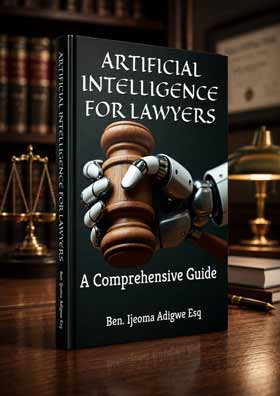 The book also examines Nigeria's legal ecosystem, focusing on the LPELR and NBA AI Guidelines. As a bonus, every purchase comes with a FREE eBook titled: How to Use the AI Features in LegalPedia and LawPavilion.
Ohio Books Ltd praises the publication, stating:
"....this is the only Nigerian book I know of on the topic."
How to Order:
📞 Call, Text, or WhatsApp: 08034917063 | 07055285878
📧 Email: benadigwe1@gmail.com
🌎 Website: www.benadigwe.com
Ebook Version: Access it directly online at https://selar.com/prv626
Authored by Ben Ijeoma Adigwe Esq., ACIarb (UK), LL.M, Dip. in Artificial Intelligence, Director at the Delta State Ministry of Justice, Asaba, Nigeria.
______________________________________________________________________
[A MUST HAVE] Evidence Act Demystified With Recent And Contemporary Cases And Materials
The book also examines Nigeria's legal ecosystem, focusing on the LPELR and NBA AI Guidelines. As a bonus, every purchase comes with a FREE eBook titled: How to Use the AI Features in LegalPedia and LawPavilion.
Ohio Books Ltd praises the publication, stating:
"....this is the only Nigerian book I know of on the topic."
How to Order:
📞 Call, Text, or WhatsApp: 08034917063 | 07055285878
📧 Email: benadigwe1@gmail.com
🌎 Website: www.benadigwe.com
Ebook Version: Access it directly online at https://selar.com/prv626
Authored by Ben Ijeoma Adigwe Esq., ACIarb (UK), LL.M, Dip. in Artificial Intelligence, Director at the Delta State Ministry of Justice, Asaba, Nigeria.
______________________________________________________________________
[A MUST HAVE] Evidence Act Demystified With Recent And Contemporary Cases And Materials

 Interested buyers are encouraged to place their orders and enquiries via:
0704 444 4777, 0704 444 4999, 0818 199 9888
Website: www.alexandernigeria.com
Interested buyers are encouraged to place their orders and enquiries via:
0704 444 4777, 0704 444 4999, 0818 199 9888
Website: www.alexandernigeria.com