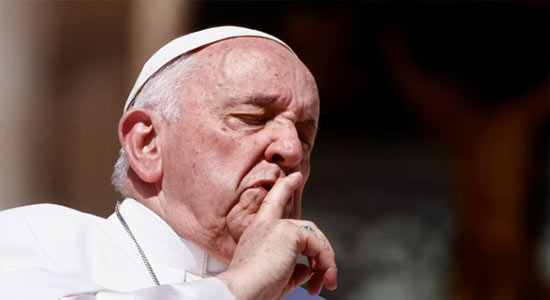
Pope Francis, 88, a humble reformer who sought to make the Catholic Church more inclusive much to the ire of some conservatives, has died, the Vatican said Easter Monday.
Cardinal Kevin Farrell, Camerlengo of the Apostolic Chamber, announced the pope’s death from the Casa Santa Marta with these words, according to Vatican News:
“Dearest brothers and sisters, with deep sorrow I must announce the death of our Holy Father Francis. At 7:35 this morning, the Bishop of Rome, Francis, returned to the house of the Father. His entire life was dedicated to the service of the Lord and of His Church. He taught us to live the values of the Gospel with fidelity, courage, and universal love, especially in favor of the poorest and most marginalized. With immense gratitude for his example as a true disciple of the Lord Jesus, we commend the soul of Pope Francis to the infinite merciful love of the One and Triune God.”
The pope’s death comes one day after a frail but determined Francis greeted thousands in St. Peter’s Square after Easter Mass in his open-air popemobile − and just weeks after an extended hospital stay in which he battled bilateral pneumonia and other health issues
The pope, who shunned pomp and privilege and loved to be among the people, sat in a raised chair in the vehicle as thousands cheered “viva il papa.” He stopped at several places along the square, much to the delight of the crowd.
Born Jorge Mario Bergoglio in Buenos Aires to Italian immigrant parents, Francis rose through the ranks as a Jesuit priest in his home country of Argentina. Elected in March 2013, Francis was the 266th pope, the first pope from the Americas and the first born outside of Europe in over a millennia. During his papacy, he was praised and criticized for commenting on political issues, from immigration to LGBTQ issues.
Francis draws praise from LGBTQ+ ministry
Francis DeBernardo, executive director of New Ways Ministry, a Catholic ministry of justice and reconciliation for LGBTQ+ people, called Francis a ” a “gift to the church and to the LGBTQ+ community.” DeBernardo credited the pope with encouraging church leaders to “accompany, listen, and dialogue with LGBTQ+ people,” thus opening doors that had been “sealed shut by the homophobia and transphobia” of previous popes.
“Francis was not only the first pope to use the word “gay” when speaking about LGBTQ+ people, he was the first pope to speak lovingly and tenderly to them,” DeBernardo said in an email to USA TODAY. “His kind words of welcome to this community, traditionally marginalized in the church, rang loudly around the globe.”
When did JD Vance meet the pope?
Vice President JD Vance shared his condolences April 21 after the death of Pope Francis, a day after he met with the head of the Catholic Church in the Vatican. Photos taken by the Vatican and shared by the White House showed a smiling Vance, a Catholic convert who clashed with Francis in the past over immigration, seated across from Francis, who was in a wheelchair.
“My heart goes out to the millions of Christians all over the world who loved him. I was happy to see him yesterday, though he was obviously very ill,” Vance posted on X. “But I’ll always remember him for the … homily he gave in the very early days of COVID. It was really quite beautiful.”
− Francesca Chambers
Pope had been near death in the hospital weeks earlier
Francis’s Easter Sunday appearance in the crowd at St. Peter’s Square came after a hospital stay of more than five weeks during which at one point physicians considered halting treatment to allow him to die peacefully.
Francis was admitted to the hospital on Feb. 14 after a weeklong battle with bronchitis. He had been struggling to speak and even breathe during public appearances. His hospitalization included multiple attacks of “acute respiratory insufficiency,” according to daily updates issued by the Vatican.
While hospitalized, the pope was also diagnosed with a polymicrobial infection and then mild renal insufficiency.
Sergio Alfieri, a physician at Rome’s Gemelli hospital, told Italy’s Corriere della Sera in an interview last month that two weeks into the pope’s hospitalization the medical team had to decide whether to “stop and let him go or force it and try all the drugs and therapies possible.” Alfieri said the pope delegated health care decisions to Massimiliano Strappetti, his personal health assistant, who told the team to “try everything, don’t give up.”
The pope was released from the hospital March 23 and has been back to work, albeit on a shortened schedule.
Pope Francis’ last appearance was Easter Sunday
Before Francis emerged into the crowd at St. Peter’s Square on Easter Sunday in his popemobile, the pope had blessed the throng from a balcony.
He gave a proclamation that ‘Christ, my hope, has risen” before passing on his text to be read by Archbishop Diego Ravelli. An Italian cardinal presided over the Easter morning Mass that drew more than 50,000 faithful gathered to the “flower-filled Saint Peter’s Square,” the Vatican said.
How will the next pope be selected?
The election of a new pope is a highly mystified and sacred process, dating back centuries and enshrined in last year’s award-winning thriller “Conclave.”
The last time the College of Cardinals gathered to vote and select the next representative of God on Earth was more than a dozen years ago, when Pope Francis was selected.
His predecessor, Pope Benedict, stepped down from the papacy in 2013, a decision that had not been made by someone of his station in almost 600 years. Benedict, then 85, cited his age and declining health. He died in 2022. Read more here about what the process will look like.
Francis tapped nearly 80% of the cardinal electors
Francis appointed nearly 80% of the cardinal electors who will choose the next pope, increasing, but not guaranteeing, the possibility that his successor will continue his progressive policies. Some Vatican experts have predicted a more moderate, less divisive successor.
Under his watch, an overhauled Vatican constitution allowed any baptized lay Catholic, including women, to head most departments in the Catholic Church’s central administration.
He put more women in senior Vatican roles than any previous pope but not as many as progressives wanted.
 The book also examines Nigeria's legal ecosystem, focusing on the LPELR and NBA AI Guidelines. As a bonus, every purchase comes with a FREE eBook titled: How to Use the AI Features in LegalPedia and LawPavilion.
Ohio Books Ltd praises the publication, stating:
"....this is the only Nigerian book I know of on the topic."
How to Order:
📞 Call, Text, or WhatsApp: 08034917063 | 07055285878
📧 Email: benadigwe1@gmail.com
🌎 Website: www.benadigwe.com
Ebook Version: Access it directly online at https://selar.com/prv626
Authored by Ben Ijeoma Adigwe Esq., ACIarb (UK), LL.M, Dip. in Artificial Intelligence, Director at the Delta State Ministry of Justice, Asaba, Nigeria.
_______________________________________________________________________
“Enhance Legal Practice With Authoritative Reports” — Alexander Payne Offers Comprehensive Law Reports, Spanning Over A Century Of Nigerian Jurisprudence
The book also examines Nigeria's legal ecosystem, focusing on the LPELR and NBA AI Guidelines. As a bonus, every purchase comes with a FREE eBook titled: How to Use the AI Features in LegalPedia and LawPavilion.
Ohio Books Ltd praises the publication, stating:
"....this is the only Nigerian book I know of on the topic."
How to Order:
📞 Call, Text, or WhatsApp: 08034917063 | 07055285878
📧 Email: benadigwe1@gmail.com
🌎 Website: www.benadigwe.com
Ebook Version: Access it directly online at https://selar.com/prv626
Authored by Ben Ijeoma Adigwe Esq., ACIarb (UK), LL.M, Dip. in Artificial Intelligence, Director at the Delta State Ministry of Justice, Asaba, Nigeria.
_______________________________________________________________________
“Enhance Legal Practice With Authoritative Reports” — Alexander Payne Offers Comprehensive Law Reports, Spanning Over A Century Of Nigerian Jurisprudence
 Interested buyers are encouraged to place their orders and enquiries via:
0704 444 4777, 0704 444 4999, 0818 199 9888
Website: www.alexandernigeria.com
Interested buyers are encouraged to place their orders and enquiries via:
0704 444 4777, 0704 444 4999, 0818 199 9888
Website: www.alexandernigeria.com