By Victor Anayochukwu Jonah

Introduction
From the Nigerian Law School, I was immediately ushered into the devouring claws of Buhari’s administration in 2015. Nigerians assumed they had endured the height of leadership incompetence, bigotry, and recklessness during Muhammadu Buhari’s divisive reign, which spanned eight years—from May 29, 2015, to May 29, 2023. Yet, the current era of ‘Jangabanism’ has proven to be an even graver assault on democracy—a slow, deliberate strangulation of our hard-won freedoms, secured through immense sacrifices, including the loss of lives.
The judiciary, once revered as a pillar of hope even during military regimes, has become a shadow of its former self, reduced to a puppet of the executive. The Supreme Court, now tainted by partisan appointments and questionable rulings, has shattered the people’s trust, delivering decisions that defy legal principles and are detached from the notion of justice and common sense.
In this void of credibility, Nigerians have turned to unconventional and unrefined voices on social media, like #VeryDarkMan, seeking quicker, albeit crude, paths to justice. This phenomenon reflects a desperate populace, disillusioned with a judiciary that no longer serves as the guardian of their rights. The rise of these social media merchants signals not just a collapse of institutional integrity but a broader societal reckoning with the caricature of leadership we have allowed to thrive. I submit, on the strength of Section 14(2)(a) of the 1999 Constitution, that only the sovereign will of the Nigerian people can restore balance and reclaim the essence of justice in Nigeria.
A Journey from Golgotha Back to Golgotha
The genuine efforts of our forebears to rescue Nigeria from the dungeon of retrogression and backwardness to the shining pride of the Black race on the global scene seem, in recent times, to manifest in a cyclic and futile voyage. The Nigerian legal system is, at best, a miniature attempt to mimic the English legal structure, offering little more than constant lip service to the realities of our unique local circumstances.
In this vein, the great English jurist, Lord Denning, admonished: “Be you so high, the law is above you.” It would not be presumptuous to speculate that it was the ingrained discipline of the colonial era that saw Chief Adetokunbo Ademola (Chief Justice of Nigeria, as he then was) steering the ship of this sacred institution from the pre-colonial era of 1958 to the post-colonial and military incursion of 1972.
At the eclipse of the genocidal Nigerian Civil War, during the high-handed military reign of young and boisterous Yakubu Gowon, the Nigerian Supreme Court, led by Chief Ademola, boldly confronted the hot-headed young military officers in the Executive arm. It held that the confiscation of Lakanmi’s property under the Public Officers and Other Persons (Investigation of Assets) Edict No. 5 of 1967 was unconstitutional because it violated the fundamental rights guaranteed by the Constitution. It reechoed: “The Constitution is supreme, and its provisions shall have binding force on all authorities and persons throughout the Federal Republic of Nigeria.” (Lakanmi & Anor. v. Attorney-General (Western State) & Ors. (1970) SC.58/69). For them, there was no pandering to mortal men in military uniform other than the supreme provisions of Constitution in the general interest of Nigeria and Nigerians.
In 1981, the revered Justice Mohammed Bello of the Supreme Court followed the timetested and cherished notion of judicial independence to reiterate: “The judiciary must not only be independent but must also be seen to be independent.” (AttorneyGeneral of Bendel State v. Attorney-General of the Federation (1981) 10 SC 1).
In 1986, one of the finest and most celebrated jurists of that era, Justice Kayode Eso, reined in the military boys under the brutish reign of Ibrahim Badamosi Babangida. He delivered one of the most courageous judicial decisions: “The judiciary must remain the last hope of the common man. It must not be seen as a tool for the executive or any other arm of government.” (Governor of Lagos State v. Ojukwu (1986) 1 NWLR (Pt. 18) 621). As can be deduced, in the heyday of military dictatorship, Justice Kayode Eso made a bold and shocking pronouncement that echoed across military barracks throughout Nigeria. In hindsight, this era represented the glory days of the Nigerian judiciary—a time when its courage and independence were almost unshaken.
The judiciary’s legacy of fearless judgments continued sporadically into the 4th Republic. Most notable was the loud gong of warning echoed by the Supreme Court through Justice Sunday Akinola Akintan in 2007, who boldly confronted and rebuked the power-drunk and daring influence of the President’s executive lawlessness with this statement: ‘The Constitution is supreme, and its provisions shall have binding force on all authorities and persons throughout the Federal Republic of Nigeria. No one, not even the President, is above the Constitution.’ (Attorney-General of the Federation v. Abubakar (2007) 2 All N.L.R. 58). The dramatis personae in this impasse were Vice President Alhaji Atiku Abubakar and President Olusegun Obasanjo.
However, the critical question remains: since 2015, how many audacious decisions has the Supreme Court delivered to check the daily excesses and brazen rascality of the Executive and National Assembly?
Up is Down, Down is Up
The deterioration of the judiciary, headed by the Supreme Court, is glaringly evident in its fairly recent decisions. On January 14, 2020, the people of Imo State woke up with Emeka Ihedioha as governor and went to bed with Hope Uzodinma in the same position. This decision irreparably stained the already damaged integrity of the Supreme Court. Even if the premise for nullifying Mr. Ihedioha’s election by the Supreme Court may arguably be correct, the consequential enthronement of Mr. Uzodinma was akin to arrogating the sovereign will of the Imo people to itself.
On January 20, 2023, and February 13, 2023, the Supreme Court validated the candidacies of Senators Ahmed Lawan and Godswill Akpabio, despite controversies surrounding their non-participation in their parties’ primary elections after earlier contesting in the presidential primaries. In a last-minute twist, the APC substituted the candidates. Perhaps if the Supreme Court had taken a firm stand on internal party democracy within the APC, Nigeria’s current political trajectory in the National Assembly might have been different.
Against widespread rigging, violence, vote-buying, and manipulation of the IREV portal, the Supreme Court validated all the presidential and governorship elections arising from the 2023 general elections. Ironically, it later invalidated the Rivers State local government election, aligning with public perceptions of political vested interests tied to its affiliate, the FCT minister.
On March 7, 2025, the Supreme Court missed another opportunity to uphold the cherished constitutional value of self-defense. Instead of commuting a death sentence to manslaughter, the Court dashed the hopes of Mr. Sunday Jackson by sentencing him to death.
On February 28, 2025, the Supreme Court delivered a judgment that appeared to have been crafted after a joint meeting between President Bola Tinubu and the FCT minister. This judgment approved a grand Machiavellian scheme to place the Rivers State governor at the mercy of federal might. The validation of the Martin Amawhule-led members of the Rivers State House of Assembly, who defected in a televised show, and the seizure of Rivers State’s monthly allocation (contrary to the constitutional principle of federalism) will forever stain the Supreme Court’s image.
As the Supreme Court continues its acrobatic naked dance in full glare of the public, destroying the vestiges of trust once reposed in it, disgruntled Nigerians have resorted to social media warlords and religious leaders—most of whom claim to have received overnight divine calls to rescue them. This is a function that squarely falls within the constitutional confines of judicial and similar institutions of government. The corollary is that the lack of public trust in Nigeria’s legal system has weakened the Bar. Public perception of the profession in Nigeria is now ignoble.
A Glance At the Crystal Ball
There have always been, and will always be, differing perspectives on individual perceptions of how the intangible asset of law should be deployed for social good. However, there is near unanimity of opinion that law should serve as an instrument of justice. A contrary view would amount to an invocation of anarchy.
Legal education in Nigeria remains heavily skewed toward the rote digestion of verbose statutes and judicial pronouncements, often at the expense of fostering critical interrogation and a deeper appreciation of the fundamental essence and purpose of the law.
I have repeatedly watched in utter pain and disgust as some senior lawyers analyze judicial decisions from the apex court and laws enacted by lawmakers at both national and subnational levels, with partisan and parochial considerations, without questioning the motive, rationale, vision, or applicability of these laws for the common good of Nigerians and humanity.
What purpose does the law serve if it is mired in technical jargon, detached from the everyday realities of ordinary people, and fails to act as a catalyst for social engineering? As members of the Bar and Bench, we must embrace the noble and courageous responsibility of wielding both pen and voice to challenge the jurisprudence of laws that hinder our common humanity and societal progress. This is far more honorable than the passive role of merely consuming and reciting the playbooks of lowquality lawmakers, who have assumed the damning position of slave masters at the National Assembly.
Conclusion
History is replete with examples of countries that fought to rescue their nations from the selfish and myopic grip of the few. Such revolutions often emanate from the steel of courage and fearlessness. Nigeria’s potential for Africa and the Black race is immense and towering. No external forces can change Nigeria’s narrative. The people must eschew the parochial sentiments of religion and ethnicity and tell the rascals in power: ENOUGH! Religious houses must lead our people to clarity about the political witchcraft in Aso Rock and state government houses across the federation, rather than perpetuating the opium of religious hallucination that bread falls from heaven and that the undoing of Nigerians are in the villages. Until we understand the power we wield as a people, Nigeria will continue to drift. A few elements pretending to serve our common interest will continue to whip us into submission and dictate how we express our anguish, frustration, and sorrow. Nations are built by selfless men of courage and fine steel, not weaklings.
“For we wrestle not against flesh and blood, but against principalities, against powers, against the rulers of the darkness of this world, against spiritual wickedness in high places.”
Victor Anayochukwu Jonah Lawyer and Public Commentator victorjonah89@yahoo.com.
 Interested buyers are encouraged to place their orders and enquiries via:
0704 444 4777, 0704 444 4999, 0818 199 9888
Website: www.alexandernigeria.com
Interested buyers are encouraged to place their orders and enquiries via:
0704 444 4777, 0704 444 4999, 0818 199 9888
Website: www.alexandernigeria.com

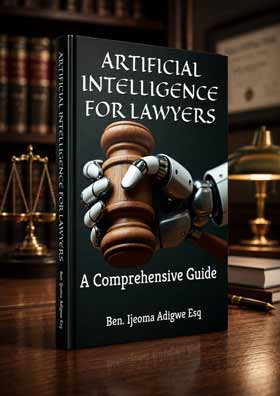 The book also examines Nigeria's legal ecosystem, focusing on the LPELR and NBA AI Guidelines. As a bonus, every purchase comes with a FREE eBook titled: How to Use the AI Features in LegalPedia and LawPavilion.
Ohio Books Ltd praises the publication, stating:
"....this is the only Nigerian book I know of on the topic."
How to Order:
📞 Call, Text, or WhatsApp: 08034917063 | 07055285878
📧 Email: benadigwe1@gmail.com
🌎 Website: www.benadigwe.com
Ebook Version: Access it directly online at https://selar.com/prv626
Authored by Ben Ijeoma Adigwe Esq., ACIarb (UK), LL.M, Dip. in Artificial Intelligence, Director at the Delta State Ministry of Justice, Asaba, Nigeria.
_______________________________________________________________________
The book also examines Nigeria's legal ecosystem, focusing on the LPELR and NBA AI Guidelines. As a bonus, every purchase comes with a FREE eBook titled: How to Use the AI Features in LegalPedia and LawPavilion.
Ohio Books Ltd praises the publication, stating:
"....this is the only Nigerian book I know of on the topic."
How to Order:
📞 Call, Text, or WhatsApp: 08034917063 | 07055285878
📧 Email: benadigwe1@gmail.com
🌎 Website: www.benadigwe.com
Ebook Version: Access it directly online at https://selar.com/prv626
Authored by Ben Ijeoma Adigwe Esq., ACIarb (UK), LL.M, Dip. in Artificial Intelligence, Director at the Delta State Ministry of Justice, Asaba, Nigeria.
_______________________________________________________________________