By Henry Chibuike Ugwu, Esq.

Background
President Bola Tinubu declared a state of emergency in Rivers State, Nigeria, on March 18, 2025. The reasons President Tinubu gave for the declared state of emergency could be grouped into three:
- Political crisis;
- Pipeline vandalism, and
- Institutional breakdown.
President Tinubu based his claims of political crisis on the tension between the Governor of Rivers State- Siminalayi Fubara and some members of Rivers State House of Assembly. President Tinubu also alleged that Governor Siminalayi Fubara unjustifiably demolished the House of Assembly on December 13, 2023, and failed to rebuild it for over 14 months. According to President Tinubu, the Governor and the House of Assembly had failed to work together for peace and good governance of Rivers State.
On pipeline vandalism, President Tinubu claimed that Militants had issued threats against perceived enemies of the Governor Fubara, and the Governor had not disowned or condemned their actions. Furthermore, the President alleged that security reports indicated recent incidents of pipeline vandalisation by militants, and the governor failed to take action to address the situation.
Regarding institutional breakdown, President Tinubu highlighted that the Supreme Court (SC), in its February 28, 2025, judgment on about eight consolidated appeals concerning the political crisis in Rivers State, found that the governor had deliberately dismantled the legislature to govern without oversight, effectively ruling as a despot. The SC declared: “As it is, there is no government in Rivers State.” The Supreme Court then issued orders to restore constitutional democracy in Rivers State. Among these directives was the immediate passage of an Appropriation Bill by the Rivers State House of Assembly, a mandate that has yet to be fulfilled. President Tinubu took the position that the combination of political instability and security challenges has significantly hampered effective governance in the state.
Consequently, President Tinubu suspended the Governor of Rivers State, Mr Siminalayi Fubara, the Deputy Governor, Mrs Ngozi Odu, and all elected members of the House of Assembly of Rivers State for an initial period of six months. Furthermore, the President nominated Vice Admiral Ibokette Ibas (Rtd) as Administrator to take charge of the affairs of Rivers State. President Tinubu noted that the Administrator could “formulate regulations as may be found necessary to do his job, but such regulations will need to be considered and approved by the Federal Executive Council and promulgated by the President for the state.”
The President’s diction is starkly reminiscent of Nigeria’s past unconstitutional military interventions, where democratic governance was arbitrarily suspended, and validly enacted laws were disregarded. This raises grave concerns about the erosion of constitutional rule and the dangerous precedent of executive overreach veering toward illegitimate military-style governance.
State of Emergency under the Nigerian Constitution
Section 305 of the 1999 Constitution of the Federal Republic of Nigeria outlines the procedure for proclaiming a state of emergency. Section 305(3) lists seven specific scenarios in which the President may declare a state of emergency:
- The Federation is at war.
- The Federation faces imminent danger of invasion or being involved in a state of war.
- There is an actual breakdown of public order and safety in any part of the Federation, requiring extraordinary measures to restore peace.
- There is a clear and present danger of a breakdown of public order and safety in any part of the Federation, requiring extraordinary measures to avert the danger.
- There is a disaster or imminent threat of a natural calamity affecting any community or part of the Federation.
- There is a public danger that constitutes a clear threat to the existence of the Federation.
- The President receives a request to do so, in accordance with subsection (4) of this section.
In his broadcast on March 18, 2025, President Tinubu purportedly invoked powers under section 305 to declare a state of emergency in Rivers State. However, a close examination of the conditions outlined in section 305(3) reveals no justification for such a declaration. There is nothing in Rivers State’s recent political climate that surpasses the scope of dispute resolution mechanisms and democratic oversight already provided for in the Nigerian Constitution.
Even assuming, for argument’s sake, that a condition for declaring a state of emergency exists in Rivers State, there is no constitutional provision that grants the President the power to remove or suspend a duly elected governor, deputy governor, or members of the State House of Assembly. Any such suspension is flagrantly unconstitutional and a direct violation of democratic principles.
Section 188 provides for the removal of a governor or deputy governor, while section 189 deals with their permanent incapacity. Neither provision accommodates the manner in which President Tinubu has suspended Governor Siminalayi Fubara and his Deputy. Additionally, section 109 of the Constitution pertains to the tenure of members of a House of Assembly, while Section 110 provides for their recall. None of these provisions grant the President the authority to usurp the powers of a state legislature and appoint an ex-military officer as an Administrator, as President Tinubu has done. Furthermore, nothing in the Constitution grants President Tinubu, the Federal Executive Council, or the Administrator appointed by Tinubu the authority to promulgate laws for Rivers State, as the President has suggested.
A Dangerous Overreach and the Influence of Nyesom Wike
President Tinubu’s actions reflect a worrying overreach. It seems he has adopted the mentality of past military rulers like Sani Abacha, believing himself to be above the Constitution and the democratic processes that govern Nigeria. His claim that he has “soberly reflected on and evaluated the political situation in Rivers State” does not give him the right to unilaterally suspend elected officials. If such unchecked powers are allowed in Rivers, where do we draw the line? What happens after the President has another “sober reflection” in Kano, Bauchi, or any other state? This must be called out, as it sets a dangerous precedent for Nigeria’s democracy.
But there is a bigger issue lurking in the background—the influence of Mr. Nyesom Wike. Everyone knows that Governor Fubara was elected with the backing of his predecessor, Mr. Wike. Since Wike became the Minister of the FCT under President Tinubu, tensions have escalated between the two. The political chaos in Rivers State is largely due to Wike’s continued interference in the State’s governance. Rather than hold the Minister accountable for his meddling, President Tinubu has chosen to take unconstitutional actions against the duly elected officials of Rivers State, thereby protecting the personal interests of Wike. This is not only a grave misstep but a tragic failure to uphold the principles of justice, fairness, and democracy.
Conclusion
President Tinubu’s declaration of a state of emergency in Rivers State under the guise of addressing political crisis, pipeline vandalism, and institutional breakdown, raises significant concerns about Nigeria’s nascent democracy and the rule of law. By suspending the Governor, Deputy Governor, and all elected members of the House of Assembly, and appointing a former military officer as Administrator, Tinubu’s actions echo a troubling precedent of unconstitutional military-style interventions in governance. The reliance on broad claims of political instability and security issues without due process undermines democratic principles and judicial authority. This intervention threatens to erode the fragile democratic structures in Nigeria, potentially paving the way for unconstitutional takeovers reminiscent of military regimes, and marks a dangerous shift away from rule of law and democratic accountability.
Henry Chibuike Ugwu Esq.henrycugwu@gmail.com
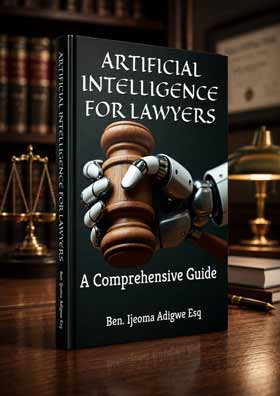 The book also examines Nigeria's legal ecosystem, focusing on the LPELR and NBA AI Guidelines. As a bonus, every purchase comes with a FREE eBook titled: How to Use the AI Features in LegalPedia and LawPavilion.
Ohio Books Ltd praises the publication, stating:
"....this is the only Nigerian book I know of on the topic."
How to Order:
📞 Call, Text, or WhatsApp: 08034917063 | 07055285878
📧 Email: benadigwe1@gmail.com
🌎 Website: www.benadigwe.com
Ebook Version: Access it directly online at https://selar.com/prv626
Authored by Ben Ijeoma Adigwe Esq., ACIarb (UK), LL.M, Dip. in Artificial Intelligence, Director at the Delta State Ministry of Justice, Asaba, Nigeria.
_______________________________________________________________________
“Enhance Legal Practice With Authoritative Reports” — Alexander Payne Offers Comprehensive Law Reports, Spanning Over A Century Of Nigerian Jurisprudence
The book also examines Nigeria's legal ecosystem, focusing on the LPELR and NBA AI Guidelines. As a bonus, every purchase comes with a FREE eBook titled: How to Use the AI Features in LegalPedia and LawPavilion.
Ohio Books Ltd praises the publication, stating:
"....this is the only Nigerian book I know of on the topic."
How to Order:
📞 Call, Text, or WhatsApp: 08034917063 | 07055285878
📧 Email: benadigwe1@gmail.com
🌎 Website: www.benadigwe.com
Ebook Version: Access it directly online at https://selar.com/prv626
Authored by Ben Ijeoma Adigwe Esq., ACIarb (UK), LL.M, Dip. in Artificial Intelligence, Director at the Delta State Ministry of Justice, Asaba, Nigeria.
_______________________________________________________________________
“Enhance Legal Practice With Authoritative Reports” — Alexander Payne Offers Comprehensive Law Reports, Spanning Over A Century Of Nigerian Jurisprudence
 Interested buyers are encouraged to place their orders and enquiries via:
0704 444 4777, 0704 444 4999, 0818 199 9888
Website: www.alexandernigeria.com
Interested buyers are encouraged to place their orders and enquiries via:
0704 444 4777, 0704 444 4999, 0818 199 9888
Website: www.alexandernigeria.com