By O.G. Ogbom, Esq.


The declaration of a state of emergency in Rivers State by President Tinubu has raised fundamental questions about its constitutionality. A thorough examination of the 1999 Constitution reveals that the President’s actions may have overstepped his constitutional powers.
Section 305(1) of the Constitution empowers the President to declare a state of emergency in any part of the country. However, this power is not absolute and is subject to strict constitutional safeguards.
Section 305 of the constitution of federal republic Nigeria has been notoriously reproduced by different writers, the need to do same will be avoided.
In the American case of Goldberg v. Kelly, (1970), the Supreme Court of America clearly stated that Emergency measures must not violate the Due Process Clause of the 5th and 14th Amendments.
Similarly, in Attorney-General of Cross River State v. Attorney-General of the Federation (2005) 15 NWLR (Pt. 947) 71, the Supreme Court held that the President’s power to declare a state of emergency is not a carte blanche to disregard the Constitution. The court emphasized the importance of the National Assembly’s approval and the need for the President to demonstrate that the situation warrants a state of emergency.
Furthermore, Section 305(6) of the Constitution requires the President to transmit the proclamation of a state of emergency to the National Assembly for approval. The National Assembly must then approve the proclamation by a two-thirds majority vote. In the absence of such approval, the declaration of a state of emergency would be unconstitutional.
The Supreme Court has consistently held that the President cannot unilaterally declare a state of emergency without the approval of the National Assembly. (See: Attorney-General of Lagos State v. Attorney-General of the Federation (2003) 12 NWLR (Pt. 832) 222.)
Again, A.G. of Ondo State v. A.G. of the Federation (2002) 10 NWLR (Pt. 774) 222: The Supreme Court held that the President’s power to declare a state of emergency under Section 305 of the Constitution must be exercised in a manner that respects other constitutional provisions, including the fundamental rights of citizens and also held in Attorney-General of Abia State v. Attorney-General of the Federation (2002) 6 NWLR (Pt. 762) 542: The Supreme Court emphasized that the exercise of constitutional powers must be done in a way that does not violate other provisions of the Constitution.
Although the President has the authority to declare a state of emergency under Section 305, this power must be exercised within the strict confines of the Constitution. Any deviation from these constitutional boundaries would effectively constitute an unconstitutional seizure of power, akin to a coup.
The President must also ensure that the declaration of a state of emergency must be based on concrete evidence of an imminent threat to national security or public safety. The President must demonstrate that the situation is beyond the control of the state government and that extraordinary measures are necessary to restore order. In the absence of such evidence, the declaration of a state of emergency would be an abuse of power.
In Atiku Abubakar v. Olusegun Obasanjo (2007) 4 NWLR (Pt. 1022) 601. The Supreme Court of Nigeria clearly stated the yardstick upon which an elected official can be removed from office. The court in that case stated the grounds as follows:
- Proven allegations of corruption or gross misconduct: The court emphasized that allegations of corruption or gross misconduct must be proven beyond reasonable doubt.
- Breach of the Constitution or oath of office: The court stated that a breach of the Constitution or oath of office can be grounds for removal.
- Failure to discharge duties: The court held that failure to discharge duties as an elected official can be grounds for removal.
The Supreme Court also outlined the procedure for removing an elected official such as:
- Impeachment: The court stated that impeachment is a constitutional process for removing an elected official.
- Resignation: The court held that resignation is another way an elected official can be removed.
- Court order: The court stated that a court order can also remove an elected official.
Those who advocate for unchecked executive authority may try to draw a distinction between suspension and removal. However, this subtle distinction collapses under scrutiny, as it prompts a fundamental inquiry: what constitutional provision empowers the President to suspend elected officials? If no such provision exists, it’s impermissible to infer or imply its presence. In essence, the Constitution’s silence on this matter is a clear indication that such power does not exist. Any attempt to unilaterally suspend or remove elected officials would constitute an egregious overreach of executive authority, undermining the very foundations of democratic governance and the rule of law.
The Supreme Court of Nigeria has consistently held that it is impermissible to read or import into the Constitution what is not explicitly stated in it. This principle is often referred to as the “doctrine of constitutional literalism” or “strict constructionism.”
In various decisions, the Supreme Court has emphasized that the Constitution must be interpreted in accordance with its clear and unambiguous language, without importing or reading into it what is not explicitly stated.
In A.G. of the Federation v. A.N.P.P. (2003) 15 NWLR (Pt. 843) 561, Attorney-General of Lagos State v. Attorney-General of the Federation (2003) 15 NWLR (Pt. 843) 113 and INEC v. Musa (2003) 3 NWLR (Pt. 806) 72. In these cases, the Supreme Court has consistently held that the Constitution is a foundational document that must be interpreted in accordance with its clear language, without resorting to implied or inferred meanings.
The Constitution of the Federal Republic of Nigeria is unequivocal regarding the appointment of a Sole Administrator – nowhere does it grant the President such authority. Instead, Section 11(4) explicitly empowers the National Assembly to assume the duties of a State House of Assembly, but only on a limited and temporary basis, as necessary and expedient.
Section 1(2) of the constitution of federal republic of Nigeria states:
The Federal Republic of Nigeria shall not be governed, nor shall any persons or group of persons take control of the Government of Nigeria or any part thereof, except in accordance with the provisions of this Constitution.
The constitution clearly states that Government of Nigeria or any part thereof shall not be governed nor shall any persons take charge of control except in accordance with the provisions of the constitution.
Certain individuals are attempting to legitimize the President’s unconstitutional actions by invoking the historical precedent of Olusegun Obasanjo’s administration, which unilaterally removed Governors Joshua Dariye and Ayo Fayose from office. They argue that since Obasanjo’s actions went unchallenged, the current President’s similar actions are equally justified. It is not correct that the actions went unchallenged, unfortunately, the action of Joshua Dariye in Plateau State of Nigeria & Anor. V Attorney-General of the Federation & Anor. (2006)-lLJR-SC, was thrown out on technical grounds. However, the Supreme Court of Nigeria has emphasized the importance of not repeating constitutional violations simply because they have occurred in the past. This principle is rooted in the need to uphold the rule of law and ensure that the Constitution is respected and enforced. The Supreme Court has made decisions in various cases that highlight the importance of adhering to constitutional provisions and avoiding violations.
The notion that a Governor can be removed has its roots in the 1962 Western Region crisis, where government structures collapsed amidst a severe political upheaval. Premier Chief S.L. Akintola’s refusal to step down after being ousted by the Regional House of Assembly in favor of Alhaji Dawodu Soroye Adegbenro led to Federal Government intervention, with Dr. Moses Majekodunmi being appointed as Administrator of the Western Region, bypassing Adegbenro’s expected takeover and further fueling the tense political climate. The Emergency Powers Act of 1961 upon which Akintola was removed was derived from the 1960 Constitution. The Federal government did have an enabling law that gave the Prime Minister the power to declare a State of Emergency and, in the process, remove the Premier and appoint an Administrator to superintend the management of the Region’s affairs.
Notably, while the 1961 State of Emergency Act, enacted under the 1960 Constitution, permitted the removal of Premiers, subsequent constitutions did not grant similar powers. Specifically, the 1979 and 1999 Constitutions outlined the procedures for declaring a State of Emergency, but explicitly excluded the removal of a Governor from these provisions.
Declaring a State of Emergency doesn’t grant the President absolute power to dismantle the country’s legislative structure and remove himself from office. According to the Constitution, the President can declare a State of Emergency in Nigeria if the nation is at war, but this doesn’t include the removal of the National Assembly or the President’s own office. Instead, specific provisions outline the circumstances under which a State of Emergency can be declared. This also applies to states.
In conclusion, the declaration of a state of emergency in Rivers State by President Tinubu is unconstitutional, as it fails to satisfy the constitutional requirements of demonstration of an imminent threat to national security or public safety. The President’s actions undermine the principles of federalism and the rule of law, and may have far-reaching consequences for the democratic institutions of Nigeria if sanctioned by the National Assembly.
O.G. Ogbom, Esq.PhD(in view), is a Port Harcourt based lawyer.
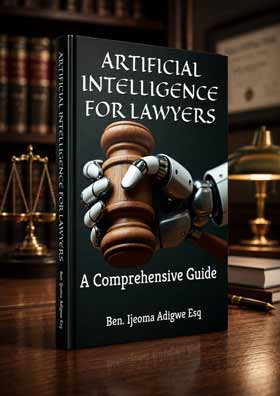 The book also examines Nigeria's legal ecosystem, focusing on the LPELR and NBA AI Guidelines. As a bonus, every purchase comes with a FREE eBook titled: How to Use the AI Features in LegalPedia and LawPavilion.
Ohio Books Ltd praises the publication, stating:
"....this is the only Nigerian book I know of on the topic."
How to Order:
📞 Call, Text, or WhatsApp: 08034917063 | 07055285878
📧 Email: benadigwe1@gmail.com
🌎 Website: www.benadigwe.com
Ebook Version: Access it directly online at https://selar.com/prv626
Authored by Ben Ijeoma Adigwe Esq., ACIarb (UK), LL.M, Dip. in Artificial Intelligence, Director at the Delta State Ministry of Justice, Asaba, Nigeria.
_______________________________________________________________________
“Enhance Legal Practice With Authoritative Reports” — Alexander Payne Offers Comprehensive Law Reports, Spanning Over A Century Of Nigerian Jurisprudence
The book also examines Nigeria's legal ecosystem, focusing on the LPELR and NBA AI Guidelines. As a bonus, every purchase comes with a FREE eBook titled: How to Use the AI Features in LegalPedia and LawPavilion.
Ohio Books Ltd praises the publication, stating:
"....this is the only Nigerian book I know of on the topic."
How to Order:
📞 Call, Text, or WhatsApp: 08034917063 | 07055285878
📧 Email: benadigwe1@gmail.com
🌎 Website: www.benadigwe.com
Ebook Version: Access it directly online at https://selar.com/prv626
Authored by Ben Ijeoma Adigwe Esq., ACIarb (UK), LL.M, Dip. in Artificial Intelligence, Director at the Delta State Ministry of Justice, Asaba, Nigeria.
_______________________________________________________________________
“Enhance Legal Practice With Authoritative Reports” — Alexander Payne Offers Comprehensive Law Reports, Spanning Over A Century Of Nigerian Jurisprudence
 Interested buyers are encouraged to place their orders and enquiries via:
0704 444 4777, 0704 444 4999, 0818 199 9888
Website: www.alexandernigeria.com
Interested buyers are encouraged to place their orders and enquiries via:
0704 444 4777, 0704 444 4999, 0818 199 9888
Website: www.alexandernigeria.com