The House of Representatives has passed, for a second reading, a bill seeking to insulate judicial officers from prosecution by the Code of Conduct Bureau (CCB).


The bill, sponsored by Solomon Bob (PDP, Rivers), was debated on Thursday and passed for a second reading despite stiff opposition.
It seeks to amend the Code of Conduct Bureau and Tribunal Act to insulate judicial officers from prosecution until they are legally removed from office.
The bill proposes that a judge must first be removed by the National Judicial Council (NJC) before being arraigned before the Code of Conduct Tribunal (CCT).
The debate on the bill’s general principles began on Wednesday amid strong opposition.
During Wednesday’s debate, Clement Jimbo (APC, Akwa Ibom) raised a constitutional point of order, stating that the proposal conflicts with Section 308 of the 1999 Constitution, which explicitly lists those exempt from prosecution.
He argued that judicial officers are not among those exempt and that the bill should not be allowed to progress.
In exercising his right of reply, Mr Bob said Mr Jimbo’s interpretation was not consistent with the intent of the bill. He explained that the bill seeks to prevent the pre-emptive prosecution of judicial officers for political reasons.
However, several members complained that they had not received copies of the bill.
As a result, Deputy Speaker Ben Kalu, who presided over the session, ruled that the bill should be stepped down until copies were distributed to members.
When the debate resumed on Thursday, Mr Bob clarified that the bill does not seek to confer immunity on judicial officers but to ensure that the NJC perform its functions.
He emphasised that the bill is specific to the CCT and does not apply to all courts.
Speaking against the bill, Paul Kalejaiye (APC, Lags) warned the House against creating a law inconsistent with the Constitution.
“This bill will exclude these people. We don’t need unnecessary immunity,” Mr Kalejaiye said.
Supporting the bill, Sada Soli (APC, Katsina) argued that it does not create a new form of immunity but merely ensures that a sitting judge is not subjected to prosecution while in office.
When the deputy speaker put the bill to vote after about 22 minutes of debate, most of the lawmakers voted in its support.
The bill is believed to help prevent judicial officers from suffering the fate of a former Chief Justice of Nigeria, Walter Onnoghen.
The trial, which many perceived as political, started with the suspension of Mr Onnoghen by the then President, Muhammadu Buhari, in the middle of the preparation for the 2019 general election.
Mr Buhari was seeking re-election for a second term at the time.
However, the trial revealed hidden bank accounts and transactions of the former CJN not declared to the Code of Conduct Bureau (CCB) as provided by law thus raising ethical questions, which the NJC also probed.
The NJC has yet to make the report of its probe public, though it confirmed that Mr Onnoghen resigned voluntarily.
It also confirmed that President Buhari accepted Mr Onnoghen’s voluntary resignation, which came ahead of the CCT judgement that convicted him.
The Court of Appeal later upturned the verdict.
Mr Onnoghen was not the only judicial ofgicer that faced such treatment under the Buhari administration.
The SSS in a Gestapoo manner, raided the homes of Supreme Court judtices, John Okoro and Sylvester Ngwuta (now deceased), as well as the residences of Adeniyi Ademola and Nnamdi Dimgba of the Federal High Court in Abuja.
While charges were not preferred against Mr Okoro, Messrs Ngwuta and Adeniyi were arraigned in court.
The FCT High Court dismissed the charges against Mr Adeniyi after the prosecution concluded its case.
Mr Ngwuta’s case was terminated on technical grounds.
 Interested buyers are encouraged to place their orders and enquiries via:
0704 444 4777, 0704 444 4999, 0818 199 9888
Website: www.alexandernigeria.com
Interested buyers are encouraged to place their orders and enquiries via:
0704 444 4777, 0704 444 4999, 0818 199 9888
Website: www.alexandernigeria.com

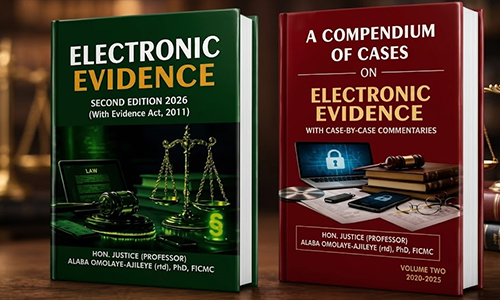
“Order Justice Omolaye-Ajileye’s Electronic Evidence Books Now” — Essential Guides On Evidence Act, Case Law And Digital Proof
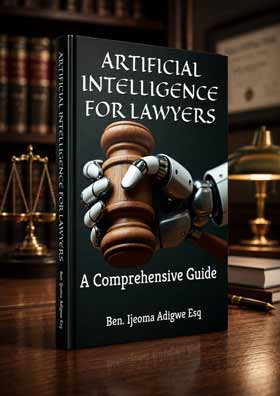 The book also examines Nigeria's legal ecosystem, focusing on the LPELR and NBA AI Guidelines. As a bonus, every purchase comes with a FREE eBook titled: How to Use the AI Features in LegalPedia and LawPavilion.
Ohio Books Ltd praises the publication, stating:
"....this is the only Nigerian book I know of on the topic."
How to Order:
📞 Call, Text, or WhatsApp: 08034917063 | 07055285878
📧 Email: benadigwe1@gmail.com
🌎 Website: www.benadigwe.com
Ebook Version: Access it directly online at https://selar.com/prv626
Authored by Ben Ijeoma Adigwe Esq., ACIarb (UK), LL.M, Dip. in Artificial Intelligence, Director at the Delta State Ministry of Justice, Asaba, Nigeria.
_______________________________________________________________________
The book also examines Nigeria's legal ecosystem, focusing on the LPELR and NBA AI Guidelines. As a bonus, every purchase comes with a FREE eBook titled: How to Use the AI Features in LegalPedia and LawPavilion.
Ohio Books Ltd praises the publication, stating:
"....this is the only Nigerian book I know of on the topic."
How to Order:
📞 Call, Text, or WhatsApp: 08034917063 | 07055285878
📧 Email: benadigwe1@gmail.com
🌎 Website: www.benadigwe.com
Ebook Version: Access it directly online at https://selar.com/prv626
Authored by Ben Ijeoma Adigwe Esq., ACIarb (UK), LL.M, Dip. in Artificial Intelligence, Director at the Delta State Ministry of Justice, Asaba, Nigeria.
_______________________________________________________________________