By Abdurrahman Hamza Ahmad, Esq. AICMC

As of April 2024, the Nigerian Correctional Service (NCoS) reports that there are currently 3,504 prisoners on death row, comprising 3,431 males and 73 females. While the death penalty remains part of Nigerian law, executions have not been carried out in recent years due to a moratorium driven by human rights considerations. This suspension has resulted in significant financial implications for the government, which continues to incur substantial costs for the prosecution, maintenance, and feeding of these prisoners. In addition, there are increasing calls for a review of the funds allocated for their upkeep, in light of the ongoing economic challenges and hyperinflation plaguing the nation.
Punishment, in legal systems, serves various objectives depending on the crime, the offender’s history, and societal values. Several theories of punishment guide the rationale behind sentencing, and these theories directly influence decisions related to capital punishment. The primary theories of punishment are as follows:
- Deterrence
Deterrence aims to prevent future crimes by ensuring the punishment is severe enough to outweigh the benefits of committing the offense. There are two main forms of deterrence:
- Specific deterrence: This focuses on preventing the individual offender from committing future crimes. If the punishment is severe enough, it should deter the individual from repeating their crime.
- General deterrence: This aims to deter the broader society by making an example of the offender. The public should be discouraged from committing similar crimes due to the fear of facing similar punishments.
For example, a person contemplating armed robbery might be discouraged by the potential life imprisonment that outweighs any immediate material gain from the crime.
- Rehabilitation
The rehabilitation theory underscores reforming offenders and reintegrating them into society as law-abiding citizens. This approach views punishment not only as a penalty but as an opportunity to address underlying causes of criminal behavior, such as substance abuse or lack of education, with the aim of reducing the likelihood of re-offending. Programs focused on rehabilitation attempt to change the offender’s mindset and behavior to prevent future offenses.
- Retribution
Retribution holds that punishment is justified because offenders deserve to be punished for their wrongful actions. This theory operates on the idea that the severity of the punishment should be proportionate to the seriousness of the crime committed. It is closely tied to the principle of “an eye for an eye,” meaning the punishment should reflect the harm caused by the crime. In the case of heinous offenses such as murder, kidnapping or sexual violence, society often demands a punishment that reflects the gravity of the crime.
- Incapacitation
Incapacitation seeks to protect society by physically restraining offenders through imprisonment or other means. By removing offenders from society, it ensures that they are unable to commit further crimes for the duration of their sentence. This is particularly important for individuals who pose a significant risk to society, such as violent criminals. Removing such individuals from society provides a measure of safety for the public.
Execution and the Objectives of Punishment
Despite the existence of these theories, the recurring questions that beg to be answered are: What is the significance of keeping inmates on death row without executing them? Does this practice fulfill the objectives of punishment?
Executions for capital offenses, such as murder, are central to achieving several key objectives of punishment, notably deterrence, retribution, and incapacitation. The failure to execute offenders means that the deterrent effect is undermined, as potential criminals may not fear the consequences of their actions. In addition, the families of victims may feel that justice has not been fully served, as the punishment is delayed or never carried out, despite the conviction and sentence. Furthermore, keeping dangerous criminals in prison indefinitely, without execution, also fails to remove them from society in the most effective manner and they might revert in the event of a dreadful jail break.
Execution as a form of punishment has been practiced since time immemorial, and the principle of “an eye for an eye” is echoed in both legal and religious texts. The Qur’an (2:178-179, 5:45) and the Old Testament (Exodus 21:24, Leviticus 24:20, and Deuteronomy 19:21) all reference the idea of proportional punishment for wrongdoing, which remains relevant in modern debates on capital punishment.
Judicial Observations and Real-World Impact
I have personally witnessed judicial concerns regarding this issue. At a recent court event, a state high court judge lamented that while the judiciary faithfully discharges its duty, convicting individuals and sentencing them to death for capital offenses, it is ultimately up to the executive to carry out these executions. In Kano State, the last execution took place over 15 years ago under the administration of Malam Ibrahim Shekarau, and the matter remains unresolved.
Similarly, a young man was arrested in 2003 and was eventually convicted in 2011 for armed robbery (hirabah) under Section 140 of the Kano State Sharia Penal Code Law 2000, his sentence was to have his right hand from the wrist amputated and his left foot from the ankle cut off. Yet, despite this sentence, he remains in prison after over two decades without the execution of his punishment. His fate continues to hang in the air, which not only prevents his rehabilitation but also undermines the objectives of justice and deterrence.
The Case for Resumption of Capital Punishment
The continuation of the moratorium on executions in Nigeria raises several concerns. While human rights organizations argue against the death penalty, there are valid reasons for resuming executions, particularly for those convicted of heinous crimes. The failure to carry out capital punishment may inadvertently undermine the justice system and send the wrong message to society about the consequences of serious offenses.
Moreover, the resumption of capital punishment can be seen as a necessary measure to restore confidence in the justice system, deliver justice to the victims’ families, and ensure that convicted offenders face punishment proportionate to their crimes. It is crucial to note that the right to life, as enshrined in Section 33(1) of Nigeria’s 1999 Constitution, is not absolute. The Constitution permits the deprivation of life in cases where an individual has been lawfully convicted of a crime and sentenced to death.
Conclusion
In conclusion, while the international community and human rights groups may raise objections, Nigeria must consider the broader implications of suspending executions for capital offenses. Resuming executions aligns with the core objectives of punishment—deterrence, retribution, and incapacitation. It would also restore a sense of justice for victims and their families and send a strong message to potential offenders that the legal system will hold them accountable for their actions. By resuming executions, Nigeria can better fulfill its constitutional and moral obligations, ensuring that punishments for capital offenses are fair, just, and proportionate to the crimes committed.
Abdurrahman Hamza Ahmad, Esq. AICMC
M.B. Dan’Azumi & C0.
No. 11o New Court Road, (Atop Flash Printers), Opp. Royal Specialty Clinic, Gyadi-Gyadi Kano State, Nigeria.
08067245910
[A MUST HAVE] Evidence Act Demystified With Recent And Contemporary Cases And Materials

Available now for NGN 40,000 at ASC Publications, 10, Boyle Street, Onikan, Lagos. Beside High Court, TBS. Email publications@ayindesanni.com or WhatsApp +2347056667384. Purchase Link: https://paystack.com/buy/evidence-act-complete-annotation
______________________________________________________________________ “Enhance Legal Practice With Authoritative Reports” — Alexander Payne Offers Comprehensive Law Reports, Spanning Over A Century Of Nigerian Jurisprudence Interested buyers are encouraged to place their orders and enquiries via:
0704 444 4777, 0704 444 4999, 0818 199 9888
Website: www.alexandernigeria.com
Interested buyers are encouraged to place their orders and enquiries via:
0704 444 4777, 0704 444 4999, 0818 199 9888
Website: www.alexandernigeria.com
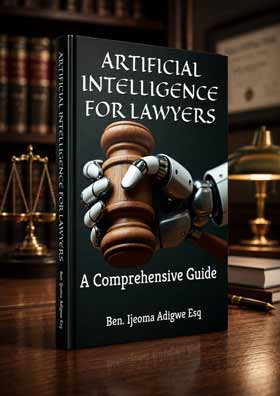 The book also examines Nigeria's legal ecosystem, focusing on the LPELR and NBA AI Guidelines. As a bonus, every purchase comes with a FREE eBook titled: How to Use the AI Features in LegalPedia and LawPavilion.
Ohio Books Ltd praises the publication, stating:
"....this is the only Nigerian book I know of on the topic."
How to Order:
📞 Call, Text, or WhatsApp: 08034917063 | 07055285878
📧 Email: benadigwe1@gmail.com
🌎 Website: www.benadigwe.com
Ebook Version: Access it directly online at https://selar.com/prv626
Authored by Ben Ijeoma Adigwe Esq., ACIarb (UK), LL.M, Dip. in Artificial Intelligence, Director at the Delta State Ministry of Justice, Asaba, Nigeria.
______________________________________________________________________
The book also examines Nigeria's legal ecosystem, focusing on the LPELR and NBA AI Guidelines. As a bonus, every purchase comes with a FREE eBook titled: How to Use the AI Features in LegalPedia and LawPavilion.
Ohio Books Ltd praises the publication, stating:
"....this is the only Nigerian book I know of on the topic."
How to Order:
📞 Call, Text, or WhatsApp: 08034917063 | 07055285878
📧 Email: benadigwe1@gmail.com
🌎 Website: www.benadigwe.com
Ebook Version: Access it directly online at https://selar.com/prv626
Authored by Ben Ijeoma Adigwe Esq., ACIarb (UK), LL.M, Dip. in Artificial Intelligence, Director at the Delta State Ministry of Justice, Asaba, Nigeria.
______________________________________________________________________