*Technology and AI Key to Solving Conflicting Judgments, Says Idigbe
*Retired Ghana Supreme Court Justice Advocates for West African Court of Appeal
*CJN Kekere-Ekun Stresses Importance of Judicial Independence and Judge Craft


To transform the judiciary and make it efficient and truly independent, polical will is needed from all arms of the government.
This view was expressed by Dr Anthony Idigbe (SAN), who is the Global Chairman of the Forum Against Counterfeiting (FAC).
He spoke on the sidelines of a two-day retreat on “Judicial independence and judge craft” for appellate court justices.
It was organised by the National Judicial Institute (NJI) in collaboration with FAC and was held in Uyo, the Akwa Ibom State capital.
Idigbe, Senior Partner at PUNUKA Atttorneys & Solicitors, said: “For the judiciary to be truly independent, you need political will on all sides – executive, legislature and the judiciary.
“There can be very quick transformation with the right investments in the people, processes and technology, and the judiciary will deliver for Nigerians.
“You can have a CJN that has all the good ideas and the passion to deliver, but what happens if there is resistance by the other arms of government?
“You can have a President who wants to make changes but could face resistance or inhibitions from the other arms. The same with the legislature.
“So, the easiest way is for the three arms to agree on the Nigerian agenda, and all obstacles can be overcome.”
A retired Justice of the Supreme Court of Ghana, Victor Jones Mawulorm Dotse, said the funding of the judiciary should be automatic.
He faulted a situation where heads of court go to the executive to ask for money.
He said this undermines the independence of the judiciary.
Dotse also called for the establishment of the West African Court of Appeal with powers to make final decisions on cases from commonwealth countries.
The three-day retreat featured presentations by Chief Justice of Nigeria Kudirat Kekere-Ekun; Court of Appeal President Justice Monica Dongban-Mensem; NJI Administrator Justice Salisu Abdullahi; Justice Inyang Okoro of the Supreme Court and Chief Judge of Borno State, Justice Kashim Zannah.
Others were Justice Nelson Ogbuanya of the National Industrial Court, Chief Executive Officer of Nigeria Intelligence Unit, Hajiya Hafsat Bakari, and FAC National Coordinator for Nigeria, Mrs Ebelechukwu Enedah.
There was a lively discussion among judges on how to improve the justice delivery system and attain internal and external independence of the judiciary.
There was also a session on health and wellbeing.
Chief Justice Kekere-Ekun, who gave the keynote address, stressed the importance of judicial independence and the need for judges to improve on their craft – skills and ethics in dealing with cases.
Dr. Idigbe said technology can be used to solve the problem of conflicting judgments.
He blamed the problem on the inability to instantly recall similar verdicts on previous cases, saying not all of them are deliberate.
Idigbe believes the problems of delays and congestion can be addressed by leveraging technology and artificial intelligence (AI).
He expects the Supreme Court to resolve them, noting that some of the contradictory verdicts happen over time as hundreds of judgments are delivered dealing with similar subjects.
Idigbe said: “You’re talking about thousands of judgments over a period, which results in loss of history. That is where technology comes in.
“However, if all these data is stationed within the AI environment, it is possible to manage that issue and ensure we return to the original concept of stare decisis by which precedent is followed.
“The NJC is doing a lot to address it with AI.
“If everything goes as planned, many of those issues will be eliminated, and where they occur, people can be held accountable for not using the tools.”
In his presentation, Idigbe stressed that implementing a robust court management system (CMS) will allow courts to track cases electronically, manage court schedules, and enhance the overall case flow.
This, he said, not only improves the efficiency of court proceedings but also reduces administrative errors and delays in legal processes.
With technology, he said cases can be tracked.
“There can be real-time updates on case progress, ensuring that all stakeholders are informed.”
He said technology can also enhance schedule management, allowing for centralised court plans, including hearing dates and deadlines, which will be accessible to all authorised personnel.
Idigbe added: “In a time where technology is reshaping every aspect of our lives, the legal sector must embrace innovation to enhance its efficiency and effectiveness.
“The integration of legal technology products ranging from case management software to document automation tools offers law firms and legal practitioners the opportunity to streamline processes.
“By leveraging the capabilities of modern legal tech solutions, practitioners can navigate complex legal challenges with greater ease, ultimately leading to improved access to justice for all.
“The journey toward digital transformation may present challenges, but the potential benefits are compelling reasons for legal professionals to invest in technology.
“By staying ahead of the curve and continually adapting to technological advancements, the legal community can ensure it remains relevant.”
Justice Dotse was of view that a West African Court of Appeal will further enhance independence of the judiciary in the region.
He said: “Before independence, the four West African Commonwealth countries – Nigeria, Ghana, Sierra Leone and Gambia – had the West African Court of Appeal headquartered in Nigeria as their final court of appeal.
“We had judges from the four countries coming to sit on cases. We may have to consider reviving something like that.
“The countries will send judges, and the court will have common headquarters to deal especially with constitutional cases.
“Judges from different countries will decide cases from others. And they will be under less pressure.
“We have the European Court of Justice where all the European countries go to, so we can have something like that.”
On financial autonomy, Dotse decried delays in funds allocation to the judiciary by the executive, which he said would rather prefer to put funds in areas that will attract votes.
He also said there should be automatic percentage increases in judicial allocations to avoid heads of courts going back and forth to make cases for increased allocations.
“This should be automatic so that judiciary heads don’t have to be going to the executive or Minister of Finance to beg for money,” he said.
On the essence of the retreat, Dotse added: “Judge craft is the act of the judges taking decisions in court. We’re trying to remind ourselves about our core values.
“It is the judiciary’s duty to interpret the Constitution, decide cases and maintain law and order.
“From time to time judges need to meet to discuss new ways of judging and how to use technology and AI to improve efficiency.
“Judicial independence starts with the appointment process, determining their qualifications. There has to be democratisation of the power of appointment.
“There must also be that understanding that the executive can come to court and lose cases.”
Justice Dotse, in his paper, listed the do’s and don’t for judges.
They are as follows:
• A judge must always be on top of any case file that comes before him. This is in respect of both the facts and the law.
• A judge must equally be seen by all the parties and Counsel to be neutral, fair and transparent in his handling of the case both on and off the Bench.
• Cases must be dealt with expeditiously whilst adhering to the principles of natural justice.
• A judge must exhibit complete control of his courtroom atmosphere with decorum and diligence as the hallmarks.
• A Judge must exhibit patience, dignity and courtesy to parties, Counsel and or staff.
• Judgments must be delivered on agreed dates without any adjournments.
• A judge must not unnecessarily interject or interrupt a lawyer or party in the Box. This can be interpreted as a sign of hostility especially if it was not done to the other party.
• A judge must also refrain from expressing his views on the matter, save for pointing out incorrect references to points of law or evidence which are verifiable. Such acts may be construed as bias in favour of a party and against another party. Wait patiently, because the decision is yours at the end of the day.
• A judge must also not be seen to be openly abrasive and hostile to a party, their witness or counsel, save for acts of misconduct by the party, counsel or witness.
• A judge must recuse himself if there is a potential conflict of interest situation arising.
• A judge must not be seen to be openly sympathetic to the case of any of the parties or Counsel before him.
• Any other conduct that is likely to bring the Judge and the administration of justice into disrepute must be avoided.
Justice Ogbuanya, whose paper was on judicial communication, said it occurs in various aspects and layers of judicial duties and interactions.
According to him, such interfaces include judge’s comportment and courtroom management; abuse of power of issuance of interim orders ex-parte and resultant counter-orders by courts of coordinate jurisdiction; peer communication by judicial officers; routine communication between judicial officer and court staff; communication involving a judicial officer with third parties; as well as collective posturing giving rise to public perception of the judiciary.
The judge noted that the various layers of judicial communication ought to be taken seriously and put in their rightful place in judicial administration.
He added: “The impact of social media on judicial communication in the evolving digital era has underscored the imperative of effective judicial communication, to reposition the judiciary with transparent and effective outlook.
“The Nigerian Judiciary cannot afford to abdicate or be stampeded out of its adjudicator-role or be consigned to play a restrictive role as being prescribed and canvassed by some anti-judiciary reformists, merely because it is not intentional in protecting and promoting its brand. Such reform would negatively impact on its brand in the legal system.
“It is time to rebrand and entrench corporate culture for the judiciary for sustainability and relevance in nation-building.
“As the judiciary’s pre-eminent role in the society is rooted in public confidence, it is imperative that effective judicial communication is entrenched at various aspects and layers of judicial communication.
“Concerted efforts should, therefore, be geared towards re-branding the perceived negative public branding of the judiciary as communicated through judicial conducts which invariably condensed as what the judiciary represents(the brand), albeit erroneously.
“Effective discharge of the appellate courts’ role as moderator of judicial communication to ensure certainty of law in line with the principles of judicial precedents needed for the enthronement of rule of law in the polity is key to this reform.
“In all, guided embrace of the emerging technologically-driven communicative medium with strategic information management approach, and entrenched corporate culture reflective of the corporate brand of the judiciary, are the way forward towards achieving effective judicial communication for strengthening the legal and judicial system in modern times!”
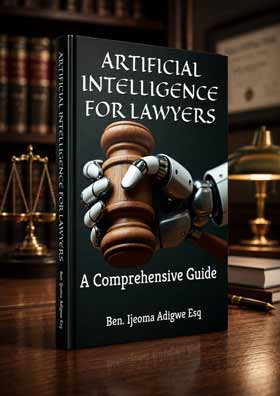 The book also examines Nigeria's legal ecosystem, focusing on the LPELR and NBA AI Guidelines. As a bonus, every purchase comes with a FREE eBook titled: How to Use the AI Features in LegalPedia and LawPavilion.
Ohio Books Ltd praises the publication, stating:
"....this is the only Nigerian book I know of on the topic."
How to Order:
📞 Call, Text, or WhatsApp: 08034917063 | 07055285878
📧 Email: benadigwe1@gmail.com
🌎 Website: www.benadigwe.com
Ebook Version: Access it directly online at https://selar.com/prv626
Authored by Ben Ijeoma Adigwe Esq., ACIarb (UK), LL.M, Dip. in Artificial Intelligence, Director at the Delta State Ministry of Justice, Asaba, Nigeria.
_______________________________________________________________________
The book also examines Nigeria's legal ecosystem, focusing on the LPELR and NBA AI Guidelines. As a bonus, every purchase comes with a FREE eBook titled: How to Use the AI Features in LegalPedia and LawPavilion.
Ohio Books Ltd praises the publication, stating:
"....this is the only Nigerian book I know of on the topic."
How to Order:
📞 Call, Text, or WhatsApp: 08034917063 | 07055285878
📧 Email: benadigwe1@gmail.com
🌎 Website: www.benadigwe.com
Ebook Version: Access it directly online at https://selar.com/prv626
Authored by Ben Ijeoma Adigwe Esq., ACIarb (UK), LL.M, Dip. in Artificial Intelligence, Director at the Delta State Ministry of Justice, Asaba, Nigeria.
_______________________________________________________________________
“Order Justice Omolaye-Ajileye’s Electronic Evidence Books Now” — Essential Guides On Evidence Act, Case Law And Digital Proof
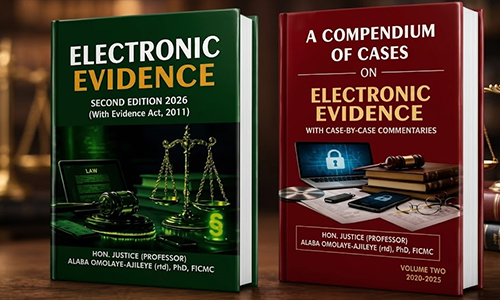
 Interested buyers are encouraged to place their orders and enquiries via:
0704 444 4777, 0704 444 4999, 0818 199 9888
Website: www.alexandernigeria.com
Interested buyers are encouraged to place their orders and enquiries via:
0704 444 4777, 0704 444 4999, 0818 199 9888
Website: www.alexandernigeria.com