By Opatola Victor Esq. Victor@Legalifyattorneys.com

The recent directive by the Central Bank of Nigeria for banks to enforce Cybersecurity levy pursuant to the section 44 of the Cybercrime amendment Act have ignited a fervent debate surrounding the boundaries of legislative power and the protection of federalism.
The introduction of a cybersecurity levy on banking transactions has not only raised eyebrows but has also underscored the imperative for citizens to actively monitor bills passed by the National Assembly. Citizens must be consistently active in the timely checkmating of National Assembly by timeously raising issues on bills before they are enacted and signed into laws.
While the origins of this levy can be traced back to the 2015 Cybercrime Act, its recent expansion in the 2024 amendment has amplified concerns. By drastically broadening and increasing the levy amount from 0.005 % to 0.5% and scope of its application and even criminalizing non-compliance, the amendment has further entrenched the levy, casting a shadow over its legality.
Central to the debate is the question of the Cybercrime Act’s legitimacy. Despite being enacted by the National Assembly, doubts linger regarding its conformity with constitutional provisions. The argument that the National Assembly, under Section 4(2) of the 1999 Constitution, possesses the authority to legislate for the “peace, order, and good governance” of the Federation, raises alarms about the ploy at unnecessary broadening of the powers vested in the legislative body.
The issue of the Legality of the cyber-crimes Act in itself remains unsettled, it still hovers in conjecture. To be emphatic, the argument that because the National Assembly has powers in section 4 of the Constitution to make law for the peace, order and good governance of the Federation, then it can validly enact the cyber security Act is a very dangerous argument that gives the National Assembly too much vague powers that can effectively erode the powers and efficacy of the residual list.
In the recent case of A.G Rivers v. FIRS & A.G Federation, the court held that the National Assembly cannot validly legislate in respect of residual powers conferred on the State Houses of Assembly to make laws under section 4(7) of the Constitution;
Now, it is unsettled, whether the National Assembly can impose levies and taxes on issues not contained in the exclusive or concurrent legislative list, in the guise of making laws for the “peace, order and governance of the Federation” as provided in section 4(2) of the Constitution, thus needing judicial interpretation.
I will posit, that an argument to justify the imposition of levy and taxation outside of its powers in the exclusive and concurrent list is a very dangerous argument and in the name of casting and widening the tax drag-net; we should be very cautious of what we wish for.
These arbitrary powers that the National Assembly usurps to itself are dangerous and anti-thesis to true federalism in Nigeria.
As it is currently, the National Assembly has the powers to legislate on everything in the exclusive list. The same National Assembly can legislate on everything in the concurrent list, in the guise of the “doctrine of covering the field”.
Yet, notwithstanding its many powers under the exclusive and concurrent list, laws that by natural logic ought to be on the residual list and by so doing at the exclusive reserve of the state to make laws are now been coveted by the National Assembly in the name of “making laws for peace, order and good of the Federation.
The take away point here is that : “If the argument is that the National Assembly, in the guise of making laws for peace, order and good, can upend the residual list; then I believe we should officially amend the Constitution to cancel the residual list altogether and give the role of making all the laws in Nigeria to the National Assembly in the name of making laws for the “peace, order and good governance of the Federation “.
The issue of the cybercrime levy extends beyond mere legality to the erosion federalism itself. By granting the National Assembly unchecked authority to legislate on all matters, the essence of federalism is compromised. The arbitrary expansion of legislative powers not only undermines the ppwer sharing but also undermines the diversity and autonomy of Nigeria’s federating units. The imposition of levies and taxes on matters outside the exclusive or concurrent legislative lists challenges the delicate balance of power between the federal and state governments. This overreach not only undermines the autonomy of states but also threatens the principles of true federalism. Again, the doctrine of “covering the field” exemplifies the guise of this encroachment, whereby the National Assembly assumes jurisdiction over matters traditionally reserved for state legislation. What was once considered the residual list, exclusive to state jurisdiction, is now subject to federal oversight in the name of “making law for the peace, order and good governance”. If left unchecked, this trend poses a grave threat to Nigeria’s democratic fabric and undermines the very essence of federalism as a system of governance.
In conclusion, this is a call on the federal government to suspend the application of this levy, the urge and the need to always increase the levy and tax drag net those not include driving the citizens into penury. The citizens and CSO should continuously guard jealously their role of vigilance and stand against all efforts to continuously enlarge the law making powers of the National Assembly beyond constitutional provisions.
Opatola Victor is a Legal Practitioner and writes from Abuja, and can be reached through Victor@Legalifyattorneys.com
 Interested buyers are encouraged to place their orders and enquiries via:
0704 444 4777, 0704 444 4999, 0818 199 9888
Website: www.alexandernigeria.com
Interested buyers are encouraged to place their orders and enquiries via:
0704 444 4777, 0704 444 4999, 0818 199 9888
Website: www.alexandernigeria.com

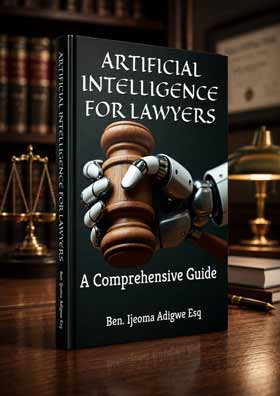 The book also examines Nigeria's legal ecosystem, focusing on the LPELR and NBA AI Guidelines. As a bonus, every purchase comes with a FREE eBook titled: How to Use the AI Features in LegalPedia and LawPavilion.
Ohio Books Ltd praises the publication, stating:
"....this is the only Nigerian book I know of on the topic."
How to Order:
📞 Call, Text, or WhatsApp: 08034917063 | 07055285878
📧 Email: benadigwe1@gmail.com
🌎 Website: www.benadigwe.com
Ebook Version: Access it directly online at https://selar.com/prv626
Authored by Ben Ijeoma Adigwe Esq., ACIarb (UK), LL.M, Dip. in Artificial Intelligence, Director at the Delta State Ministry of Justice, Asaba, Nigeria.
_______________________________________________________________________
The book also examines Nigeria's legal ecosystem, focusing on the LPELR and NBA AI Guidelines. As a bonus, every purchase comes with a FREE eBook titled: How to Use the AI Features in LegalPedia and LawPavilion.
Ohio Books Ltd praises the publication, stating:
"....this is the only Nigerian book I know of on the topic."
How to Order:
📞 Call, Text, or WhatsApp: 08034917063 | 07055285878
📧 Email: benadigwe1@gmail.com
🌎 Website: www.benadigwe.com
Ebook Version: Access it directly online at https://selar.com/prv626
Authored by Ben Ijeoma Adigwe Esq., ACIarb (UK), LL.M, Dip. in Artificial Intelligence, Director at the Delta State Ministry of Justice, Asaba, Nigeria.
_______________________________________________________________________