By Dave Ajetomobi

Customary law marriage has the following legal features:
- It is generally polygamous.
- The spouses have the right to the enjoyment of each other’s property although the right of the wife is lost on the occasion of her desertion or divorce.
- In customary law, the wife is an agent of necessity of her husband.
- Paternity of child is in not relevant if bride price has been refunded since the child born will belong to the former husband of the woman. It should also be noted that the case of Eddet v Essien is a leading deviation to this rule.
- The customary marriage is between the parties and their families and not just the parties, therefore, members of the family are usually actively involved in the affairs of the couple. It is left for the couple to set boundaries.
5 The couple enjoys each other’s company including cohabitation and reasonable sexual demands.
6. The husband has the right to discipline his wife using reasonable punishments. However, in reality, some men depending on their background tend to be excessive in the so called disciplinary power.
7. A wife has no legal right to her husband’s property or income. This is however dependent on the background of the man involved. It is also important to note that some of these features are also seen in marriages under the Act because parties are humans irrespective of their type of marriages. Habits die hard.
Dissolution of customary marriage:
Whatever that has a beginning will definitely have an end, customary marriage can either be terminated by death of either of the spouses or by divorce. The requirement for the dissolution of a customary law marriage is not as stringent as that under the Marriage Act. A customary law marriage can be dissolved without judicial (court) pronouncement or intervention. None of the parties has a legal duty to provide and prove grounds of divorce as is required under the Matrimonial Causes Act, 1990.
Either of the spouses may decide to break the union and the usual defences of collusion or condemnation under statutory marriage is not available to any of them. However, there must be a formal act on the part of the party who is not willing to continue with the union or association. In most places, the two families are involved in the dissolution. [Okpanum v. Okpanum (1972) ECSLR 561)
In Anambra and Imo States of Nigeria, customary marriage may be dissolved by mutual agreement between the couple with active involvement of their parents in the presence of the marriage middlemen and one or more elders from each of the two families. Spouses who want divorce do not have to go to court to obtain it.
The parties mentioned above decide how much of the bride-price and other marriage expenses paid on the woman concerned should be refunded to the husband. In coming to this decision, factors like the duration of the marriage and whether or not there are children of the marriage are taken into consideration. The bride-price and other marriage expenses which are refundable are then paid to the husband through the hands of the marriage middlemen. After this is done, the marriage is declared dissolved.
In cases where neither the bride price was refunded nor evidence that middlemen were present, the act of the husband merely asking his parents and relations not to allow the wife stay in the matrimonial home is not tantamount to dissolution of the marriage. Equivalent to what is called judicial separation in the English wedding.
It is to be noted that unlike position under the Act, customary law does not prescribe any length of time a party must be married before initiating dissolution process. However, like the marriage under the Act, the welfare of the children is of paramount important.
In modern days, most parties to customary Marriages seeking dissolution end up in the Customary Courts, we read in the news, especially in the social media stories of couples seeking dissolution of their marriages before Customary Courts, and grounds for divorce include excessive sexual demand, extra large manhood and other funny reasons to bizarre ones.
 Interested buyers are encouraged to place their orders and enquiries via:
0704 444 4777, 0704 444 4999, 0818 199 9888
Website: www.alexandernigeria.com
Interested buyers are encouraged to place their orders and enquiries via:
0704 444 4777, 0704 444 4999, 0818 199 9888
Website: www.alexandernigeria.com

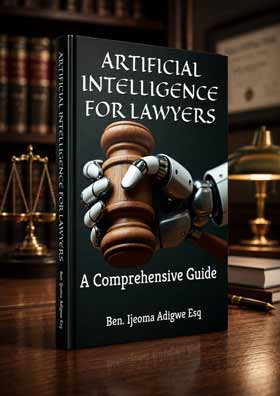 The book also examines Nigeria's legal ecosystem, focusing on the LPELR and NBA AI Guidelines. As a bonus, every purchase comes with a FREE eBook titled: How to Use the AI Features in LegalPedia and LawPavilion.
Ohio Books Ltd praises the publication, stating:
"....this is the only Nigerian book I know of on the topic."
How to Order:
📞 Call, Text, or WhatsApp: 08034917063 | 07055285878
📧 Email: benadigwe1@gmail.com
🌎 Website: www.benadigwe.com
Ebook Version: Access it directly online at https://selar.com/prv626
Authored by Ben Ijeoma Adigwe Esq., ACIarb (UK), LL.M, Dip. in Artificial Intelligence, Director at the Delta State Ministry of Justice, Asaba, Nigeria.
_______________________________________________________________________
The book also examines Nigeria's legal ecosystem, focusing on the LPELR and NBA AI Guidelines. As a bonus, every purchase comes with a FREE eBook titled: How to Use the AI Features in LegalPedia and LawPavilion.
Ohio Books Ltd praises the publication, stating:
"....this is the only Nigerian book I know of on the topic."
How to Order:
📞 Call, Text, or WhatsApp: 08034917063 | 07055285878
📧 Email: benadigwe1@gmail.com
🌎 Website: www.benadigwe.com
Ebook Version: Access it directly online at https://selar.com/prv626
Authored by Ben Ijeoma Adigwe Esq., ACIarb (UK), LL.M, Dip. in Artificial Intelligence, Director at the Delta State Ministry of Justice, Asaba, Nigeria.
_______________________________________________________________________