
*Long Detention Of Suspects To Await Trial Amounts To Human Rights Violation — Osagiede, Mni
*Detention Facilities Across Sub-Sahara Are Unfriendly — Rwanda Lecturer, Dr. Bikesha
*Magistrates In Lagos State Visit Detention Facilities In Company Of Lawyer — DSN Convener, Akinlade
*The Dignity And Value Of Man Must Be Respected — Burundi Director, Ntawuyamara,
*We Must Harness The Potential Of Technology— Adeoye

Former Controller, Nigerian Correctional Services, Francis Enobore Osagiede, mni, has said that Pre-trial detention and its arbitrary use has constituted a huge challenge to justice dispensation in Nigeria. He also added that the mechanisms to regulate the use of pre-trial detention and expeditious trial have not effectively address the problem of keeping suspects in detention for a long time before the trial.
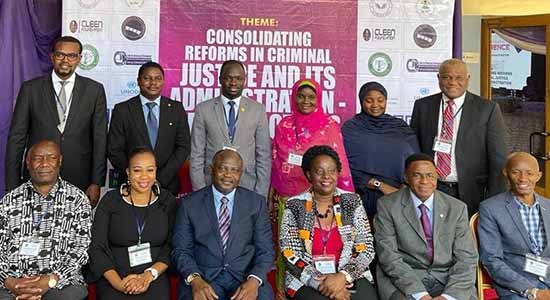
Osagiede, mni, made this remark on Wednesday at the ongoing 3-Day Regional Conference of Sub-Saharan African Criminal Justice, organized by Juristrust Centre for Socio-Legal Research and Documentation (JCSLRD), in Abuja with the theme: “Consolidating Reforms in Criminal Justice and Its Administration – Best Practices”.
Speaking on the topic: “Effective Mechanisms For Management Of Pre-Trial Detention In Sub-Saharan Africa,” he pointed out that the problems could be inadequate logistics to convey the awaiting suspect to court, or awaiting for ‘advice’ from the Director of Public Prosecution (DPP) etc.
“The long detention of suspects to await trial amounts to Human Rights violation because their right to fair and expeditious hearing is abused. Also, overcrowding creates difficulties in carrying out effective supervision in terms of ensuring that inmates are not bullied either by their fellow inmates or staff. Pre-trial detainees are most likely to lose touch with their relations, contract diseases, risk being abandoned, suffer violence and abuse from fellow inmates and staff, and may die in incarceration without consequences.
“Keeping suspects in prison to await trial for excessively long periods has continued to be linked to restiveness and riots among the inmates, including armed attacks on prison/correctional facilities. Many pre-trial detainees in Nigeria have spent over 5 years with no hope for fair and expeditious trial hence, they often spearhead most jailbreaks. The mastermind of the August 8, 2016 riot in Abakaliki Custodial Centre in Ebonyi State was an inmate who had spent over 9 years awaiting trial.
“The country has had about 15 jailbreaks between September 2014 to July 2022 where not fewer than 7,000 inmates have been illegally released, most of them hardened criminals, including boko haram 18 elements and other violent extremists. Findings revealed that the attackers after gaining access to the prison, usually break awaiting trial cells to free inmates while leaving convict cells intact hence over 85 percent of the escapees are awaiting trial inmates.”
He said in order to address this unabating influx of persons, there’s need to have Infrastructural intervention, Case Tracking system, Virtual Court hearing system, jail delivery, Presidential intervention, Pro bono Services, Legislative intervention, Alternative Dispute Resolution.
“Challenges of pre-trial detention in Kenya is that state agencies including the judiciary and the prosecution agencies are underfunded because of political and national agenda thereby creating a serious clog in the criminal justice system. Lack of coordination in providing detainees in court.
“Furthermore, Kenyan Law Reform Commission 47 reported that there is little understanding of bail and bond amongst the public. Many Kenyans have no knowledge of bail or bond, while those who claim to know think it is money paid to the police or the court for a pre-trial detainee to be released from custody. They therefore see granting of bail or bond to persons accused of serious crimes as a great injustice. This requires deliberate public awareness to enhance acceptability by the public and reduce pre-trial detention.”
In addressing these challenges he said the government is exploring the alternative dispute resolution mechanism to tackle the phenomenon of pre-trial detention. “Also noticeable decongestion programme which entails releasing petty offenders and encouraging the judiciary to increase the use of a community service programme in its sentencing.
According to him In Democratic Republic of Congo (DRC) the challenge facing them in pre-trial detention are, Human Rights violation, Institutional capacity, Pressure on infrastructure, while in South Africa, it is Institutional challenge, overcrowding and security.
To address it there is need for international collaboration and Legislative/policy intervention.
He recommended that the media and civil society groups should promote public awareness of the problem of pre-trial detention in Africa, including collecting and publishing statistics as well as the consequences of the practice when abusively used. There should be a centralized administrative structure to whom all agencies in the criminal justice system report. This will improve coordination among actors and speedy resolution of limiting factors. There is a dire need to advocate for the use of pre-trial detention only in exceptional cases and as a last resort in Sub-Saharan Africa etc.
Dr. Denis Bikesha, Dean School of Law, University of Rwanda, said Pre-trial detention has detrimental effects in African communities but something may be done to make sure that it is only done at the last resort.
“Also, there is much to do so that even those detained as the last resort may be put improved detention facilities especially in the Sub-Saharan Africa where, currently, the facilities are unfriendly.
“There is also much to with the mentality of considering detention as a principle when it is supposed to be seen as an exception to the principle of prosecuting a criminal suspect that is free until the time he or she may be convicted and be in prison custody or otherwise continue to be free when acquitted.
“Rwanda has recorded many success stories but the current criminal justice system has more to be done too like any other Sub-Saharan counties. Nevertheless, Rwanda has to be commended for the way the aftermath of the genocide against the Tutsi was handled in terms of administration of pre-trial detention.
“Although there were more than criminals that played a role in the genocide against the Tutsi, currently the number of people detained in Rwandan Courts are only 24,019.
The Convener Duty Solicitor Nework, Bayo Akinlade, “Visiting Detention Facilities By Magistrates: What we Have Achieved,” called that the intimidation of magistrates by law enforcement officers must be brought to an end. He noted that magistrates are willing to go on prison visitations but the feeling of being embarrassed by these officers prevents them from carrying out their task.
“Duty Solicitors Network (DSN) partnered with the Judiciary in Lagos and the NBA to ensure that Magistrates carried out these responsibilities by organizing volunteer lawyers to accompany the Magistrates.
“Since 2019, when Magistrates in Lagos State started visiting police detention facilities in Lagos State accompanied by volunteers; the following are some of the successes: There has been a decline in indiscriminate arrests and detention, decongestion of Police Cells and Court dockets, Suspects are released during the visits, Civil cases are distinguished, Parties settle their issues quickly with the intervention of the visiting magistrates, Conditions of the police cells have improved, Suspects are hardly ever detained for more than 24 to 48 hours where the Magistrates, visit are consistent and where PDSS is active, More respect for Human Rights.
However he pointed out that some challenges that the visiting magistrates face are “Maintaining the element of surprise, not letting the police know when the magistrate is undertaking the visit, because the police have the tendency to hide suspects. Lack of full cooperation from the police, Funding and mobility, as well as Case load of the Magistrate.
The solutions he proffered are; an effective ACJMC is required, membership of the ACJMC requires review. Most principal members are already very busy Public and Civil Servants, the ACJMC should be headed by an independent person with no government ties, Te ACJA should recognize and give effect to the Police Duty Solicitors Scheme(PDSS) and the DPP filtering initiative should be given legal backing.
“Management of Pre-Trial Detention:“Challenges in Protecting the Fundamental Human Rights of Suspects/Defendants and Challenges,” Germain Ntawuyamara, Director Responsible for Civil, Criminal and Special Affair Ministry of Justice, Burundi, said, the dignity and value of man have to be respected because each person is a human. And they are provided for their Constitution, the Penal Code and the Law the Ministerial Ordinance on the internal regulations of prison establishment (2004).
“Burundi’s criminal procedure legislation and prison laws under 2018 constitution have a significant impact on human rights and international standards relating to procedural safeguards for arrested and detained persons.
“Burundi must make efforts to continue to comply with international law, in terms of normative content and implementation mechanisms by making legal analysis and considering some challenges for arrested individuals.
Lawyer, Social Innovator Founder, Hope Behind Bars Africa, Oluwafunke Adeoye, while presenting on her paper titled: “Technology: A Leading Edge for Reducing Pre-trial Detention”, said, technology has been adjudged an enabler which has supported criminal justice administration in several parts of the world. Although Africa is catching up at a snail’s pace, lessons from the Coronavirus Pandemic show that technology serves as a model for resolving some challenges in criminal justice Administration.
She added that considering the increasing rate of the use of pretrial detention within the shores of Africa, there urgently arises a need for new models relevant to curbing this as a high point for governments and policymakers to consider.
“Pretrial detention often prevents suspects from tampering with investigations or jumping bail. However, given the challenges in our justice system, we find that the rights of suspects are frequently trampled upon, especially when such a suspect is a person of low economic means or subject to other vulnerabilities.
“In addition to all other spirited efforts by the government, the digitalisation of the entire criminal justice process will help reduce the number of pretrial detainees and the use of pretrial detention.
“The government must create an enabling environment for technology to thrive by taking cues from Kenya and other parts of the world where technology has worked, bearing in mind our specific cultural and socio-economic realities.
“Technology has come to make work easier for us, and we must do all we can to harness its potential,” she added.
[A MUST HAVE] Evidence Act Demystified With Recent And Contemporary Cases And Materials
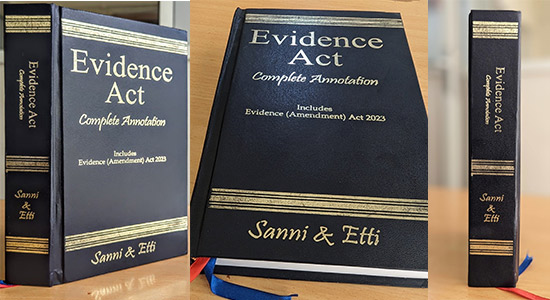
Available now for NGN 40,000 at ASC Publications, 10, Boyle Street, Onikan, Lagos. Beside High Court, TBS. Email publications@ayindesanni.com or WhatsApp +2347056667384. Purchase Link: https://paystack.com/buy/evidence-act-complete-annotation
______________________________________________________________________ “Enhance Legal Practice With Authoritative Reports” — Alexander Payne Offers Comprehensive Law Reports, Spanning Over A Century Of Nigerian Jurisprudence Interested buyers are encouraged to place their orders and enquiries via:
0704 444 4777, 0704 444 4999, 0818 199 9888
Website: www.alexandernigeria.com