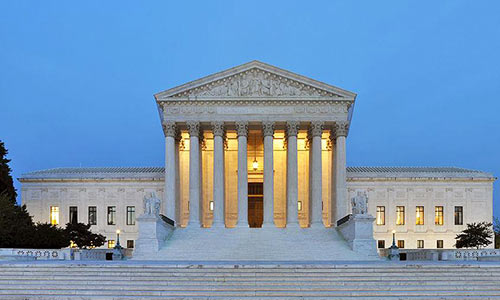
The Supreme Court on Tuesday turned down a case that would have forced them to decide whether fetuses are entitled to constitutional rights after overturning Roe v. Wade in June.


The high court’s conservative majority sidestepped the case that would have triggered a new front in the nation’s culture wars as they declined to hear an appeal involving a Catholic group and two women from Rhode Island who challenged a 2019 state law in Rhode Island that codified abortion rights.
The two women, pregnant at the time when the case was first filed, sued on behalf of their fetuses together with a Catholic organization against a decision by the Rhode Island supreme court.
The state court left in place a Rhode Island abortion rights law and determined the unborn babies had no legal right to sue because they were not ‘persons’ protected by the 14th Amendment.
Conservative Justice Samuel Alito wrote in June’s ruling overturning the abortion rights precedent that in the decision the court took no position on ‘if and when prenatal life is entitled to any of the rights enjoyed after birth.’
The legal battle surrounded the Reproductive Privacy Act, signed by then-Gov. Gina Raimondo in 2019 which sought to enshrine into law the right to an abortion before Roe was overturned.
Old Rhode Island laws that predated the 1973 Roe ruling that legalized abortion pre-viability in all 50 states had prohibited abortions and included a criminal statute. After the Roe ruling, a federal court declared that Rhode Island law unconstitutional, and it was not in effect when the Democratic-led legislature enacted the 2019 Reproductive Privacy Act.
Lawyers for the group Catholics for Life and the two Rhode Island women – one named Nichole Leigh Rowley and the other using the pseudonym Jane Doe – argued that the 2019 case ‘presents the opportunity for this court to meet that inevitable question head on’ by deciding if fetuses possess due process and equal protection rights conferred by the U.S. Constitution’s 14th Amendment.
The Rhode Island supreme court relied on the now-reversed Roe precedent in finding that the 14th Amendment did not extend rights to fetuses. The Roe ruling had recognized that the right to personal privacy under the U.S. Constitution protected a woman’s ability to terminate her pregnancy.
The Supreme Court’s ruling in Dobbs v. Jackson Women’s Health Organization tossed the abortion question back to the states.
Some Republicans at the state level have pursued what are called fetal personhood laws, like one enacted in Georgia affecting fetuses starting at around six weeks of pregnancy, that would grant fetuses before birth a variety of legal rights and protections like those of any person.
The Georgia 2019 law grants fetal personhood at around 6 weeks and allows pregnant women to claim their unborn children on their tax returns.
Under such laws, termination of a pregnancy could be considered murder under the law.
More than a dozen states have enforced near-total abortion bans since the Supreme Court’s abortion June ruling.
Abortion is protected by law in 21 states and the District of Columbia and is ‘at risk of being severely limited or prohibited’ in 26 states and three territories, according to the Center for Reproductive Rights.
“Order Justice Omolaye-Ajileye’s Electronic Evidence Books Now” — Essential Guides On Evidence Act, Case Law And Digital Proof
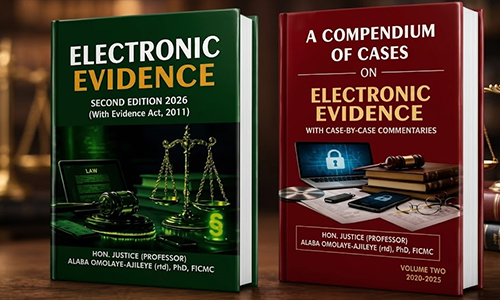
[A MUST HAVE] Evidence Act Demystified With Recent And Contemporary Cases And Materials

Available now for NGN 40,000 at ASC Publications, 10, Boyle Street, Onikan, Lagos. Beside High Court, TBS. Email publications@ayindesanni.com or WhatsApp +2347056667384. Purchase Link: https://paystack.com/buy/evidence-act-complete-annotation
______________________________________________________________________ “Enhance Legal Practice With Authoritative Reports” — Alexander Payne Offers Comprehensive Law Reports, Spanning Over A Century Of Nigerian Jurisprudence Interested buyers are encouraged to place their orders and enquiries via:
0704 444 4777, 0704 444 4999, 0818 199 9888
Website: www.alexandernigeria.com
Interested buyers are encouraged to place their orders and enquiries via:
0704 444 4777, 0704 444 4999, 0818 199 9888
Website: www.alexandernigeria.com
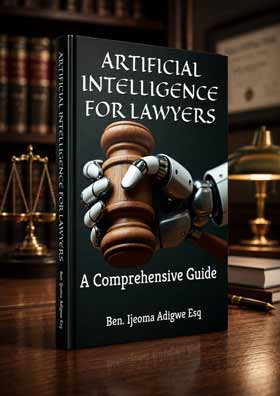 The book also examines Nigeria's legal ecosystem, focusing on the LPELR and NBA AI Guidelines. As a bonus, every purchase comes with a FREE eBook titled: How to Use the AI Features in LegalPedia and LawPavilion.
Ohio Books Ltd praises the publication, stating:
"....this is the only Nigerian book I know of on the topic."
How to Order:
📞 Call, Text, or WhatsApp: 08034917063 | 07055285878
📧 Email: benadigwe1@gmail.com
🌎 Website: www.benadigwe.com
Ebook Version: Access it directly online at https://selar.com/prv626
Authored by Ben Ijeoma Adigwe Esq., ACIarb (UK), LL.M, Dip. in Artificial Intelligence, Director at the Delta State Ministry of Justice, Asaba, Nigeria.
______________________________________________________________________
The book also examines Nigeria's legal ecosystem, focusing on the LPELR and NBA AI Guidelines. As a bonus, every purchase comes with a FREE eBook titled: How to Use the AI Features in LegalPedia and LawPavilion.
Ohio Books Ltd praises the publication, stating:
"....this is the only Nigerian book I know of on the topic."
How to Order:
📞 Call, Text, or WhatsApp: 08034917063 | 07055285878
📧 Email: benadigwe1@gmail.com
🌎 Website: www.benadigwe.com
Ebook Version: Access it directly online at https://selar.com/prv626
Authored by Ben Ijeoma Adigwe Esq., ACIarb (UK), LL.M, Dip. in Artificial Intelligence, Director at the Delta State Ministry of Justice, Asaba, Nigeria.
______________________________________________________________________