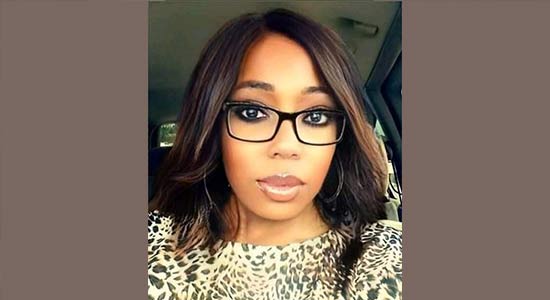
By Deborah Iniye Warrie Esq.


FICTIONAL STORY 1.
Jonah is an experienced Licensed Bodyguard with SMITH&SMITH SECURITIES LIMITED. Mr Barnanba Agip, procured Jonah’s professional services when His(Mr. Barnabas Agip’s) only daughter’s life was threatened by some cult boys in her school. One fateful day, while picking up Mr. Barnabas’s daughter from school, two cult boys fired three shots at their car and ran off with a power bike. Immediately, Jonah aimed at the two assailants on their bike and fired two shots at them. The assailant behind fell off the bike instantly, while the driver of the power bike sustained a serious injury on his right hand causing him to veer off the road, into a trailer.
Both assailants died on the spot and their parents charged Jonah for culpable homicide (Whoever causes death by doing an act with the intention of causing death, or with the intention of causing such bodily injury as is likely to cause death, or with the knowledge that he is likely by such act to cause death, commits the offense of culpable homicide). SECTION 299 OF THE INDIAN PENAL CODE.
During the Court proceedings, the Prosecutor stated to the Court that Jonah was guilty of the offense of culpable homicide because he aimed at the hitmen, who were already fleeing the scene of the crime. As such he took the shot with the intention to kill. Jonah’s lawyer, on the other hand, stated to the court that Jonah’s intention to kill was not established, as his prompt action was taken in the course of his duty, as a bodyguard to his Client (Mr. Barnabas Agip’s daughter).
FICTIONAL STORY 2.
Obiora was fetching water one evening at his town’s general borehole, when
Akpan from nowhere knocked Obiora from behind to the ground, punching Obiora’s face continuously. While this was going, Felicia who was passing by with her bicycle, saw the bloody scene and in jiffy ran into Akpan with her bicycle, forcing him to hit his head on the pavement. Akpan died on the spot. Felicia was taken into police custody. In the course of the Court Proceedings, her lawyer stated to the Court that the pronto action she took was in defense of another.
- What is the defense of Jonah’s Lawyer in the eyes of the law?
- What is the defense of Felicia’s Lawyer in the eyes of the law?
- Are both line defenses fully captured in Nigeria’s Jurisprudence?
All these and more will be discussed in this article.
- What is the defense of Jonah’s Lawyer in the eyes of the law? SELF DEFENSE IN THE LINE OF DUTY
Generally, Self–defence is a defense permitting reasonable force to be used to defend one’s self. See JOSEPH v. NIGERIAN NAVY (2020) LPELR-49692(CA)
“Let me briefly restate the law on self-defense. It would have been available to the appellant where at the time the accused person was said to have killed the deceased a reasonable apprehension of death or grievous harm, and the belief by the accused that the act of killing was necessary in order to save his own life. It must be a spontaneous reaction by the accused to an unprovoked attack, to ward off or avoid the said attack against him and to defend himself from further attack.” Per HAMMA AKAWU BARKA, JCA (Pp 25 – 25 Paras A – E)
Nevertheless, in this case, it is a defense permitting reasonable force to be used to defend another, while doing one’s job. Are bodyguards allowed to defend their clients with lethal force? YES.
Generally speaking, in the U.S., a person acting as private security or anyone acting lawfully to protect is permitted to use deadly force if his or her life is in jeopardy or the life of another. Any force that commensurates with the threat is permissible and no duty to retreat is expected. For example, a soldier/policeman/fireman or a bodyguard in Jonah’s case.
In Croatia, Bodyguards often have training in firearms tactics, unarmed combat, tactical driving, and first aid. In multi-agent units (like those protecting a head of state) one or more bodyguards may have training in specific tasks, such as providing a protective escort, crowd screening, and control, or searching for explosives or electronic surveillance devices (“bugs”). Bodyguards also learn how to work with other security personnel to conduct threat or risk assessments and analyze potential security weaknesses.
LEGAL PRECAUTION, REGULATING THE PRINCIPLE OF SELF DEFENSE IN THE LINE OF DUTY
The military forces in many countries offer close protection training for the members of their own armed forces who have been selected to work as bodyguards to officers or heads of state (e.g., the British RMP – Royal Military Police, Close Protection Unit). In the private sector, there are a vast number of private bodyguard training companies, which offer training in all aspects of close protection relative to their local laws and threat level, including the legal aspects of physical protection (e.g., use of force, use of deadly force), how to escort clients, driving drills, searching facilities and vehicles, etc.
In the United Kingdom, the industry is highly regulated by the Security Industry Authority and requires an individual to obtain a level 3 vocational close protection qualification and pass an enhanced criminal record background check in addition to attending a recognized first-aid course prior to a license being issued. Most UK security firms will request that operatives hold an SIA license, even if operations are conducted outside of the UK. The SIA model has been adopted and modified by nearby countries Ireland and France. In France bodyguards require a CNAPS (Conséil National des Activitées Privée de Sécurité) license to operate legally as a bodyguard. Both the SIA and CNAPS have come under heavy criticism over the years for failing to assist license holders and meet their primary objectives of “raising the standards” in the private security industry.
Depending on the laws in a bodyguard’s jurisdiction and on which type of agency or security service they are in, bodyguards may be unarmed, armed with a less-lethal weapon such as a pepper spray, an expandable baton, or a Taser (or a similar type stun gun), or with a lethal weapon such as a handgun, or, in the case of a government bodyguard for a Secret Service-type agency, a machine pistol. Some bodyguards such as those protecting high-ranking government officials or those operating in high-risk environments such as war zones may carry assault rifles.
In addition to these weapons, a bodyguard team may also have more specialist weapons to aid them in maintaining the safety of their principal, such as sniper rifles and anti-materiel rifles (for anti-sniper protection) or shotguns. Bodyguards that protect high-risk principals may wear body armor such as kevlar or ceramic vests. The bodyguards may also have other ballistic shields, such as Kevlar-reinforced briefcases or clipboards which, while appearing innocuous, can be used to protect the principal. The principal may also wear body armor in high-risk situations. For a close protection officer, the primary tactic against sniper attacks is defensive: avoid exposing the principal to the risk of being fired upon.
What is the defense of Felicia’s Lawyer in the eyes of the law? Self Defense of Another Person
An individual has the legal right to use reasonable force to defend another person who is the victim (or about to be the victim) of an assault. The rule is a person can use force to defend another person if that person would be justified in using force himself in self-defense. It is the right of a person to protect a third party with reasonable force against another person who is threatening to inflict force upon the third party. It is also known as the Alter Ego rule.
Alter Ego” Rule
It is the obsolete rule that a person coming to the aid of a third party has no more right to defend the third party than the third party would, himself, have had to defend himself. In most jurisdictions, the defendant may use reasonable force in defense of any third person. See Foster v. Commonwealth, 412 S.E.2d 198 (Va. 1991) it was held thus
Under the majority view, in order to justifiably defend another, the defendant must reasonably believe that the person being defended was free from fault; whether the defended person was, in fact, free from fault is legally irrelevant to the defense in those jurisdictions. This view is based on the principle that one should not be convicted of a crime for attempting to protect one whom he or she perceives to be a faultless victim from a violent assault. Under this approach, the policy of the law is to encourage individuals to come to the aid of perceived victims of assault. We find this position to be well-grounded in principle and policy. Accordingly, we hold that the law pertaining to the defense of others is that one may avail himself or herself of the defense only where he or she reasonably believes, based on the attendant circumstances, that the person defended is without fault in provoking the fray.
Today, most international jurisdictions, along with the Model Penal Code, allow a defendant to use force in defense of others as long as it reasonably appears that the person has the right to use self-defense himself. The Model Penal Code § 3.05, entitled “Use of Force for the Protection of Other Persons,” provides in pertinent part as follows.
“(1) Subject to the provisions of this Section and of Section 3.09, the use of force upon or toward the person of another is justifiable to protect a third person when: (a) the actor would be justified under Section 3.04 in using such force to protect himself against the injury he believes to be threatened to the person whom he seeks to protect; and (b) under the circumstances as the actor believes them to be, the person whom he seeks to protect would be justified in using such protective force, and (c) the actor believes that his intervention is necessary for the protection of such other person.” Model Penal Code § 3.05(1) (Adopted 1962).
In the US, Model Penal Code §3.04 contains an elaborate formulation for use of force, including when it is justified, and limitations on the justification. The Model Penal Code is not official law in the United States. But many of their courts and states borrow heavily from it.
Consequently, in our above example, since it reasonably appears to Felicia that Obiora was being attacked Felicia had the right to use force to defend him, She also had the right to use force to protect herself. See State v. Beeley, 653 A.2d 722 (R. I. 1995). It was held thus
In sum, it seems to this court preferable to predicate the justification on the actor’s own reasonable beliefs. We are of the opinion that an intervenor is justified in using reasonable force to defend another as long as the intervenor reasonably believes that the other is being unlawfully attacked. This rule is “predicated on the social desirability of encouraging people to go to the aid of third parties who are in danger of harm as a result of unlawful actions of others.” Commonwealth v. Monico, 373 Mass. 298, 303, 366 N.E.2d 1241, 1244 (1977). As we noted in Gelinas, there is an “important social goal of crime prevention, a duty of every citizen.” Gelinas, 417 A.2d at 1385 n. 5.
The right of self-defense of another applies for the purpose of defending the lives of others, including –in certain circumstances– the use of deadly force.
Are both line defenses fully captured in Nigeria’s Jurisprudence?
Unfortunately, no our jurisprudence only captures the concept of self-defense, as it pertains to a single individual, to an attacker. See UWAGBOE v. STATE
(2008) LPELR-3444(SC)
“The defense of self-defense is open only to an accused person who is able to prove that he was a victim of an unprovoked assault causing him reasonable apprehension of death or grievous harm. But he is even entitled to use such force to defend himself as he believes on reasonable grounds to be necessary to preserve himself from the danger, and this he is entitled to do even though such force may cause death or grievous harm. If the act of self-defense is committed after all danger from the assailant is past and by way of revenge, the defense will not be available to such an accused person. See R. v. Dummemi (1955) 15 WACA 75.” Per SUNDAY AKINOLA AKINTAN, JSC (Pp 18 – 18 Paras D – F)
Notwithstanding, this doesn’t mean that the above principle will not apply in Jonah or Felicia’s case if it’s presented before the Nigerian Court. See ESSIEN v. STATE (2021) LPELR-55181(CA)
“The Apex Court in considering the defense of self-defense had this to say when laying down the ingredients that must be present. They are that: “a. The accused must be free from fault in bringing about the encounter. b. There must be present an impending peril to life or of great bodily harm either real or so apparent as to create an honest belief of an existing necessity. c. There must have been a necessity for taking life …” All the above ingredients must co-exist and be established in order to sustain the defense.” Per RITA NOSAKHARE PEMU, JCA (Pp 18 – 18 Paras C – F)
CONCLUSION FOR LITIGANTS
In general, one can only use reasonable force. In defending someone else, a third party can only use as much force and means as a reasonably prudent person would use under the same or similar conditions. There are exceptions, but this is the general rule of law.
Please note that in situations where the defendant comes to the aid of a third person, the defendant is not allowed to use any more force than reasonably seems necessary under the circumstances. Therefore, if non-deadly force is all that reasonably appears necessary, the defendant may not use deadly force. If, however, deadly force reasonably seems necessary (to prevent the use of deadly force against the third person), then the defendant may use deadly force as well.
CONCLUSION FOR LAWYERS
The law surrounding the defense of another | defending another is very similar to the law surrounding self-defense. Nevertheless, our jurisprudence has not fully grasped the concept of Jonah’s and Felicia’s case, as the U.S has done with its Model Penal Code § 3.05, entitled “Use of Force for the Protection of Other Persons.
Furthermore, all cases involving the defense of another gave some clarification in the Revised Code of Washington RCW 9A.16.020.wherein the statute Model Penal Code § 3.05, entitled “Use of Force for the Protection of Other person defense is derived.
In Nigeria there are no specific regulations for bodyguards or security personnel designated to protect the life of another, security providers are allowed to shape their programs according to their whims and caprices, with a heavy focus on physical training and shooting, neglecting intelligence and the strategic part of the job for marketing reasons. This has been recently criticized as useless and called “bodyguard amusement tourism” by the International Association of Personal Protection Agents (IAPPA). Hence we must create specific regulations, that regulate, bodyguards or security personnel designated to protect the life of others, this gives room for checks and balances in the security system.
REFERENCES :
- https://www.mondaq.com/india/crime/988662/difference-between-murder-and-culpable-homicide
- https://en.wikipedia.org/wiki/Bodyguard#Close_protection_training
- https://en.wikipedia.org/wiki/Bodyguard
- https://en.wikipedia.org/wiki/Main_Page
- https://en.wikipedia.org/wiki/Right_of_self-defense#Defense_of_others
- https://www.springandspring.com/self-defense-defense-of-another-defense-of-property
- https://www.quora.com/Are-bodyguards-allowed-to-defend-their-clients-with-lethal-force
- https://www.springandspring.com/self-defense-defense-of-another-defense-of-property/
- https://lawshelf.com/coursewarecontentview/defense-of-others
- https://rhodeslegalgroup.com/criminal-law/defending-another-person/
- https://www.leagle.com/decision/1991610412se2d1981605
For more legal advice and tips, follow DEBBY G CONSULTS ON 09018561398 https://wa.me/message/6OOIP3WVZXE6G1 OR https://www.facebook.com/DEBBY-G-Consults-123260913269689/ or debbywhizz.blogspot.com https://www.blogger.com/?hl=en&tab=jj&authuser=1.
 Interested buyers are encouraged to place their orders and enquiries via:
0704 444 4777, 0704 444 4999, 0818 199 9888
Website: www.alexandernigeria.com
Interested buyers are encouraged to place their orders and enquiries via:
0704 444 4777, 0704 444 4999, 0818 199 9888
Website: www.alexandernigeria.com

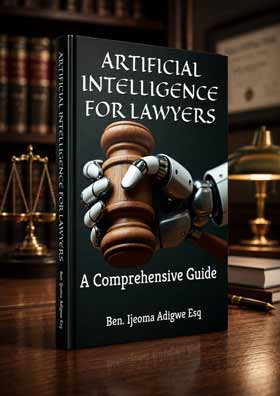 The book also examines Nigeria's legal ecosystem, focusing on the LPELR and NBA AI Guidelines. As a bonus, every purchase comes with a FREE eBook titled: How to Use the AI Features in LegalPedia and LawPavilion.
Ohio Books Ltd praises the publication, stating:
"....this is the only Nigerian book I know of on the topic."
How to Order:
📞 Call, Text, or WhatsApp: 08034917063 | 07055285878
📧 Email: benadigwe1@gmail.com
🌎 Website: www.benadigwe.com
Ebook Version: Access it directly online at https://selar.com/prv626
Authored by Ben Ijeoma Adigwe Esq., ACIarb (UK), LL.M, Dip. in Artificial Intelligence, Director at the Delta State Ministry of Justice, Asaba, Nigeria.
_______________________________________________________________________
The book also examines Nigeria's legal ecosystem, focusing on the LPELR and NBA AI Guidelines. As a bonus, every purchase comes with a FREE eBook titled: How to Use the AI Features in LegalPedia and LawPavilion.
Ohio Books Ltd praises the publication, stating:
"....this is the only Nigerian book I know of on the topic."
How to Order:
📞 Call, Text, or WhatsApp: 08034917063 | 07055285878
📧 Email: benadigwe1@gmail.com
🌎 Website: www.benadigwe.com
Ebook Version: Access it directly online at https://selar.com/prv626
Authored by Ben Ijeoma Adigwe Esq., ACIarb (UK), LL.M, Dip. in Artificial Intelligence, Director at the Delta State Ministry of Justice, Asaba, Nigeria.
_______________________________________________________________________