Nigeria has declined to join an international agreement that has several other countries of the world sign up to a historic deal to ensure big companies pay a fairer share of tax.


Some 136 countries of the world agreed to enforce a corporate tax rate of at least 15 per cent, as well a fairer system of taxing profits where they are earned.
The decision follows concern that multinational companies are re-routing their profits through low tax jurisdictions to cut their bills.
The Organisation for Economic Cooperation and Development (OECD), an intergovernmental organisation, had led talks on a minimum rate for a decade, saying that the deal could bring in an extra $150bn (£108bn) of tax a year, bolstering economies as they recover from Covid.
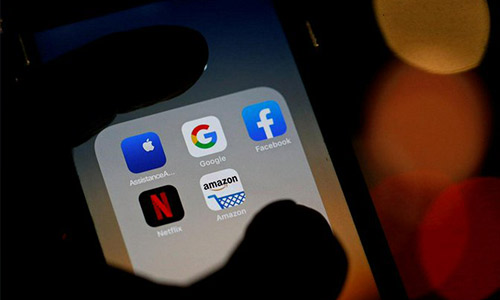
The move is expected to hit digital giants like Amazon and Facebook, as well as firms with global sales above 20 billion euros and profit margins above 10 per cent.
A quarter of any profits they make above the 10 per cent threshold will be reallocated to the countries where they were earned and taxed there.
But critics have said that a 15 epr cent rate is too low, and firms will get around the rules.
Earlier in July, more than 100 countries supported the initial OECD proposals when they were made public.Countries that initially resisted, including Ireland, Hungary and Estonia, are now on board.
However, Nigeria, Kenya, Pakistan and Sri Lanka have not yet joined the agreement.
Here’s a look at key aspects of the deal:
___
WHAT PROBLEM DOES IT ADDRESS?
In today’s economy, multinationals are increasingly likely to earn profits from intangibles such as trademarks and intellectual property. Those can be easy to move, and global companies can assign the earnings they generate to a subsidiary in a country where tax rates are very low.
Some countries compete for revenue by using rock-bottom rates to lure companies, attracting huge tax bases that generate large revenue even when tax rates only marginally above zero are applied. Between 1985 and 2018, the global average corporate headline rate fell from 49% to 24%. By 2016, over half of all U.S. corporate profits were booked in seven tax havens: Bermuda, the Cayman Islands, Ireland, Luxembourg, the Netherlands, Singapore, and Switzerland. That costs the U.S. Treasury $100 billion a year according to one estimate.
___
HOW WOULD A GLOBAL MINIMUM TAX WORK?
The basic idea is simple: Countries would legislate a global minimum corporate tax rate of at least 15% for very big companies, those with annual revenues over 750 billion euros ($864 billion.)
Then, if companies have earnings that go untaxed or lightly taxed in one of the world’s tax havens, their home country would impose a top-up tax that would bring the rate to 15%.
That would make it pointless for a company to use tax havens, since taxes avoided in the haven would be collected at home. For the same reason, it means the minimum rate would still take effect even if individual tax havens don’t participate.
___
HOW WOULD THE TAX PLAN ADDRESS THE DIGITALIZED ECONOMY?
The plan would also let countries tax part of the earnings of the 100 or so biggest multinationals when they do business in places where they have no physical presence. That could be through internet retailing or advertising. The tax would only apply to a portion of profits above a profit margin of 10%.
In return, other countries would abolish their unilateral digital services taxes on U.S. tech giants such as Google, Facebook and Amazon. That would head off trade conflicts with Washington, which argues such taxes unfairly target U.S. companies and has threatened to retaliate with new tariffs.
___
DOES EVERYONE LIKE THE DEAL?
Some developing countries and advocacy groups such as Oxfam and the UK-based Tax Justice Network say the 15% rate is too low and leaves far too much potential tax revenue on the table. And although the global minimum would capture some $150 billion in new revenue for governments, most of it would go to rich countries because they are where many of the biggest multinationals are headquartered.
A 20% to 30% minimum was recommended by the UN’s high-level panel on International Financial Accountability, Transparency and Integrity. In a report earlier this year, the panel said that a rate that is too low can incentivize countries to lower their rate to remain competitive.
Countries that participated in the talks but did not sign the agreement were Kenya, Nigeria, Pakistan and Sri Lanka.
___
WHAT IS THE U.S. ROLE IN THE AGREEMENT?
Biden’s tax agenda is stuck in negotiations among Democratic lawmakers, as the scope of his spending and proposed rate hikes are still under debate. But the administration has staked a claim in saying that it must expand the U.S. global minimum tax in order to convince other nations to do so.
Biden has retreated somewhat from his initial proposals as Congress has provided its input. The latest plan from the House Ways and Means Committee would increase global minimum tax to roughly 16.5% from 10.5%. The president initially wanted 21% as the U.S. global minimum rate. Domestic corporate income would be taxed at 26.5%, up from 21% currently.
U.S. participation in the minimum tax deal is crucial, simply because so many multinationals are headquartered there. Complete rejection of Biden’s global minimum proposal would seriously undermine the international deal.
Manal Corwin, a tax principal at professional services firm KPMG and a former Treasury Department official in the Obama administration, said that the removal of the unilateral digital taxes, or DST’s, would provide “a very strong motivation” for the U.S. to participate. That is because the agreement would head off destructive trade dispute that could spread to unrelated companies in other sectors of the economy.
“When you get into back-and-forth threats of tariffs, the tariffs are not necessarily imposed on the companies that are in the crosshairs of the issue being debated,” she said. “It may be DSTs today and then tomorrow it’s some other unilateral measure.” She said international taxation needs stability and consensus “to encourage investment and growth …. (T)he unravelling of global consensus, if it starts with DSTs, can expand to other things.”
___
HOW WOULD THE AGREEMENT TAKE EFFECT?
The accord will go to the Group of 20 leaders. Agreement there is likely since all 20 members signed Friday’s deal. Implementation then moves to the individual countries.
The tax on earnings where companies have no physical presence would require countries to sign up to an intergovernmental agreement during the course of 2022, with implementation in 2023. The global minimum could be applied by individual countries using model rules developed by the OECD. If the U.S. and European countries where most multinationals are headquartered legislate such minimums, that would have much of the intended effect.
“Order Justice Omolaye-Ajileye’s Electronic Evidence Books Now” — Essential Guides On Evidence Act, Case Law And Digital Proof
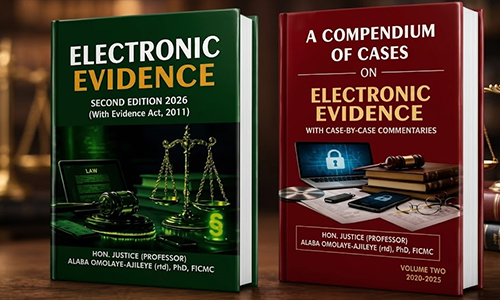
[A MUST HAVE] Evidence Act Demystified With Recent And Contemporary Cases And Materials

Available now for NGN 40,000 at ASC Publications, 10, Boyle Street, Onikan, Lagos. Beside High Court, TBS. Email publications@ayindesanni.com or WhatsApp +2347056667384. Purchase Link: https://paystack.com/buy/evidence-act-complete-annotation
______________________________________________________________________ “Enhance Legal Practice With Authoritative Reports” — Alexander Payne Offers Comprehensive Law Reports, Spanning Over A Century Of Nigerian Jurisprudence Interested buyers are encouraged to place their orders and enquiries via:
0704 444 4777, 0704 444 4999, 0818 199 9888
Website: www.alexandernigeria.com
Interested buyers are encouraged to place their orders and enquiries via:
0704 444 4777, 0704 444 4999, 0818 199 9888
Website: www.alexandernigeria.com
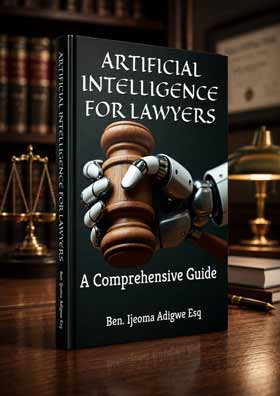 The book also examines Nigeria's legal ecosystem, focusing on the LPELR and NBA AI Guidelines. As a bonus, every purchase comes with a FREE eBook titled: How to Use the AI Features in LegalPedia and LawPavilion.
Ohio Books Ltd praises the publication, stating:
"....this is the only Nigerian book I know of on the topic."
How to Order:
📞 Call, Text, or WhatsApp: 08034917063 | 07055285878
📧 Email: benadigwe1@gmail.com
🌎 Website: www.benadigwe.com
Ebook Version: Access it directly online at https://selar.com/prv626
Authored by Ben Ijeoma Adigwe Esq., ACIarb (UK), LL.M, Dip. in Artificial Intelligence, Director at the Delta State Ministry of Justice, Asaba, Nigeria.
______________________________________________________________________
The book also examines Nigeria's legal ecosystem, focusing on the LPELR and NBA AI Guidelines. As a bonus, every purchase comes with a FREE eBook titled: How to Use the AI Features in LegalPedia and LawPavilion.
Ohio Books Ltd praises the publication, stating:
"....this is the only Nigerian book I know of on the topic."
How to Order:
📞 Call, Text, or WhatsApp: 08034917063 | 07055285878
📧 Email: benadigwe1@gmail.com
🌎 Website: www.benadigwe.com
Ebook Version: Access it directly online at https://selar.com/prv626
Authored by Ben Ijeoma Adigwe Esq., ACIarb (UK), LL.M, Dip. in Artificial Intelligence, Director at the Delta State Ministry of Justice, Asaba, Nigeria.
______________________________________________________________________