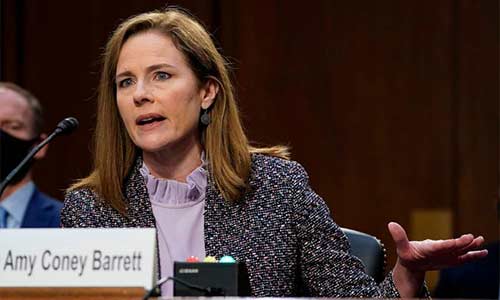
WASHINGTON (Reuters) – President Donald Trump’s U.S. Supreme Court nominee Amy Coney Barrett on Wednesday said it is an “open question” as to whether Trump could pardon himself while adding that the nation’s top judicial body “can’t control” whether a president obeys its decisions.

On the third day of her four-day Judiciary Committee hearing, Barrett also sought to allay Democratic fears that she would be an automatic vote to strike down the Obamacare healthcare law in a case due to be argued Nov. 10, promising an “open mind.”
Barrett sidestepped questions from senators on the ability of presidents to evade efforts to hold them accountable.
Trump has said he has the “absolute power” to pardon himself, part of his executive clemency authority. Asked by Democratic Senator Patrick Leahy whether a president has such power, Barrett said the “question has never been litigated.”
“That question may or may not arise but it’s one that calls for legal analysis of what the scope of the pardon power is. So because it would be opining on an open question when I haven’t gone through the judicial process to decide it, it’s not one on which I can offer a view,” Barrett added.
Trump faces a criminal investigation about the conduct of himself and his businesses by a New York City prosecutor who is seeking his financial records and tax returns. Trump also has issued executive clemency to political allies and friends.
Barrett, a conservative federal appellate judge, is the Republican president’s third selection for a lifetime job on the Supreme Court. Trump has asked the Senate, controlled by his fellow Republicans, to confirm her before the Nov. 3 U.S. election.
Barrett said “no one is above the law” but twice declined to answer directly when Leahy asked her whether a president who refuses to comply with a court order is a threat to the U.S. constitutional system of checks and balances within the three branches of government.
“The Supreme Court can’t control whether or not the president obeys,” Barrett said.
Supreme Court rulings, Barrett said, have the “force of law” but the court lacks enforcement power and relies on the other branches of government.
“A court can pronounce the law and issue a judgment but it lacks control over how the political branches respond to it,” Barrett added.
Barrett declined to discuss whether Trump is violating the U.S. Constitution’s “emoluments” clause with his business dealings, objecting to Leahy’s characterization of the provision as an anti-corruption measure. The provision bar presidents from taking gifts or payments from foreign and state governments without congressional approval.
“I don’t know if I would characterize it as an anti-corruption clause,” Barrett said, adding that it was designed to “prevent foreign countries from having influence.”
OBAMACARE CASE
Barrett could be on the high court for arguments in a challenge by Trump and Republican-led states to the 2010 law formally called the Affordable Care Act (ACA) that has helped millions of Americans obtain medical coverage and includes protections for people with pre-existing conditions.
In response to Democratic suggestions that she would vote to strike down Obamacare in its entirety if one part is deemed unlawful, Barrett said that if a statute can be saved, it is a judge’s duty to do so.
Barrett indicated she favors of a broad reading of the “severability doctrine” in which courts assume that when one provision of a law is unlawful, Congress would want the rest of the statute to remain in place. The Supreme Court has taken such an approach in recent years.
“I think insofar as it tries to effectuate what Congress would have wanted, it’s the court and Congress working hand in hand,” Barrett said of the doctrine.
When judges address the legal question raised in the Obamacare case, the “presumption” is that Congress did not intend the whole statute to fall, Barrett added.
“If I were on the court, and if a case involving the ACA came before me, I would approach it with an open mind,” Barrett told Republican Senator John Cornyn.
Barrett has criticized previous Supreme Court rulings upholding Obamacare.
ABORTION RIGHTS
Barrett has faced questions on contentious social issues including abortion, which as a devout Catholic she personally opposes.
“This is history being made folks,” Senator Lindsey Graham, the chairman of the panel, said. “This is the first time in American history that we’ve nominated a woman who is unashamedly pro-life and embraces her faith without apology, and she’s going to the court.”
Barrett, 48, would be the fifth woman ever to serve on the court.
Barrett reiterated her Tuesday comments that the landmark 1973 Roe v. Wade ruling that legalized abortion nationwide was not a “super-precedent” that could never potentially be overturned. Barrett also said she has an “open mind” on whether to allow television coverage of Supreme Court proceedings.
Barrett’s confirmation would give the court a 6-3 conservative majority. Republicans have a 53-47 Senate majority, making Barrett’s confirmation a virtual certainty.
Democrats have said the winner of the presidential election should get to fill the court’s vacancy left by the death of liberal Justice Ruth Bader Ginsburg.
The four-day hearing is scheduled to end on Thursday with testimony from outside witnesses. Republicans are preparing for a committee vote next week and a final Senate confirmation vote before the end of October. Trump nominated Barrett to a lifetime post on the court on Sept. 26.
[A MUST HAVE] Evidence Act Demystified With Recent And Contemporary Cases And Materials

Available now for NGN 40,000 at ASC Publications, 10, Boyle Street, Onikan, Lagos. Beside High Court, TBS. Email publications@ayindesanni.com or WhatsApp +2347056667384. Purchase Link: https://paystack.com/buy/evidence-act-complete-annotation
______________________________________________________________________ “Enhance Legal Practice With Authoritative Reports” — Alexander Payne Offers Comprehensive Law Reports, Spanning Over A Century Of Nigerian Jurisprudence Interested buyers are encouraged to place their orders and enquiries via:
0704 444 4777, 0704 444 4999, 0818 199 9888
Website: www.alexandernigeria.com
Interested buyers are encouraged to place their orders and enquiries via:
0704 444 4777, 0704 444 4999, 0818 199 9888
Website: www.alexandernigeria.com