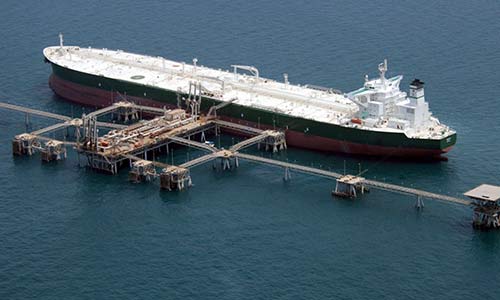
The federal government has signed a $1.5 billion prepayment deal with Standard Chartered and backed by oil traders Vitol Group and Matrix Energy. The Nigerian National Petroleum Corporation (NNPC) signed on behalf of the federal government.
A report yesterday by Reuters, quoting persons close to the matter, said it would be the first such agreement since the COVID-19 pandemic, which would see the country supply a certain quantity of prepaid barrels of oil over time.
The financing package, called ‘Project Eagle,’ was also backed by African Export-Import Bank (Afrexim) and United Bank for Africa (UBA).
Vitol and Matrix will each get 15,000 barrels per day (bpd) of crude as repayment over five years, starting in August with Nigeria’s crude production nearly two million bpd, minus a recent quota cut agreed by OPEC members.
Nigerian trader, Matrix confirmed its participation in the deal, while Vitol, the world’s biggest independent oil trader declined to comment, Reuters reported.
A spokesman for Standard Chartered declined to comment and Afrexim did not have an immediate comment.
UBA and the NNPC also did not immediately respond to Reuters’ requests for comment.
The prepayment deal will likely weaken longer-term revenues since Nigeria will offer its oil at a reduced price and will miss out on any price increases.
However, the deal would provide Nigeria with upfront cash and guaranteed revenue as it expands its budget.
At the same time, the agreement would assure traders a source of supply at a discount for an extended period of time that they can use for resale in the global market.
Prepayment deals usually allow traders to establish long-term relationships with producers.
When petro-states are cash-strapped, prepayment deals are not uncommon, with banks and bond markets remaining the top source of financing for the oil and gas sector.
In 2013, Russia’s Rosneft signed a $10 billion deal with Vitol and Glencore and made a similar agreement with Trafigura around the same time.
Venezuela, Ecuador, Colombia, Libya, and Algeria have also utilised similar pre-payment structures.
Market analysts also, believe that when traders strike prepayment deals with countries like Nigeria, they will enjoy the advantages of a close relationship with a major oil exporter, giving them access to time-sensitive data that will boost their market intelligence and information flow.
The current deal would provide the Organisation of Petroleum Exporting Countries (OPEC) member with much-needed cash after its finances were hit by the oil price crash in April as COVID-19 lockdowns erased nearly one-third of global oil demand.
Prepayments with traders are widely used in commodity finance as banks consider them to be one of the more secure forms of lending in countries viewed as risky.
For trading firms such as Vitol, these loans are ideal for securing long-term supplies and boosting razor-thin margins.
NNPC has been trying to raise cash through prepayments with traders for years.
However, it is believed that the firm’s opaque finances and costly fuel subsidies have made it tough for it to secure private financing on attractive terms.
Nigeria announced the end of subsidies earlier this year.
NNPC will use a large portion of the money to pay taxes owed by its subsidiary Nigerian Petroleum Development Company (NPDC), the sources said while the remainder will go towards operational expenses and capital expenditure.
One of the sources said money from the prepayment could fund an upgrade of the Port Harcourt refinery.
The Group Managing Director, NNPC, Malam Mele Kyari, in an interview recently, had said the corporation was in the process of securing funding for the Port Harcourt refinery, one of Nigeria’s refineries that has been comatose for years.
Kyari said the NNPC was pursuing “a different model” for the refineries, including the type used by the Nigeria LNG Limited (NLNG), which he said will make them operate more efficiently.
[A MUST HAVE] Evidence Act Demystified With Recent And Contemporary Cases And Materials

Available now for NGN 40,000 at ASC Publications, 10, Boyle Street, Onikan, Lagos. Beside High Court, TBS. Email publications@ayindesanni.com or WhatsApp +2347056667384. Purchase Link: https://paystack.com/buy/evidence-act-complete-annotation
______________________________________________________________________ “Enhance Legal Practice With Authoritative Reports” — Alexander Payne Offers Comprehensive Law Reports, Spanning Over A Century Of Nigerian Jurisprudence Interested buyers are encouraged to place their orders and enquiries via:
0704 444 4777, 0704 444 4999, 0818 199 9888
Website: www.alexandernigeria.com
Interested buyers are encouraged to place their orders and enquiries via:
0704 444 4777, 0704 444 4999, 0818 199 9888
Website: www.alexandernigeria.com
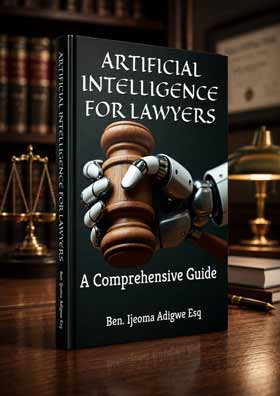 The book also examines Nigeria's legal ecosystem, focusing on the LPELR and NBA AI Guidelines. As a bonus, every purchase comes with a FREE eBook titled: How to Use the AI Features in LegalPedia and LawPavilion.
Ohio Books Ltd praises the publication, stating:
"....this is the only Nigerian book I know of on the topic."
How to Order:
📞 Call, Text, or WhatsApp: 08034917063 | 07055285878
📧 Email: benadigwe1@gmail.com
🌎 Website: www.benadigwe.com
Ebook Version: Access it directly online at https://selar.com/prv626
Authored by Ben Ijeoma Adigwe Esq., ACIarb (UK), LL.M, Dip. in Artificial Intelligence, Director at the Delta State Ministry of Justice, Asaba, Nigeria.
______________________________________________________________________
The book also examines Nigeria's legal ecosystem, focusing on the LPELR and NBA AI Guidelines. As a bonus, every purchase comes with a FREE eBook titled: How to Use the AI Features in LegalPedia and LawPavilion.
Ohio Books Ltd praises the publication, stating:
"....this is the only Nigerian book I know of on the topic."
How to Order:
📞 Call, Text, or WhatsApp: 08034917063 | 07055285878
📧 Email: benadigwe1@gmail.com
🌎 Website: www.benadigwe.com
Ebook Version: Access it directly online at https://selar.com/prv626
Authored by Ben Ijeoma Adigwe Esq., ACIarb (UK), LL.M, Dip. in Artificial Intelligence, Director at the Delta State Ministry of Justice, Asaba, Nigeria.
______________________________________________________________________